Pune: Maharashtra Chief Minister Devendra Fadnavis on Friday said the state needs 50,000 electric buses over the next three years as demand for electric mobility continues to rise across the state.
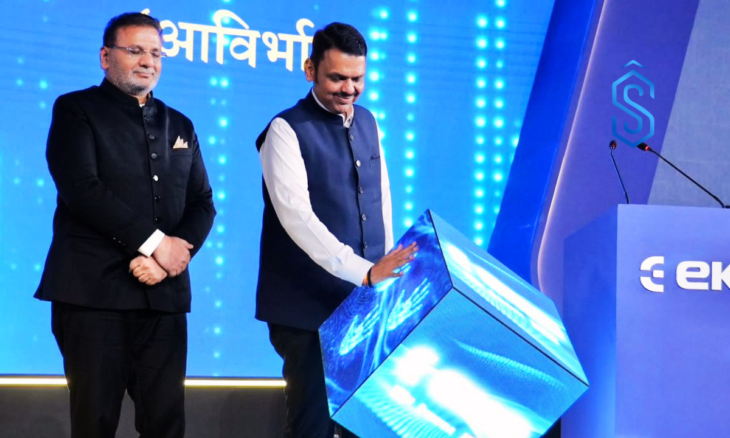
Speaking at the inauguration of six manufacturing facilities of EKA Mobility Solutions, Fadnavis said Maharashtra is witnessing strong demand for electric buses and that the state is looking to procure buses for Mumbai and the Maharashtra State Road Transport Corporation (MSRTC).
“As Nitin Gadkari said, there is a very large demand for EVs here. Today, we see that in the car sector and the SUV sector, whatever new launches are taking place are being preferred by people on a very large scale,” Fadnavis said.
Highlighting the state’s growing requirement for electric buses, Fadnavis said Maharashtra needs large-scale manufacturing capacity to meet demand for public transport electrification.
Maharashtra Needs 50,000 Electric Buses
Fadnavis said the state wants to procure electric buses for Mumbai as well as MSRTC, but manufacturers are currently unable to supply buses at the scale required.
He also said the manufacturing facilities being developed in the state would help meet Maharashtra’s demand through local production.
Clean Mobility a Major Priority
Fadnavis said clean and green mobility has become a major priority as India moves towards a developed economy. He linked the push for electric buses and electric mobility to the need to reduce pollution in cities and decrease India’s dependence on imported fossil fuels.
“With this objective, under the leadership of Prime Minister Narendra Modi, several large-scale schemes for electric mobility and alternative fuels have continuously been formulated and implemented. Our ministries under Nitin Gadkari ji and Kumaraswamy have continuously promoted this, and today we can see that electric mobility manufacturing has begun on such a large scale in India. We have also seen several new initiatives in the automobile sector.”
Maharashtra Emerging as EV Manufacturing Hub
Fadnavis said Maharashtra is gradually emerging as a major hub for automobile and EV investments, with Pune, Chhatrapati Sambhajinagar and Nagpur playing important roles in the state’s electric mobility ecosystem.
He also added that Pune has traditionally been an automobile hub, while other cities are now emerging as important centres for EV manufacturing.
Green Power to Support Electric Mobility
Fadnavis also highlighted the importance of green power in supporting the large-scale expansion of electric mobility. He said Maharashtra’s power-generation plans are being aligned with the state’s growing industrial and EV requirements.
He said Maharashtra is the first state to have prepared its own Resource Adequacy Plan.
“Maharashtra has an installed capacity of 35,000 megawatts – 35 gigawatts. By 2030, we will add another 46 gigawatts – that is, 46,000 megawatts – to this, of which 91% will be green power,” Fadnavis stated.
“Maharashtra’s power mix is expected to become increasingly green. This means that by 2030, Maharashtra’s power mix will be 52% green, and by 2035, it will be 65% green. So, Maharashtra will have one of the greenest power mixes,” Fadnavis said.
He added the investments required for this transition have already been made or are currently being established.
Maharashtra to Support EV Charging Infrastructure
Fadnavis also said Maharashtra would support the development of the charging infrastructure required to enable the large-scale adoption of electric buses and other EVs.
He said the charging ecosystem would be critical to the state’s electric mobility expansion and that Maharashtra has prepared a master plan for developing charging infrastructure.
“If we want to bring EVs here on such a large scale, the most important infrastructure required for this is the charging ecosystem. We have also prepared a complete master plan for this, and we want to develop this charging ecosystem across Maharashtra together with all EV manufacturers.”
Fadnavis said EV manufacturers are ready to invest in charging infrastructure but face challenges related to permissions and availability of land.
He said the state government would take responsibility for facilitating these requirements under its charging infrastructure framework.
“Therefore, under the charging infrastructure framework that we have prepared, we will take responsibility for all these aspects, and together with all EV manufacturers, we will develop charging infrastructure across Maharashtra and on all highways.”