
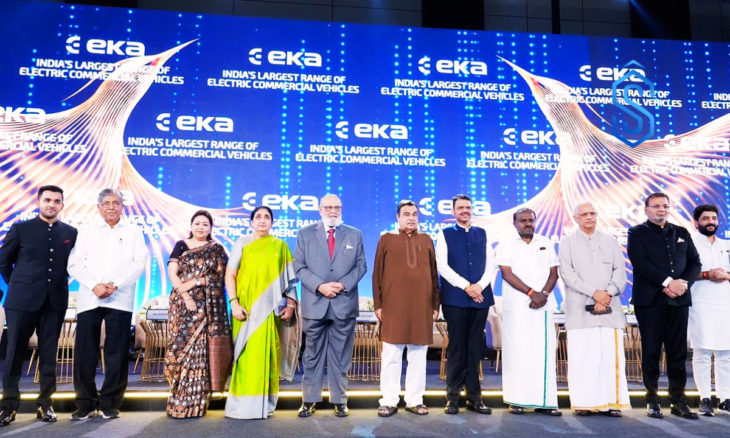
Pune: Union Minister for Road Transport and Highways Nitin Gadkari on Friday said the electric vehicle – EV charging rate needs to be reduced to make electric vehicles more popular and accelerate India’s transition away from petrol and diesel.
Speaking at the inauguration of EKA Mobility‘s manufacturing facilities in Pune, Gadkari said Maharashtra should consider EV charging rate of ₹5 per unit during the day and ₹8–₹10 per unit after 6 p.m.
Gadkari said India has moved from being the world’s seventh-largest automobile industry to the third-largest since the Narendra Modi government came to power, overtaking Japan.
He said the size of India’s automobile industry has increased from ₹15 lakh crore to ₹22 lakh crore.
“In the world, America is number one, with an industry size of ₹79 lakh crore; China is number two at ₹49 lakh crore; and India is at ₹22 lakh crore. I regularly tell original equipment manufacturers (OEMs) that India should aim to become the world’s number one automobile industry,” Gadkari said.
He described the automobile industry as the backbone of the economy, saying it generates significant revenue for state governments and the Government of India through GST.
According to Gadkari, the sector provides employment to 4.5 crore people and makes the largest contribution to India’s exports.
Lithium-Ion Battery Costs Have Fallen, But EV Prices Remain High
Gadkari said the cost of lithium-ion batteries has fallen significantly since the first electric vehicles were introduced.
“When we started the first electric vehicle, the cost of lithium-ion batteries was $150 per kilowatt-hour, which has now come down to $50 per kilowatt-hour. But the prices of electric vehicles are not coming down.”
According to Gadkari, high demand and insufficient supply are among the reasons electric vehicle prices have not declined despite lower battery costs. He said India will require 1.5 lakh buses over the next two years, while current capacity stands at only 60,000 buses.
Maharashtra Urged to Lower EV Charging Rate
Gadkari specifically highlighted the EV charging rate at roadside amenities being developed by the National Highways Authority of India (NHAI).
“I had earlier not paid attention to the electric vehicle charging rate at these facilities, where charging had been set at ₹22 per unit. But, now I have asked the Power Minister to formulate a policy on the electric vehicle charging rate. I have also requested Maharashtra CM Devendra Fadnavis to consider a lower rate for EV charging and regarding the roadside amenities being developed by NHAI. There are 700–800 of them.
“Maharashtra is progressive – from 8 a.m. to 6 p.m., make it ₹5 per unit, and after 6 p.m., make it ₹8–₹10,” Gadkari requested Fadnavis.
Gadkari said lowering the EV charging rate in this manner could encourage greater adoption of electric vehicles.
Electric Trucks Can Help Reduce Logistics Costs
Gadkari also highlighted the importance of electric trucks, particularly in reducing fuel expenses and India’s logistics costs.
“The biggest problem for our country’s economy is logistics cost. Compared with GDP, our logistics cost was 16%. IIM Bangalore, IIT Chennai and IIT Kanpur conducted a study, and I had the privilege of publishing a report by BCG. That cost has now come down to single digits, at 9%,” he added.
Gadkari Calls for 100% Indigenous Electric Vehicles
Gadkari said India has found lithium reserves in Jammu equivalent to 6% of the world’s stock. However, he identified dependence on imported electric vehicle components as a weakness that needs to be addressed.
“Of the world’s lithium reserves, what we have found in Jammu accounts for 6% of the world’s stock, which is now with us.”
He said 30–40% of electric vehicle components are continuously imported from one particular country and called for this dependence to be eliminated.
“I have only one request to make to Sudhir Mehta: the only weakness of electric vehicles is that 30–40% of the components are continuously imported from one particular country for electric vehicles. We have to eliminate that.”
Gadkari said achieving 100% indigenous electric vehicles is part of India’s ambition to become an Atmanirbhar Bharat.
“To become an Atmanirbhar Bharat, 100% indigenous electric vehicles — that is our dream.”
India Has Potential to Become an EV Export Hub
Gadkari recalled his visit to Pune for the launch of an electric Mercedes and said the global chairman had told him that electric Mercedes cars would subsequently be manufactured only in India and exported from the country.
“When I had come to Pune to launch the electric Mercedes, the global chairman told me that after this, electric Mercedes cars would be manufactured only in India and exported from here.”
Gadkari said vehicles manufactured in India by Japanese companies Toyota and Suzuki are also being exported to Japan.
“Therefore, there is a domestic market, of course, but there is also enormous potential in the international market, and particularly in electric vehicles.”
Startups and IIT Engineers Can Drive Automobile Innovation
Gadkari welcomed the involvement of young IIT graduates and engineers in startups working in the automobile sector. He said innovation, entrepreneurship, science, technology, research, skills and successful practices would be important for the future of the automobile industry.
Gadkari said research into alternative and biofuels would help India’s automobile industry move further ahead and reach the number one position globally.
EKA Mobility Urged to Expand Truck and Bus Capacity
Gadkari congratulated Sudhir Mehta on the beginning made by the company but said India’s demand for electric trucks and buses is significantly higher than current production capacity. He said a capacity of 30,000 vehicles would not be sufficient and urged the company to increase its capacity.
“Believe me: even if you create a capacity of at least 1 lakh trucks and buses, you will still not be able to meet India’s requirement,” Gadkari told Sudhir Mehta.
Five-Tonne Additional Capacity for Electric Trucks
Gadkari said the government has also addressed the issue of electric truck battery weight.
“In an electric truck, the battery weighs five tonnes. So, it has a 60-tonne capacity. I had asked an officer whether the carrying capacity of a 60-tonne truck could be increased by five tonnes to account for the battery weight. This has now been implemented, allowing the trucks manufactured by the company to have an additional five-tonne capacity,” Gadkari stated.