

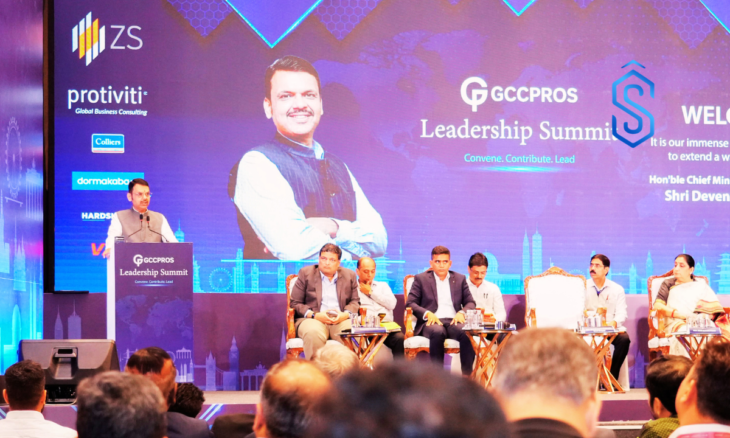
Pune: Maharashtra Chief Minister Devendra Fadnavis, speaking at the GCCPROS Leadership Summit 2026 in Pune, said the state aims to become India’s leading destination for Global Capability Centres (GCCs), with a target of attracting 400 new GCCs, ₹50,000 crore in investment and 4 lakh high-skilled jobs.
Fadnavis highlighted Maharashtra’s existing ecosystem across Mumbai, Pune, Navi Mumbai, Nashik, Nagpur and Chhatrapati Sambhajinagar, and said the state’s proposition is based not only on individual cities but on an ecosystem of cities, talent and capabilities.
“Pune city in many ways represents the evolution of India’s GCC story,” Fadnavis said while congratulating GCCPROS for bringing together the gathering at the GCCPROS Leadership Summit 2026.
GCCPROS Leadership Summit 2026: Maharashtra Wants to Be at the Centre of the GCC Transformation
Fadnavis said GCC leaders increasingly decide where engineering centres, AI teams, R&D capabilities and global professionals will be based, as well as where important business decisions will be made.
“You decide where your next engineering center will come up, where your next AI team will sit, where your next R&D capability will be built, where the next thousand, 5,000 or 10,000 global professionals will work, and increasingly you decide where the next important business decision of your global company will be made,” he said.
He said that when the GCC story began in India, the proposition was relatively simple: “India offer talent, scale and cost efficiency.”
“That proposition remains important but it is no longer the whole story,” Fadnavis said.
According to him, the GCC of 2030 will not be a back office. It will increasingly function as an engineering centre, AI centre, product development centre, cybersecurity centre, finance and analytics centre, R&D centre and a place from which global businesses are run.
“The GCC of 2030 will not be a back office,” he said. “It will be an engineering center, an AI center, a product development center, a cyber security center, a finance and analytics center and also an R&D center and increasingly a center from which global businesses are actually run.”
He added that Maharashtra wants to be at the centre of this change.
Also Read: India Office Market H1 2026: GCCs Drive 45% of Gross Office Leasing Across Top 7 Cities
GCCPROS Leadership Summit 2026: Maharashtra’s Multi-City GCC Ecosystem
At the GCCPROS Leadership Summit 2026, Fadnavis said Maharashtra has an unusual advantage because the state does not have to create a GCC ecosystem from scratch.
“We don’t have to create a GCC ecosystem from the scratch,” he said, pointing to the ecosystem already existing in Pune.
According to Fadnavis, Mumbai offers India’s deepest financial and business ecosystem, while Pune provides engineering, automotive, manufacturing, technology and a strong talent base.
He also shared the example of a US company that was considering setting up a GCC in Pune.
According to Fadnavis, the company’s CEO told him that after looking at human resources in the UK and visiting a few institutes and roots in Pune, he found Pune’s human resources “more talented, more hardworking and more focused” and decided to establish the company’s GCC in Pune.
“Of course, Navi Mumbai is becoming an entirely new business and infrastructure node and beyond these three we have Nashik, Nagpur and Chhatraati Samhajinagar each with a potential to become specialized center of global capability,” Fadnavis said.
He said Maharashtra’s proposition is to offer companies an ecosystem rather than just one city.
“So our proposition is come to Maharashtra because not only we have one good city but come to Maharashtra because we have an ecosystem of cities talent and capabilities,” he said.
GCCPROS Leadership Summit 2026: Pune’s Growing GCC Presence
Fadnavis also highlighted Pune’s performance in the GCC market.
“In 2025, it became India’s second largest GCC office market with GCC leasing more than doubling over the previous year,” he said.
He added, “And I’m sure at the end of 2026, Pune will lead the country in GCC ecosystem and in the least space for GCC.”
At the GCCPROS Leadership Summit 2026, Fadnavis stressed that Maharashtra does not want to attract GCCs simply by offering subsidies.
“We don’t want Maharashtra to win GCC’s simply because we offer a better subsidy,” he said. “Subsidies can bring an investment. They cannot sustain any ecosystem.”
According to him, talent, infrastructure, ease of doing business, quality of life, research, universities, connectivity and trust between government and industry are the factors that sustain a GCC ecosystem.
“What sustains an ecosystem is talent, infrastructure, ease of doing business, quality of life, research, universities and connectivity and above all trust between the government and the industry,” Fadnavis said.
He said Maharashtra’s GCC policy is designed around the objective of making the state the easiest place in India to establish and scale a global capability centre.
GCCPROS Leadership Summit 2026: Target of 400 New GCCs, 4 Lakh Jobs and ₹50,000 Crore Investment
Fadnavis outlined Maharashtra’s ambitious GCC targets.
“400 new GCC’s, 4 lakh highskilled jobs and 50,000 cr of investment. That is our target,” he said.
He added that the numbers should not remain targets on paper and urged GCC leaders to ask the government what it can do differently to make their investment decisions easier.
The state’s policy provides fiscal support, including payroll subsidies, capital or rental assistance, interest subsidies, R&D support and other incentives.
The policy also provides non-fiscal support, including industry status, additional FSI, zoning flexibility, priority access to land, digital data repositories, reliable infrastructure and the ability to operate 24 by 7.
“But again, these are instruments. The real objective is capability,” Fadnavis said.
GCCPROS Leadership Summit 2026: Focus on High-Skilled Talent
At the GCCPROS Leadership Summit 2026, Fadnavis said the biggest question facing the industry is no longer whether companies can find hundreds of employees, but whether they can find thousands of people with the right skills.
“The biggest question I hear from the industry is not can I find 500 people,” he said. “It is can I find the next 5,000 people with the right skills.”
He said the nature of jobs is changing rapidly, particularly because of artificial intelligence.
“AI engineers, data scientists, cyber security specialists, semiconductor engineers, product managers, advanced manufacturing engineers, quantitative finance professionals, life sciences specialist,” he said, listing some of the emerging roles.
Fadnavis said people who combine domain expertise with technology are becoming increasingly important.
“Government cannot solve this alone. Universities cannot solve it alone. Industry cannot solve it alone. We have to build the talent pipeline together,” he said.
He called for government, industry and academia to work together to shape the talent pool and said companies should help universities understand what skills they will require in the future.
“The government, the industry and the academia, all of us have to come together to really shape the talent pool,” he said.
GCCPROS Leadership Summit 2026: AI, Semiconductors, Fintech and Advanced Engineering
Artificial intelligence is expected to play a central role in the next phase of the GCC ecosystem.
“The question is what does a GCC looks like when AI becomes part of its operating model. Maharashtra wants to be early in answering this question,” Fadnavis said.
He noted that at Davos this year, Maharashtra signed an MOU to establish an AI GCC hub in BKC focused on applied agentic AI research and innovation.
“At Davos this year, we signed an MOU to establish an AI GCC hub in BKC focused on applied agentic AI research and innovation,” he said.
Fadnavis said this approach extends beyond AI to sectors including semiconductors, fintech, cybersecurity, advanced engineering, pharmaceutical R&D, electric mobility and industrial technology.
“These are precisely the areas where Maharashtra already has deep industry capability,” he said.
He added that the next generation of GCCs should sit at the intersection of these capabilities.
GCCPROS Leadership Summit 2026: Push for GCCs Beyond Mumbai and Pune
Fadnavis also invited companies to explore GCC opportunities beyond Mumbai and Pune.
“The next 400 GCC’s do not all have to go to Mumbai or Pune,” he said.
While describing Mumbai and Pune as Maharashtra’s principal global hubs, he said the state has a larger talent geography that includes Nashik, Nagpur, Chhatrapati Sambhajinagar and other emerging urban centres.
“Our GCC policy specifically seeks to bring tier 2 and tier three cities into GCC ecosystem,” he said.
He outlined a potential distribution of specialised GCC functions across the state: Mumbai could handle global finance and corporate functions, Pune could lead engineering and product development, and Navi Mumbai could become a global business and technology node.
Nagpur could develop specialised technology and shared services capabilities, Nashik could build engineering and industrial capabilities, while Chhatrapati Sambhajinagar could develop advanced manufacturing and automotive capabilities.
“That is a much more resilient GCC ecosystem and it is also a much better proposition for Maharashtra,” Fadnavis said.
GCCPROS Leadership Summit 2026: Maharashtra Government to Create Single Accountable Interface
At the GCCPROS Leadership Summit 2026, Fadnavis said the government itself must transform if it expects GCCs to transform.
“If we expect GCCs to transform, government must transform within them,” he said.
He said companies expect decisions to be made quickly and want predictability, a single answer instead of multiple departments providing different responses, and an accountable person to take ownership when problems arise.
“You expect predictability. You expect one answer, not five departments answering five in five ways differently. You expect somebody to take ownership when there is a problem,” he said.
Fadnavis committed to working towards a single accountable government interface for GCCs in Maharashtra.
“So I want to make one commitment today for GCC’s Maharashtra will work towards a single accountable government interface. A person and a system that takes responsibility for helping you establish, expand and resolve issues,” he said.
He added that ease of doing business is ultimately about the experience of the person trying to get something done.
GCCPROS Leadership Summit 2026: GCCs Central to Maharashtra’s Trillion-Dollar Economy Vision
Fadnavis said Maharashtra’s GCC ambitions are connected to the state’s broader goal of building a trillion-dollar economy.
“There is a reason this matters to us beyond investment numbers. Our ambition is to build Maharashtra a trillion dollar economy and GCC’s are central to the ambition of making Maharashtra a trillion dollar economy,” he said.
According to Fadnavis, GCCs bring more than capital to Maharashtra. They bring knowledge, global processes, R&D, leadership, high-value employment and connections between the state’s talent and the global economy.
“GCC brings something more valuable than capital. They bring knowledge. They bring global processes. They bring R&D,” he said.
“They bring leadership. They bring high value employment. They connect Maharashtra’s talent directly to the global economy. And eventually they create something even more important, a concentration of global decision making capability. That is the Maharashtra we want to build.”
GCCPROS Leadership Summit 2026: Maharashtra to Keep GCC Policy Dynamic
Fadnavis invited GCC leaders to provide feedback on the state’s policies and identify areas where the government could improve.
“We are not asking you to tell us only what we are doing well. tell us where we are failing, falling short and let me assure you we are ever ready to change,” he said.
He added that Maharashtra’s GCC policy would need to evolve as the sector develops.
“Policy cannot be static. It has to be dynamic,” Fadnavis said.
He said the state’s industries minister had announced plans to create a committee comprising GCC champions and industry leaders to advise the government on changes required in the GCC policy.
“That is why our industries minister has already announced that we’ll make a committee which will include the champions of GCC all the industry leaders to advise us on what changes they want, they require, they aspire in our GCC policy,” he said.
Fadnavis assured GCC leaders that their suggestions would be considered and the policy amended as required.
GCCPROS Leadership Summit 2026: Fadnavis Invites Global Companies to Build in Maharashtra
Concluding his address at the GCCPROS Leadership Summit 2026, Fadnavis described the evolution of India’s GCC story as a transition from delivering work from India to the world, to building in India for the world and eventually leading from India for the world.
“The GCC story in India began with an idea of delivering work from India to the world. The next chapter is much bigger. It is about building in India for the world and then another chapter after that is about leading from India for the world,” he said.
“Maharashtra wants to be where that transition happens. Pune has already shown what is possible,” Fadnavis said.
He invited global companies to establish their next GCCs, R&D centres, AI capabilities and leadership hubs in Maharashtra.
“So my invitation to every leader here is very simple. Don’t just build your next GCC in Maharashtra,” he said.
“Build your next R&D center here. Build your next AI capability here. Build your next generation of leadership here and together let us make Maharashtra India’s leading destination for global capability.”