
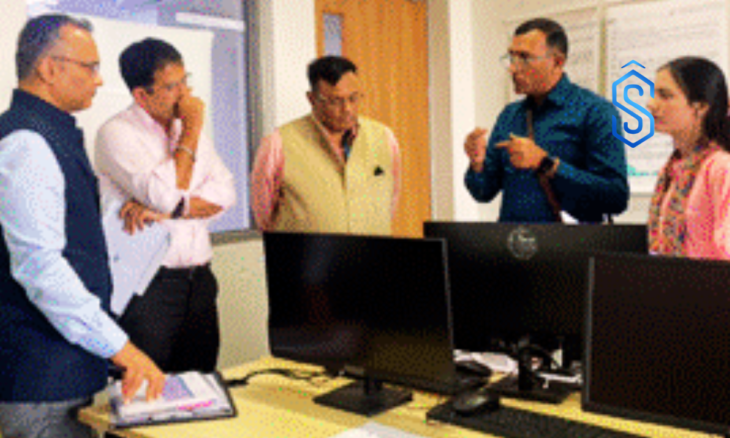
New Delhi: The VYOMA Innovation Challenge concluded with a finale at IIIT-Delhi, where 10 finalist teams showcased working prototypes focused on practical applications of open-source AI hardware for diverse Indian contexts.
The initiative was hosted by the Digital India BHASHINI Division (DIBD), under the Digital India Corporation (DIC), Ministry of Electronics and Information Technology (MeitY), Government of India, in collaboration with Current AI and Kalpa Impact.
The VYOMA Innovation Challenge brought together researchers, students and startups working on practical applications of open-source AI hardware.
The challenge focused on adapting AI hardware and software for public-interest applications and localised deployment across India.
The challenge invited participants to build on Suno Sutra, an open-source, multilingual handheld AI reference design co-developed by BHASHINI and Current AI.
Participants were encouraged to explore how the reference design could be adapted for different use cases and environments.
10 Finalist Teams Showcase AI Prototypes
The VYOMA Innovation Challenge brought together 10 finalist teams at the finale to demonstrate their working prototypes.
The solutions addressed high-impact areas including healthcare, agriculture, welfare access, legal services and accessibility.
The prototype demonstrations reflected the potential of AI designed around India’s diverse needs and real-world constraints.
The finale included presentations by the 10 finalist teams, followed by questions and feedback from the jury.
The teams demonstrated how open-source AI hardware could be adapted to address specific challenges across sectors and communities.
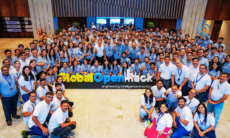
The VYOMA Innovation Challenge also brought together the wider ecosystem around open-source AI hardware, multilingual AI and Edge AI.
Participants engaged with experts on areas including hardware optimisation, model quantisation, accuracy and pathways for taking promising ideas towards real-world deployment.
Also Read: Vande Bharatam: Gujarat Startup MiCoB Secures ₹30 Cr Commitment for 3D Construction Printing
MeitY Highlights Last-Mile Potential of VYOMA Innovation Challenge
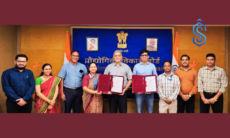
Speaking at the finale, Kavita Bhatia, Scientist ‘G’, MeitY, said: “India is moving decisively from being a consumer of global AI to building open, public-interest technologies for its own needs. But the real measure of success is not what works in a laboratory or a pilot, but what works for millions of citizens in the real world.
VYOMA brings together open-source hardware and BHASHINI’s language capabilities to take AI closer to the citizen through solutions that can work locally, function offline, reduce bandwidth dependence and protect privacy.
By enabling AI to operate on affordable, handheld devices in native languages, this initiative demonstrates how technology can become more personal, accessible and relevant to the last mile.”
Tarun Pandey, Scientist ‘E’, MeitY, said: “Hackathons such as VYOMA provide an important platform for bringing together young innovators, researchers and technology practitioners to develop practical applications of emerging technologies for public good.
The initiative reflects BHASHINI’s commitment to fostering innovation, strengthening indigenous AI capabilities and enabling inclusive language technologies that respond to India’s diverse needs.
The solutions emerging from the challenge have the potential to contribute to a broader ecosystem of accessible, open and locally relevant AI technologies.”
The VYOMA Innovation Challenge provided a platform for young innovators, researchers and technology practitioners to work on practical applications of emerging technologies for public good.
BHASHINI Focuses on Open, Offline AI
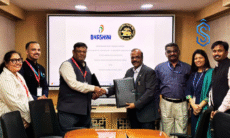
Amitabh Nag, CEO, Digital India BHASHINI Division, said: “Language is one part of inclusion, but reaching the last mile is another. VYOMA emerged from the need to explore open, offline hardware that can make AI more inclusive, particularly in diverse and connectivity-constrained environments.
What we have seen from these teams is that open hardware can translate into solutions with real-world potential. Today is a milestone, but it is also the beginning of a new journey.
The focus now must be on improving these solutions through user feedback, collaboration and the velocity of learning.”
The finale also featured a showcase of the Suno Sutra reference design and discussions on the evolution of the VYOMA Innovation Challenge, emerging use cases developed by participating teams and the broader potential of open-source AI hardware and embedded AI ecosystems.
Four Innovations Recognised at VYOMA Finale
Four innovations were recognised as winners of the VYOMA Innovation Challenge. Each winning team received prize money in recognition of its innovation and potential for public-interest deployment.
The VYOMA Innovation Challenge builds on the vision behind Suno Sutra, which was unveiled at the India AI Impact Summit in February 2026.
The initiative seeks to advance open-source, multilingual and human-centric AI hardware.
By putting the reference design in the hands of emerging builders, the challenge sought to encourage experimentation and adaptation for diverse environments, use cases and deployment contexts.
Beyond the challenge, VYOMA aims to contribute to an open ecosystem for open-source software and hardware, while advancing multilingual and Edge AI that can be adapted to India’s varied linguistic, technological and deployment environments.
The finale of the VYOMA Innovation Challenge marked a milestone in bringing together innovators, researchers, government stakeholders and ecosystem partners around the development of practical, accessible and locally relevant AI solutions.
About Digital India BHASHINI Division
The Digital India BHASHINI Division (DIBD), under the Digital India Corporation (DIC), Ministry of Electronics and Information Technology (MeitY), is building a national ecosystem for AI-powered multilingual digital inclusion.
BHASHINI supports 36 Indian text languages, 23 Indian voice languages and 35 international languages, powers 800+ government websites, has enabled 9 billion+ cumulative AI inferences and processes 24 million+ AI inferences daily, helping make Digital Public Infrastructure more accessible through Language AI.
National Hub for Language Technology (NHLT) is one of the largest inferencing platforms in the Global South, supporting the growing adoption of Language AI across government and public-facing digital services.