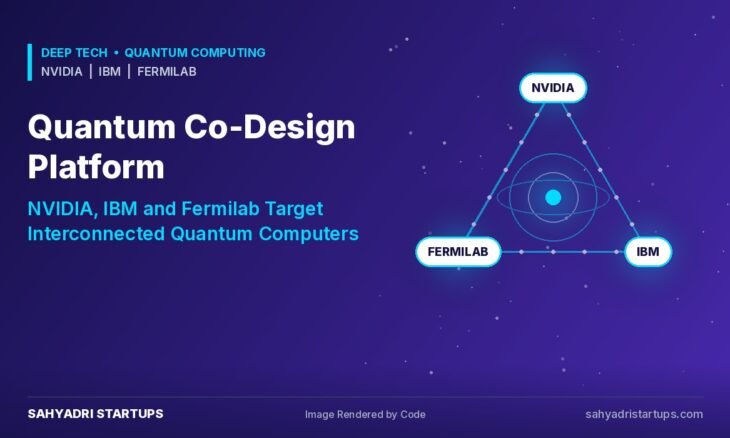
NVIDIA, IBM and the US Department of Energy’s Fermi National Accelerator Laboratory (Fermilab) are working towards a quantum co-design platform that will bring quantum processors and accelerated classical computing systems together to develop the next generation of interconnected quantum machines.
Announced on November 16, 2026, the proposed initiative will give researchers an environment to study how multiple quantum processors can communicate, operate and scale alongside conventional computing infrastructure.
The research will initially target applications in high-energy and nuclear physics, including particle interactions, neutrino physics and nuclear simulations.
The collaboration brings together IBM’s quantum computing hardware, NVIDIA’s accelerated computing infrastructure and Fermilab’s expertise in particle physics and quantum systems research.
Its central objective is to address the hardware, communication, error-correction and software challenges involved in building larger quantum computing systems.
NVIDIA said its DGX B200 systems are being co-located with IBM quantum computers, including machines powered by IBM Quantum Nighthawk. The integrated infrastructure is supporting the jointly developed quantum co-design platform.
However, the organisations have not announced a formal operational launch date, deployment scale, project cost or funding arrangements.
While NVIDIA described the integrated infrastructure as supporting the platform, IBM said the three organisations “intend to launch” it. Fermilab characterised the initiative as a proposed platform and said they “intend to collaborate”.
Quantum Co-Design Platform to Address Interconnect Challenges
A key focus of the quantum co-design platform will be understanding how multiple quantum processors can function as a connected system rather than operate as isolated machines.
Connecting quantum processors introduces challenges involving communication errors, delays and feedback between individual quantum modules. These factors can affect the reliability and performance of larger quantum computing systems.
Fermilab’s Superconducting Quantum Materials and Systems (SQMS) Center will lead the initial research into these challenges by modelling and emulating communication between quantum modules.
The first phase will examine how link errors, communication delays and feedback mechanisms influence system performance.
The results will help guide subsequent research between Fermilab’s SQMS Center and IBM on developing physical quantum interconnects.
In a later phase, SQMS plans to integrate its own superconducting cavity hardware into the research environment.
The platform will also allow researchers to develop and evaluate quantum error-correction codes, decoding algorithms and applications that combine quantum processors with classical computing resources.
Fermilab will coordinate engagement with the physics research community, software workflows and researcher access through its HEPCloud infrastructure.
“The future of quantum computing depends on more than advances in quantum hardware alone,” said Anna Grassellino, Fermilab’s chief technology officer and director of the SQMS Center.
She described the proposed initiative as “an important step toward the capabilities and community needed for a future DOE quantum computing user facility.”
Jerry Chow, IBM Fellow and chief technology officer of quantum-centric computing, said: “Scaling quantum and classical together will open new frontiers in high-energy and nuclear physics and beyond.”
Krysta Svore, NVIDIA’s vice president of applied research for quantum computing, said: “Making quantum computers useful for science requires advances in error correction, applications and the systems that bring quantum processors and accelerated computing together.”
IBM Quantum Nighthawk and NVIDIA DGX B200 Systems Form Hardware Base
IBM’s Quantum Nighthawk processors are among the quantum systems expected to be part of the collaboration.
The current Nighthawk r2 version supports circuits involving up to 7,500 two-qubit operations across 120 qubits, with sampling speeds of up to 100,000 samples per second, according to IBM.
The company announced its planned Nighthawk r3 processor on November 11, 2026. The next-generation processor is designed to feature 520 qubits and support 10,000 operations.
IBM plans to connect two Nighthawk r3 processors into a system with more than 1,000 qubits in 2027.
The integration of IBM’s quantum hardware with NVIDIA DGX B200 accelerated computing systems is intended to help researchers examine how classical computing capacity can scale alongside multiple interconnected quantum processors.
The quantum co-design platform will therefore focus not only on increasing the capabilities of individual quantum processors but also on the infrastructure and software needed to operate larger interconnected systems.
NVIDIA Introduces 13,000x Faster Quantum Error-Correction Decoder
Alongside the platform announcement, NVIDIA released TCBP-JOBS, a new algorithm designed to accelerate quantum error-correction research.
The decoder is part of NVIDIA’s CUDA-Q QEC library, version 0.9.0, which the company says is available now. It combines trajectory-calibrated belief propagation with jittered OSD beam search.
NVIDIA claims TCBP-JOBS can accelerate certain computationally intensive decoding tasks by up to 13,000 times compared with Google’s Tesseract decoder, developed by Google Quantum AI.
The comparison is based on decoding a single shot, or one execution of an error-correction circuit. In tests involving bivariate-bicycle codes, TCBP-JOBS processed the largest code in 4.09 milliseconds on a single NVIDIA GB200 GPU. The corresponding Tesseract estimate was 53.5 seconds on one CPU core.
Across four codes tested, NVIDIA reported speed improvements ranging from 6,100 to 13,300 times.
A separate benchmark involving 24.2 million shots across 28 circuits compared the total processing time. According to NVIDIA’s research paper, Tesseract required 130,257 CPU thread-hours, equivalent to approximately 12 weeks on a 64-core server if the workload were distributed perfectly.
TCBP-JOBS processed the same benchmark in 45 minutes on one GB200 GPU, with average logical error rates comparable to Tesseract, NVIDIA said.
The research paper also reported that TCBP-JOBS achieved error rates up to 4.5 times lower than a differently configured, sparsified version of Tesseract on the largest codes.
However, the reported speedups compare one GPU against one CPU core rather than equivalent hardware configurations. NVIDIA also describes TCBP-JOBS as a bounded learned search rather than an exact maximum-likelihood decoder. The algorithm requires refitting when the code family or operating settings change.
The results are based on simulated circuits and were produced by NVIDIA. The company’s published materials do not describe independent reproduction of the benchmarks.
NVIDIA Extends Slurm to Schedule Quantum Computing Resources
The quantum co-design platform is part of a broader effort to integrate quantum processors into existing high-performance computing infrastructure.
NVIDIA is expanding Slurm, the open-source workload manager used by supercomputing centres, with a quantum interface that will allow quantum processors to be scheduled alongside CPUs and GPUs.
IBM is contributing through its open-source Quantum Resource Management Interface.
NVIDIA said Slurm 26.11 will be available later in November 2026. Alice & Bob, IBM, IQM, Pasqal, Quantinuum and MQSC are among the organisations adopting the expanded system.
The integration is intended to support workload coordination across conventional supercomputers and quantum computing systems, an important requirement as researchers explore larger hybrid computing architectures.
Fermilab Expands Its Quantum Research Collaborations
Fermilab’s participation builds on its existing work in quantum technologies through the SQMS Center, one of five National Quantum Information Science Research Centers established by the US Department of Energy.
The laboratory is managed by Fermi Forward Discovery Group for the DOE Office of Science and specialises in particle physics and accelerator research.
The proposed quantum co-design platform will complement another recently launched collaboration involving IBM, Oak Ridge National Laboratory and AMD.