
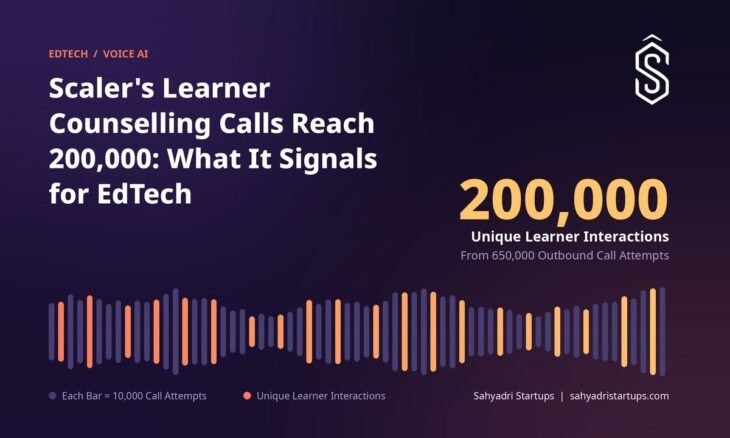
Bengaluru: Reaching 200,000 prospective learners through AI-powered conversations in three months offers an indication of how voice AI could change customer acquisition in India’s education technology sector.
Scaler has used Sarvam’s voice agents to conduct its learner counselling calls, making automated conversations an increasingly important part of how it engages potential students.
The deployment has generated approximately 200,000 unique learner interactions from 650,000 outbound call attempts over the past three months, according to a case study published by Sarvam on November 27, 2026.
The numbers point to an important shift in how EdTech companies could manage the early stages of learner acquisition.
Counselling prospective students traditionally requires human teams to explain programmes, address questions, understand career aspirations and follow up with interested candidates.
Voice AI offers a way to handle a substantial share of these conversations without relying entirely on human counsellors.
For Scaler, the technology is now central to this process. Amar Srivastava, CEO of its Online Business and Group CPO, said: “Since deploying the Sarvam voice agents, voice AI has become an important part of our learner engagement and the entire ecosystem. Today, Sarvam is the sole voice AI platform powering our counselling conversations.”
What 200,000 Learner Counselling Calls Mean for EdTech
The significance of Scaler’s deployment lies in the nature of the interactions rather than just the number of calls made.
Unlike routine customer support, education counselling involves conversations that can influence a prospective learner’s decision to invest time and money in a programme. Students may want to understand the curriculum, assess its relevance to their career goals, clarify programme requirements or ask follow-up questions before deciding whether to enrol.
Sarvam’s voice agents are designed to handle these conversations, from identifying learner interests and understanding individual goals to qualifying requirements and guiding prospective students through the programme.
The 650,000 outbound attempts resulting in 200,000 unique learner interactions also illustrate the volume of outreach required to establish meaningful engagement.
For EdTech businesses, the potential advantage is the ability to engage a larger pool of prospective students while allowing human counselling teams to concentrate on more complex or high-intent conversations.
Learner Counselling Calls: Why Hinglish Became a Key Selection Criterion
One of the more interesting aspects of Scaler’s deployment is the emphasis on conversational quality in Indian languages.
According to Sarvam’s case study, Scaler evaluated multiple voice AI platforms before selecting Sarvam. Its assessment placed particular importance on the ability to handle Hinglish conversations, where learners naturally switch between Hindi and English within the same sentence.
The other requirements included maintaining context through pauses and follow-up questions, responding quickly enough to make conversations feel natural, and supporting up to 200 calls per minute.
This has wider implications for India’s voice AI market. For companies serving diverse customer segments, language support is not simply about offering separate Hindi or English options.
The ability to understand how people actually speak, including language switching and informal expressions, can determine whether automated conversations are useful or frustrating.
Learner Counselling Calls: From 500,000 Counselling Minutes to One Million
The deployment has already accumulated between 400,000 and 500,000 conversational minutes, according to Sarvam’s case study.
The company expects the volume to reach approximately one million minutes between the third and fourth quarters of the current financial year.
At this scale, the operational question moves beyond whether AI can make outbound calls to whether it can sustain meaningful conversations across a large and diverse learner base.
Scaler has indicated that the deployment is generating strong ROI, according to the case study. However, the companies have not shared details on the cost per interaction, enrolment conversion rates, revenue contribution or savings compared with human-led counselling.
These metrics will be important in assessing the commercial effectiveness of AI-led learner engagement, particularly in a sector where customer acquisition costs and the conversion of prospective students into paying learners can significantly influence business performance.
Sarvam’s Enterprise Voice AI Business Gains Another Use Case
Scaler is among the enterprises adopting Sarvam’s voice technology for large-scale customer interactions.
At its Epoch developer conference in July 2026, Sarvam said its voice platform Samvaad had handled 325 million minutes of customer conversations over the preceding year, according to Inc42.
Mahindra Finance has also deployed Sarvam-powered voice agents across sales, collections and employee engagement, reporting more than one crore customer calls. At Bolna’s Symphony 2026 event, co-founder Vivek Raghavan said Sarvam was processing more than three million minutes of voice AI conversations daily, Inc42 reported.
Founded in 2023 by Dr Pratyush Kumar and Dr Vivek Raghavan, Bengaluru-based Sarvam raised the first $234 million of its $300 million Series B round in June 2026, at a post-money valuation of $1.5 billion. HCLTech invested $150 million as the lead strategic investor.
The company has also expanded its product portfolio with recent releases including Sarvam-105B-1711, Sarvam Dictate and Sarvam Extract in November.