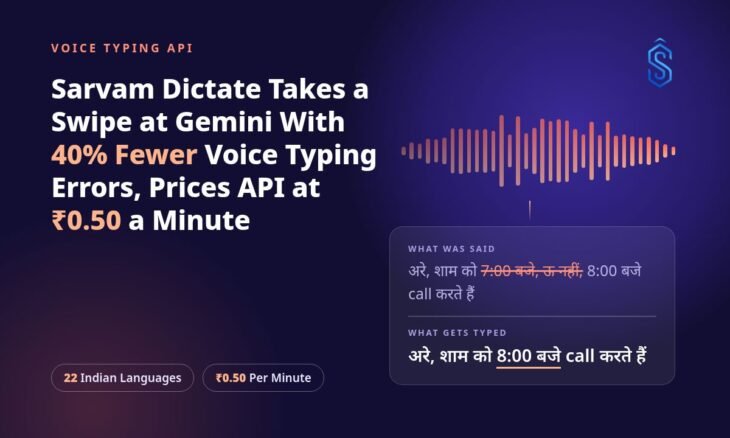
Sarvam AI is positioning its Sarvam Dictate API as an alternative to global speech-to-text services, publishing new benchmark results that show lower character-edit requirements than Google’s Gemini and AssemblyAI across several dictation tests.
The developer-focused service supports English and 22 Indian languages and is priced at ₹0.50 per minute of audio under its standard pay-as-you-go plan.
The latest disclosure, published on November 23, provides a detailed assessment of the system’s transcription and editing capabilities.
Rather than simply converting speech into text, Sarvam Dictate uses a combination of its Saaras v4 speech recognition model and a dictation-trained version of Sarvam 105B to produce cleaned-up text.
The announcement builds on the company’s November 22 Sarvam-105B model update, which had already outlined the dictation API’s language coverage, vocabulary support and pricing.
Sarvam Dictate Reports Lower Editing Requirements Than Gemini
The central claim in Sarvam’s latest evaluation is that its system requires fewer character-level corrections than competing transcription tools.
For English, Sarvam tested 2,691 dictations and reported a character-edit rate of 4.2%. The corresponding rates were 7% for Gemini 3.5 Transcribe and 5.3% for AssemblyAI Dictation.
Sarvam calculated that its system required 40% fewer character edits than Gemini in this evaluation. However, the proportion of transcripts that needed no editing was broadly comparable: 39% for Sarvam, 41% for Gemini and 40% for AssemblyAI.
The results were also tested across Indian languages. In 1,370 dictations covering 18 languages, Sarvam recorded an 8.8% character-edit rate, compared with 15.5% for Gemini.
AssemblyAI was evaluated on a smaller subset of 747 recordings in Hindi, Marathi and Urdu. Within that comparison, its edit rate was 15.8%, against 7.4% for Sarvam.
For Hinglish, the evaluation covered 184 recordings. Sarvam reported a 6.6% edit rate, while Gemini recorded 17% and AssemblyAI 14.7%.
The company uses AMEND, a metric measuring the proportion of characters requiring correction, rather than conventional word error rate. Script choice was excluded from the Indian-language and Hinglish calculations.
Application Context Is a Key Differentiator
Beyond transcription accuracy, Sarvam is focusing on a problem that affects the adoption of voice-based interfaces: the ability to recognise names, technical terms and other information specific to the application being used.
Sarvam Dictate allows developers to provide up to 1,000 vocabulary entries per request. Applications can also supply reference documents, situational information and instructions about the desired writing style.
For example, a customer relationship management application could pass customer names from an existing record, while a coding environment could provide relevant file names, functions and variables.
The system uses phonetic matching to identify potentially relevant vocabulary before determining whether the terms fit the recognised sentence.
This approach is intended to reduce incorrect spellings and substitutions when users dictate information that may not appear in a general-purpose language model’s vocabulary.
Sarvam tested this capability using 2,099 clips from the IndicContextEval benchmark across seven Indian languages.
The company reported that its system inserted a supplied vocabulary term that had not actually been spoken in 4.7% of clips. Gemini recorded 5.7%, while ElevenLabs Scribe v2 recorded 10.6%.
The systems identified actual spoken terms at broadly similar rates: 80.3% for Sarvam, 80.4% for Gemini and 81.6% for ElevenLabs.
A separate test examined the recognition of exact values such as email addresses, file paths and identifiers. Across 300 English recordings containing 1,482 such values, Sarvam achieved 84.5% accuracy using audio alone.
This increased to 93.8% when the expected values were supplied through application vocabulary and contextual information.
The latter result reflects context-assisted recognition rather than unaided speech recognition.
Sarvam Uses Reinforcement Learning to Reduce Meaning Errors
Sarvam has also detailed how it trained the dictation-specific version of its 105B model.
The company conducted 12 consecutive reinforcement-learning runs, focusing on removing unnecessary speech elements without changing the speaker’s intended meaning.
The training process penalised errors such as incorrect numbers, missing negations, invented information and the insertion of terms that were not spoken.
On 7,121 internal test items, Sarvam reported that the model’s pass rate increased from 73.9% before training to 86.3% afterwards.
The company also disclosed an issue encountered during early training. When individual edits were rewarded, the model began adding punctuation, particularly commas, instead of concentrating on removing fillers. Sarvam said it subsequently moved to pass-or-fail scoring to address the problem.
API Supports Live Dictation and Long Recordings
Sarvam Dictate is available through three API routes covering short audio clips, longer recordings and live microphone input. Short-clip requests support recordings of up to 30 seconds, while long-form jobs can handle recordings of up to one hour.
For longer audio, the system processes content in sections of approximately 500 words and uses neighbouring text to maintain context.
In another evaluation involving 1,077 English dictations longer than one minute, Sarvam reported an 8.8% character-edit rate. Gemini recorded 9.9%, while AssemblyAI recorded 10.6%.
The API returns both the original transcript and the edited version, allowing developers to choose which output to display or retain. It also supports code-mixed output and transliteration into Latin script.
However, there are some integration constraints. The API does not currently generate SRT or VTT subtitle files and does not provide short-lived browser tokens. Live connections must therefore be initiated through a developer’s server rather than exposing a permanent API key in a browser or mobile application.
If the editing stage fails or takes too long, the service can return the raw transcript with a status field indicating that the response is degraded. Developers need to account for this possibility when integrating the API.
Sarvam Dictate Pricing Starts at ₹0.50 Per Minute
Sarvam lists the standard pay-as-you-go price for Sarvam Dictate at ₹0.50 per audio minute, covering both speech recognition and text editing. Lower rates are also listed for customers on its Pro, Growth and Business plans.
The company said the development builds on its experience with Kivi, its dictation application, where users have dictated more than 30 million words.