
Bengaluru-based Sarvam AI has cut the blended inference cost of its 105-billion-parameter artificial intelligence model by nearly two-thirds with the release of an updated checkpoint, while reporting improvements in instruction following, tool use and Indian-language capabilities.
The new Sarvam 105B checkpoint, named Sarvam-105B-1711, was released on November 22 through the company’s Token Factory platform.
Sarvam has also made the model weights available, allowing developers to deploy the system on their own infrastructure or use it for further training.
The company has priced API access at ₹10 per million input tokens and ₹25 per million output tokens, excluding GST.
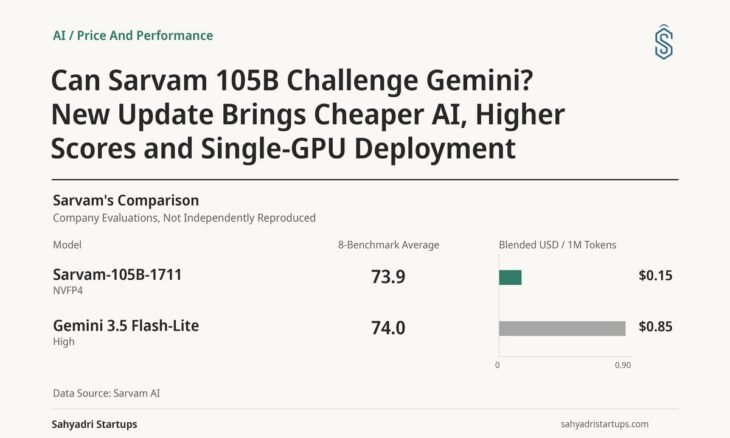
These are introductory rates. Its blended inference price comparison puts the updated model at $0.15 per million tokens, down from $0.44 for the previous checkpoint.
Beyond pricing, the release is significant for its deployment requirements.
Sarvam says a compressed version of the model can run on a single NVIDIA RTX PRO 6000 Blackwell workstation GPU with 96 GB of memory, potentially lowering the infrastructure requirements for businesses looking to operate large AI models on-premises.
The update retains the existing Sarvam 105B architecture, a mixture-of-experts model with 105 billion total parameters and 10.3 billion active parameters.
Sarvam 105B Reports Improvement Across AI Benchmarks
Sarvam reported an average score of 73.9 across eight conversational-agent benchmarks for the new checkpoint, compared with 42.6 for its earlier version.
The company’s comparison placed Gemini 3.5 Flash-Lite at 74.0 and Gemma 4 31B at 73.0. The tests cover instruction following, conversational quality, tool calling and Indian-language performance.
Among the reported improvements, the model’s IFBench score increased from 32.5 to 82.5, while its Tau2 score rose from 46.2 to 85.5. Its internal Indic benchmark improved from 30.1 to 79.1.
These figures correspond to the BF16 checkpoint. The compressed NVFP4 version intended for deployment recorded scores of 81.8 on IFBench, 84.1 on Tau2 and 78.8 on the Indic suite.
Sarvam also reported a 69.5% success rate on Tau2 customer-service tasks, measured by the proportion of tasks completed successfully across all four repeated attempts. Gemini 3.5 Flash-Lite recorded 63.9%, while Gemma 4 31B scored 62.1%. The benchmark results are based on Sarvam’s own evaluations.
On pricing, Sarvam’s comparison places the blended inference cost of Gemini 3.5 Flash-Lite at $0.85 per million tokens and Gemma 4 31B at $0.54.
Voice AI and Enterprise Applications Are Key Use Cases
Sarvam is already deploying the model across its voice agents, Indus Cowork knowledge-work platform and dictation products.
For voice applications, the company has developed a specialised fine-tune for Samvaad, its enterprise voice platform supporting 12 Indian languages.
Sarvam reported a score of 68.7 for this fine-tuned model on its Samvaad benchmark, compared with 57.9 for the base Sarvam 105B checkpoint and 68.0 for Gemma 4 31B, with thinking disabled.
The evaluation covered 338 next-turn assessments drawn from real-world scenarios in English and 12 Indian languages. Loan collection and sales accounted for a substantial part of the dataset, alongside customer surveys and onboarding scenarios.
Sarvam also published demonstrations comparing its voice model with a system it identified as GPT-6 Luna. The company said its model handled complex instructions and language selection more appropriately in those examples.
In Indus Cowork, the updated model is intended to handle knowledge-work tasks involving multiple tool calls within a single interaction. Sarvam demonstrated its use in document processing, spreadsheet operations and research workflows.
The company has also integrated a fine-tuned Sarvam 105B model with its Saaras v4 speech recognition system for Sarvam Dictate, which converts spoken audio into finished text.
In a test involving 2,959 English dictations, Sarvam reported that 5% of characters required editing to match the intended text. The corresponding figures were 8.1% for Gemini 3.5 Transcribe and 10.6% for AssemblyAI Dictation.
The evaluation used the company’s AMEND metric, which measures character-level edits rather than conventional word error rate.
Single-GPU Deployment Opens On-Premises Possibilities
The availability of compressed model weights is another important aspect of the release, particularly for businesses that want to operate AI systems within their own IT environments.
Sarvam has released a 65 GB NVFP4 checkpoint for inference and BF16 weights for fine-tuning and post-training. According to the company, the NVFP4 version is the same model used in production through Token Factory.
The company says the compressed model can run Indus Cowork entirely on-premises using a single 96 GB NVIDIA RTX PRO 6000 Blackwell GPU.
In a workstation test involving a 10,000-token prompt and one request, Sarvam measured a decoding speed of 99 tokens per second per user. Actual performance will vary depending on prompt length and concurrent workloads.
Its serving stack uses vLLM and DSpark speculative decoding, while NeMo RL supports further reinforcement learning in FP8. Speculative decoding uses a smaller draft model to propose tokens that the primary model subsequently verifies, reducing generation overhead.
For enterprises handling sensitive documents or internal knowledge bases, this deployment option offers an alternative to sending every request to an external cloud-based AI service.
Sarvam Improves Training Efficiency on NVIDIA B200 GPUs
The model release also reflects changes to Sarvam’s underlying training and inference infrastructure.
The company said an upgraded 8-bit training approach on NVIDIA B200 GPUs increased model FLOPs utilisation from approximately 19% to 38%. Pretraining throughput rose from around 5,500 to 10,900 tokens per second per GPU.
Sarvam also reported extending the model’s training context to 160,000 tokens through continued pretraining across 512 GPUs. The process involved 330 billion tokens and took slightly more than seven days.
This training context should be distinguished from the currently listed Token Factory endpoint, which specifies a 128K context window for Sarvam 105B.
On inference, the company measured aggregate decoding throughput of 6,067 tokens per second per B200 GPU using NVFP4 and DSpark at 64 concurrent requests. Its BF16 setup recorded 2,888 tokens per second, compared with 2,994 for Gemma 4 31B.
Sarvam further reported that combining 8-bit rollouts with speculative decoding made generation during reinforcement learning 2.65 times faster and reduced training-step time by 1.79 times, while maintaining similar reward scores.
These infrastructure improvements are intended to support the development of larger models and AI systems capable of handling more complex, multi-step tasks.
Sarvam Expands Its Open-Weight AI Offering
The latest release builds on the company’s efforts to develop and commercialise AI models trained in India.
Founded by Vivek Raghavan and Pratyush Kumar, the Bengaluru-based company works across foundational models, speech recognition, Indian-language technologies and enterprise AI applications.
Sarvam released its 30B and 105B models under an open-weight approach on March 6. The company said the models were trained from scratch in India using computing infrastructure provided under the IndiaAI Mission.
On November 16, the company launched Token Factory, an inference platform providing access to its own models and other open-weight systems through GPU infrastructure located in India. Its initial catalogue included models from GLM, DeepSeek, Kimi and Gemma, alongside Sarvam 105B.
The updated checkpoint adds another version of its in-house model to the platform, with an emphasis on lowering the cost of running AI applications at scale.
Sarvam‘s expansion has also attracted institutional investment. In an announcement dated June 15, HCLTech said the startup had raised $234 million in the first close of a planned $300 million Series B round at a post-money valuation of $1.5 billion.
HCLTech led the investment, with Bessemer Venture Partners, Khosla Ventures and Peak XV Partners also participating.