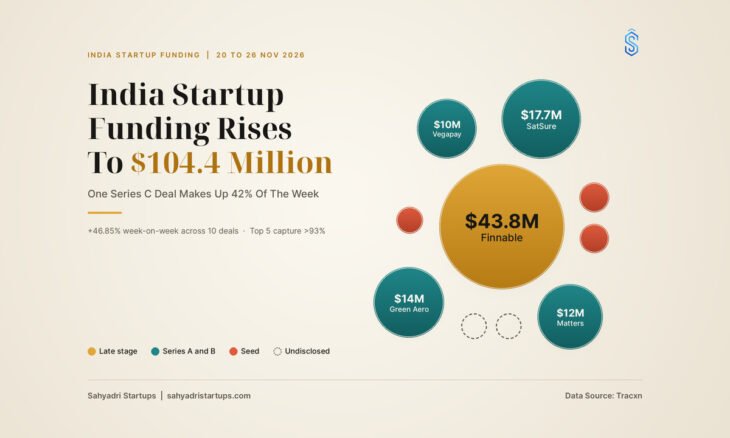
Pune: India Startup Funding reached $104.4 million across 10 funding rounds between 20 and 26 November 2026, but the headline growth figure masks a more concentrated funding environment.
Five transactions accounted for more than 93% of the capital raised, while seed-stage investments contributed just 6.6% of the weekly total.
The latest India Startup Funding Tracker by Tracxn and Sahyadri Startups recorded a 46.85% increase in funding compared with the $71.1 million raised in the previous week across 11 rounds.
However, the composition of this week’s investments is more revealing than the increase itself. A single Series C transaction by Bengaluru-based Finnable contributed $43.8 million, accounting for nearly 42% of all capital raised. Without this deal, the weekly funding total would have been approximately $60.6 million.
India Startup Funding: Early-Stage Companies Attract Capital, But Seed Funding Remains Small
The stage-wise distribution reveals an interesting shift in the funding mix.Stage Funding Share of weekly funding Rounds Early stage (Series A and B) $53.7M 51.4% 4 Late stage (Series C and above) $43.8M 42% 1 Seed and angel $6.9M 6.6% 5
Early-stage companies attracted the largest share, raising $53.7 million across four Series A and B transactions. This represents 51.4% of the weekly funding.
The continued presence of Series A and B investments is significant for founders building businesses beyond the initial product-development stage.
These companies are typically seeking capital to strengthen their technology, expand operations and move towards larger commercial opportunities.
However, the relatively small seed-stage allocation presents a different picture. Five companies raised a combined $6.9 million, accounting for only 6.6% of the capital deployed.
For early founders, this highlights the difference between the number of funding opportunities and the actual availability of capital.
Seed-stage activity continued, but the bulk of investor money went to businesses that had progressed further along the fundraising cycle.
Late-stage funding, meanwhile, was entirely driven by Finnable’s Series C transaction. The $43.8 million investment accounted for 42% of the weekly total, illustrating how one sizeable growth-stage deal can significantly influence India’s weekly funding numbers.
Emerging Key Destinations: Fintech, Aerospace and AI
Beyond the overall numbers, the sectoral spread of the investments offers a glimpse into the different technology and business opportunities attracting capital.
Fintech remained prominent, with two significant transactions. Finnable raised $43.8 million in a Series C round, while Mumbai-based Vegapay secured $10 million in Series A funding.
The two businesses operate at different parts of the financial services ecosystem. Finnable provides instant personal loans and financial management tools, while Vegapay develops B2B technology infrastructure for credit, cards, lending and banking products.
For the fintech ecosystem, these investments demonstrate that funding activity is not restricted to consumer-facing financial services. Infrastructure providers building technology for financial institutions are also attracting investor participation.
Another notable development was the $14 million Series A funding raised by Delhi-based Green Aero Propulsion.
The company’s focus on fuel-agnostic gas turbine engines for civilian and defence applications places it in a different category from conventional consumer internet startups.
Its funding, led by Crane Venture Partners, brings attention to the capital requirements and investor participation emerging around specialised aerospace and engineering technologies.
Bengaluru-based SatSure’s $17.7 million Series B investment adds another dimension. Its decision intelligence solutions use satellite imagery and aerial data to generate actionable analytics.
Meanwhile, Matters raised $12 million in Series A funding for its AI-powered data security and risk management platform.
Taken together, these transactions suggest that investors are backing businesses operating across financial infrastructure, aerospace engineering, satellite-data intelligence and enterprise security rather than concentrating exclusively on conventional consumer technology models.
Robotics, Jewellery and Digital Asset Management
The seed-stage deals offer a separate perspective on the range of businesses finding early investor support.
Bengaluru-based Cosine Robots raised $2.4 million in a round led by Avaana Capital. The company manufactures high-precision robotic actuators and hardware for automation.
The investment is notable for the presence of industrial hardware in a week otherwise dominated by larger fintech and technology transactions.
Unlike software-led businesses, robotics manufacturers also need to develop physical products and hardware capabilities.
Gurugram-based Zavya, an internet-first precious jewellery brand, secured $2.5 million in seed round.
Mumbai-based Umber raised $2 million from angel investor Nimesh Vora. The company provides digital asset management services for remote file hosting.
Two other companies raised seed funding without disclosing the amounts.
Delhi-based CYRAN, which develops hardware and software AI solutions for geospatial technology and education, secured funds from Singularity AMC.
Pune-based IYNS Tech Solutions also raised an undisclosed seed round. The company is developing modular nuclear reactors and thermal-hydraulic simulation software, with Speciale Invest, Navam Capital and BYT Capital among its investors.
The presence of Cosine Robots, CYRAN and IYNS Tech Solutions is particularly interesting from a startup ecosystem perspective.
Their businesses involve specialised hardware, engineering and technology development, areas that can have substantially different capital requirements and development timelines from software startups.
Which Investors Were Active?
Crane Venture Partners, Tanglin Venture Partners and Prosus featured among the active institutional investors in the week’s tracker.
Crane Venture Partners participated in Green Aero Propulsion‘s $14 million Series A round, while Tanglin Venture Partners invested in Matters. Prosus participated in Vegapay‘s $10 million Series A round.