Pune: The reduction in the proposed Swara Baby IPO size from ₹1,000 crore to ₹800 crore raises an interesting question about the listing strategy of Brainbees Solutions, the parent company of FirstCry: Is this primarily a partial exit by an early investor, or an attempt to give an established manufacturing business an independent identity in the public markets?
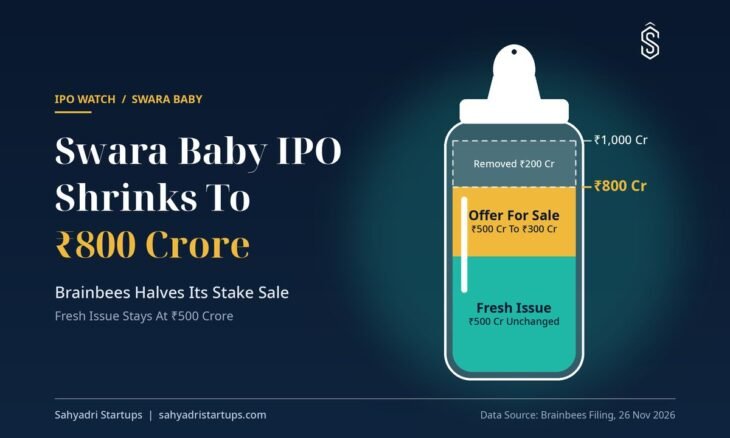
The more significant detail is where the reduction has come from. Swara Baby Products Limited, which manufactures disposable hygiene products across baby care, adult incontinence and feminine hygiene, has retained its fresh issue at ₹500 crore while cutting its offer for sale (OFS) from ₹500 crore to ₹300 crore.
Brainbees, Swara Baby’s largest promoter shareholder, has also halved its proposed stake sale from ₹300 crore to ₹150 crore.
This means the company is maintaining its planned capital-raising programme while existing shareholders are choosing to monetise a smaller portion of their holdings.
For public market investors, the distinction is important: the entire ₹500 crore fresh issue is intended to fund the business, whereas the OFS proceeds go to selling shareholders.
The revised IPO structure was disclosed in the Red Herring Prospectus dated November 26, 2026, filed with the Registrar of Companies, Gwalior.
Why Brainbees Is Taking Swara Baby Public
Swara Baby’s origins are closely linked to FirstCry’s expansion into private-label products.
When FirstCry was scaling its diaper business in 2018, it sought greater control over manufacturing and product quality through backward integration.
Swara Baby was established in this context. Brainbees subsequently invested ₹90.617 crore in the business in 2020.
Over time, Swara Baby developed into a specialised hygiene products manufacturer with multiple product categories, manufacturing capabilities and distribution channels. Its ambitions also expanded beyond its original association with FirstCry.
Brainbees says Swara Baby’s diversified product lines, channels and plans for international markets differed from its original alignment with Brainbees. It described the OFS as a partial monetisation of its investment while confirming that Swara Baby would remain its subsidiary.
At the time of the DRHP filing, Brainbees held 76.59% of Swara Baby, equivalent to 18,70,86,380 shares. Other promoters included Alok Birla, Sangita Birla and Udit Alok Birla.
Brainbees has also stated that Swara Baby operates with an independent management team led by Alok Birla and his son Udit Birla, with transactions between the two companies conducted on an arm’s-length basis.
The reduced OFS suggests that Brainbees is not using the listing as a complete exit route. Instead, it is seeking partial monetisation while retaining its interest in a manufacturing business that has developed beyond its original role within the FirstCry ecosystem.
India’s Diaper Market: The Manufacturing Opportunity
The investment proposition behind the Swara Baby IPO extends beyond its relationship with FirstCry.
According to the TKC industry report cited in its DRHP, Swara Baby was India’s largest contract manufacturer of baby diapers by revenue in FY2025, with a 37% market share by value. It was also the country’s largest adult diaper manufacturer, with an estimated 36% share.
The report estimates India’s diaper market at ₹13,820 crore in FY2025, projecting it to reach ₹25,160 crore by FY2030.
Swara Baby operates across baby care, adult incontinence and feminine hygiene. Its portfolio includes baby and adult pant and tape diapers, sanitary napkins and panty liners. Alongside contract manufacturing for other brands, it also sells its own baby and adult diaper products.
As of March 31, 2026, the company operated four manufacturing facilities with 20 production lines across Pithampur and Indore in Madhya Pradesh.
Its contract manufacturing model gives it exposure to established brands and their distribution networks without requiring the same level of consumer-facing brand investment. However, the model also brings customer concentration risks that investors will need to evaluate.
FirstCry Connection: An Advantage and a Concentration Risk
Brainbees was Swara Baby’s largest customer in FY2026, accounting for ₹263.46 crore, or 22.64% of revenue. The top 10 customers together contributed 80.31%.
While the FirstCry relationship has helped Swara Baby establish manufacturing scale, reducing dependence on a relatively small group of customers could become important as it expands.
Baby diapers accounted for 78.34% of Swara Baby’s FY2026 revenue, making this its dominant product category despite its presence in adult and feminine hygiene.
The company’s ability to grow its own brands, attract additional contract manufacturing clients and expand into international markets will therefore be important to its longer-term business diversification.
Revenue Growth Versus Declining Margins
Swara Baby’s financial performance shows expanding revenue, but its operating margins have moderated.
Revenue from operations increased from ₹749.96 crore in FY2024 to ₹942.98 crore in FY2025 and ₹1,163.90 crore in FY2026.
Profit for FY2026 stood at ₹95.59 crore, compared with ₹80.67 crore in FY2025 and ₹93.97 crore in FY2024.
However, EBITDA margins declined from 20.48% in FY2024 to 17.26% in FY2025 and 16.56% in FY2026. EBITDA for FY2026 stood at ₹192.77 crore.
Swara Baby reported a net worth of ₹553.22 crore and net debt of ₹438.79 crore as of March 31, 2026. This makes the company’s planned debt reduction and ability to improve operating profitability relevant considerations for investors.
Where the ₹500 Crore Fresh Issue Will Go
The fresh issue is particularly relevant to Swara Baby’s expansion strategy, with a substantial portion of the proposed proceeds earmarked for manufacturing capacity and debt reduction.
According to the DRHP, the company plans to invest ₹198.21 crore in a new manufacturing facility at Pithampur, Madhya Pradesh. The facility is expected to add annual production capacity of 1,464 million baby diapers and 252 million adult diapers.
Another ₹100 crore is proposed for repayment or prepayment of the company’s borrowings, while ₹27.5 crore is earmarked for repayment of borrowings at its subsidiaries.
The remaining proceeds are intended for unidentified acquisitions and general corporate purposes, subject to the prescribed cap of 35% of gross proceeds.
If implemented as proposed, the Pithampur investment could strengthen Swara Baby’s manufacturing capacity as the Indian diaper market expands. Debt repayment could also help improve its balance sheet.
These allocations were disclosed at the DRHP stage and may be updated in the RHP.
What Investors Should Watch in the Swara Baby IPO
The Swara Baby IPO offers exposure to a specialised manufacturing business operating in a growing consumer hygiene market. Its manufacturing scale, contract manufacturing relationships and presence across multiple product categories provide the foundation for its growth proposition.
However, three factors deserve particular attention:
Customer concentration: The top 10 customers account for 80.31% of revenue, making customer diversification important for sustainable growth.
Margin trajectory: EBITDA margins have declined over the past three financial years despite consistent revenue growth.
Debt and expansion: Net debt of ₹438.79 crore makes the proposed debt repayment and manufacturing investments important to the company’s future financial position.
For Brainbees, the listing offers an opportunity to partially monetise its investment while retaining control of a business that has developed beyond its original FirstCry manufacturing role.
For investors, the larger question is whether Swara Baby can translate its manufacturing leadership into sustained profitability, a broader customer base and an independent growth trajectory.
The IPO will open for subscription on December 2, 2026, and close on December 4, with anchor investor bidding scheduled for December 1. The price band is yet to be disclosed.