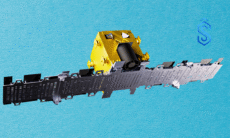


Bengaluru-based Bellatrix Aerospace has secured a multi-year contract from GalaxEye to supply ARKA electric propulsion systems for the latter’s next 30 Drishti Gen-II satellites, giving the Indian space technology company a significant commercial opportunity to deploy its propulsion technology across a larger satellite programme.
The agreement, announced at IISC 2026, covers the design, manufacturing and testing of the propulsion systems at Bellatrix’s Bengaluru facility.
The thrusters will be used to manoeuvre GalaxEye’s satellites into their designated imaging orbits after deployment.
Bellatrix described the agreement as the largest business-to-business order between two private Indian space companies by satellite count since the 2020 space sector reforms. The companies have not disclosed the contract value or the expected delivery schedule.
The ARKA electric propulsion systems deal brings together two Bengaluru-based companies working on different parts of the satellite value chain.
While GalaxEye is developing satellites that combine radar and optical imaging, Bellatrix specialises in propulsion technologies designed to support spacecraft movement and orbital operations.
ARKA Electric Propulsion Systems: Larger Commercial Deployment
The ARKA electric propulsion systems contract marks a commercial deployment opportunity for Bellatrix’s ARKA Hall-effect electric thrusters.
The technology uses electrical energy to accelerate propellant and generate thrust, offering greater fuel efficiency than conventional chemical propulsion systems.
Bellatrix’s product portfolio includes ARKA configurations ranging from 50 W to 5 kW. Its published specifications for the 200 W variant include 13.2 mN of thrust and a specific impulse of 1,300 seconds.
The company has not specified which configuration will be supplied for GalaxEye’s satellites.
ARKA has previously been tested in space aboard ISRO’s PSLV-C58 mission, launched on January 1, 2024.
Bellatrix reported that its 200 W Hall-effect thruster was flown alongside the Rudra green propulsion system.
The mission validated the ignition and functioning of the thruster and its heaterless hollow cathode.
The GalaxEye contract extends the technology’s commercial application to a multi-satellite programme, although the companies have not disclosed the individual propulsion requirements or configuration for the 30 spacecraft.
GalaxEye builds its next-generation OptoSAR satellite programme
GalaxEye is developing an OptoSAR imaging platform that combines synthetic aperture radar (SAR) and multispectral optical imaging on a single satellite.
The approach is intended to provide Earth observation capabilities across different weather and lighting conditions.
Its Mission Drishti Gen-I satellite, launched aboard a SpaceX Falcon 9 rocket on May 3, 2026, was the company’s first demonstration of this integrated imaging approach. GalaxEye has described the platform as capable of delivering 1.8-metre fused resolution.
In a November 10 update, the company said it had established communication with the satellite and completed most of its launch and early orbit operations before an extreme geomagnetic storm caused an anomaly.
GalaxEye said the experience would inform the development of its next two OptoSAR satellites.
For a multi-satellite imaging programme, propulsion systems are important for achieving the required orbital positions and supporting manoeuvres during spacecraft operations. The integration of ARKA thrusters into GalaxEye‘s satellite bus is expected to address these requirements.
Bellatrix scales manufacturing after $20 million funding round
The contract comes as Bellatrix expands its manufacturing capacity to address demand for in-space propulsion systems.
In March 2026, the company raised $20 million in a Pre-Series B funding round led by Cactus Partners and Hero Enterprise. New investors included 35 North Ventures, Indusbridge Ventures and Monarch Holdings, alongside participation from existing investors.
Bellatrix said the capital would support manufacturing expansion and the establishment of additional production lines. CEO Rohan Ganapathy had indicated that the company’s delivery lead times had fallen below six months.