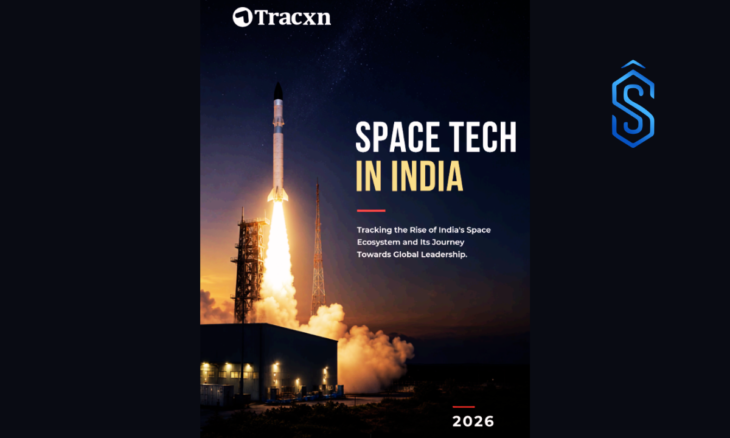
Pune: India SpaceTech has emerged as one of the country’s fastest-growing innovation ecosystems, attracting approximately $871 million across 241 funding rounds and 285 companies through July 2026, according to a comprehensive report released by global market intelligence platform Tracxn.
The report highlights how policy reforms, increased institutional investment, and successful private launches have accelerated the growth of India SpaceTech, positioning the country among the leading global space innovation hubs.
The report maps the evolution of India’s private SpaceTech ecosystem across launch vehicles, satellite manufacturing, propulsion systems, space situational awareness, earth observation, and downstream analytics.
It states that the ecosystem comprises 285 companies, of which 274 remain active, while 72 companies have received institutional equity funding.
According to the report, the defining factor behind the rapid expansion of India SpaceTech has been policy reforms that opened the sector to private participation in 2020.
These regulatory changes have enabled greater private investment, attracted institutional capital, and supported the emergence of India’s first SpaceTech unicorn along with the country’s first privately developed orbital launch vehicle.
Skyroot’s Vikram-1 Achieves Historic Orbital Launch
A major milestone for India SpaceTech came on July 18, 2026, when Skyroot Aerospace’s Vikram-1 successfully reached a 450-kilometre low Earth orbit.
The mission deployed four payloads, including technology demonstrations from Grahaa Space, Cosmoserve, DCubed, and Skyroot’s SCOPE satellite.
The successful mission made India the third country after the United States and China to achieve a privately developed orbital launch capability.
The report notes that the achievement also reflects the rapid evolution of the country’s private space ecosystem. India accomplished its first private orbital launch within six years of opening the sector to private participation in 2020. Skyroot plans another test flight later in 2026 before commencing commercial launch operations in 2027.
Also Read: Sahyadri Startups Weekly Tracker Reports USD 106M Raised by Indian Startups in 17 Jul – 23 Jul 2026
India SpaceTech Funding Climbs to Record Levels
Funding within the India SpaceTech ecosystem has grown steadily over the past several years.
Annual funding increased from $43 million across 12 rounds in 2021 to a record $200 million across 53 rounds in 2025. The strong momentum has continued in 2026 year-to-date, with $113 million raised across 24 funding rounds.
Five major funding rounds accounted for more than half of the capital deployed across 2025 and 2026:
- Skyroot Aerospace – $50 million Series C
- Digantara – $50 million Series B
- EtherealX – $21 million Series A
- Bellatrix Aerospace – $20 million Series A
- AgniKul Cosmos – $17 million Series C
Collectively, these funding rounds contributed $158 million, representing more than half of the total capital raised during the two-year period.
The report also highlights the evolution of funding stages within India SpaceTech. Seed-stage funding increased from $7 million in 2022 to $62 million in 2025, while late-stage funding emerged for the first time, reaching $17 million in 2025 and $53 million in 2026 YTD.
Investor participation has also diversified, expanding beyond domestic venture capital firms and angel investors to include sovereign wealth funds and global institutional investors.
Skyroot Emerges as India’s First SpaceTech Unicorn
The report identifies Skyroot Aerospace as the best-funded company in India SpaceTech, having raised $150 million to date.
Following its $50 million Series C funding round in May 2026, the company achieved a valuation exceeding $1.1 billion, becoming India’s first SpaceTech unicorn.
Other leading companies include:
- Pixxel – $96 million
- AgniKul Cosmos – $76 million
- Digantara – $67 million
- Bellatrix Aerospace – $34 million
Together, the top 10 funded companies have raised more than $548 million, accounting for over 60% of the total funding received by the ecosystem.
Bengaluru Leads India’s SpaceTech Ecosystem
The Tracxn report identifies Bengaluru as the leading hub for India SpaceTech, attracting $495 million across 106 funding rounds. The city hosts seven of the top ten funded SpaceTech companies, with Pixxel alone accounting for nearly 19% of Bengaluru’s total funding.
Hyderabad ranks second with $205 million, where funding is primarily driven by Skyroot Aerospace and Dhruva Space, which together account for 87% of the city’s total funding.
Chennai follows with $80 million, with AgniKul Cosmos contributing approximately 95% of the city’s total funding.
Together, Bengaluru, Hyderabad, and Chennai account for the majority of equity funding raised by India SpaceTech, underscoring their importance as the country’s leading private space innovation hubs.