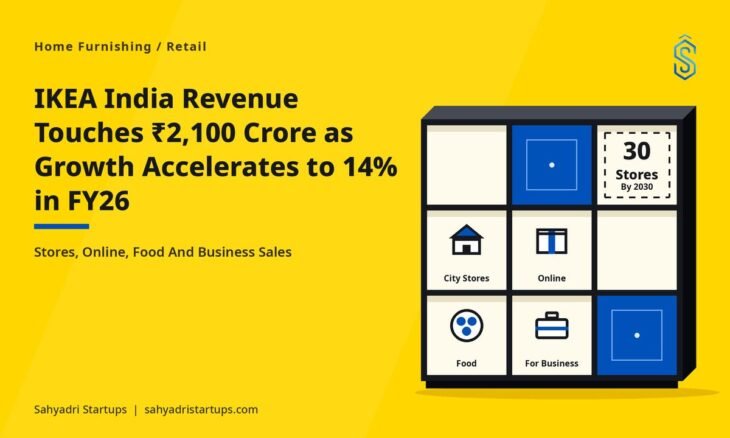
Bengaluru: IKEA India reported revenue of ₹2,100 crore in FY26, registering 14% year-on-year growth as the Swedish furniture retailer gained traction from its expanding store network, online business and institutional sales. EBITDA, excluding one-time costs, improved 10% during the year.
The revenue growth was more than double the 6% increase recorded in FY25, indicating an improvement in the company’s business momentum.
IKEA India received over 204 million customer visits across its physical stores and digital platforms in FY26, compared with 110 million in the previous year.
The expansion of its retail footprint, particularly through city stores, and the growing contribution of e-commerce have become important parts of IKEA India’s strategy to reach more Indian consumers.
The company is targeting 30 stores and a doubling of its potential customer base by 2030.
“Growing 14% this year and year-on-year is encouraging, particularly as we see growth coming from multiple parts of our business. Our investments in new markets, city stores, and digital capabilities are expanding our reach, while IKEA for Business is opening up new opportunities beyond our traditional retail business.
At the same time, we’re focused on turning growth into a stronger, more efficient business – by improving productivity, building efficiencies across our operations, and investing thoughtfully as we scale. For the long term, how we grow matters just as much as how much we grow,” Murali Iyer, Chief Financial Officer, IKEA India, said.
Pune and Delhi stores strengthen IKEA India’s expansion
Physical retail expansion was a key component of the company’s FY26 strategy. IKEA India opened its first city store in Pune and a second Delhi city store at DLF Avenue, Saket, during the financial year.
The smaller-format stores are gaining importance in the company’s retail network, contributing nearly 20% of store sales and more than a third of total store visits. They attracted approximately 2.9 million visitors in FY26.
The company is looking to build on this expansion as it works towards its 2030 target.
IKEA India CEO Patrik Antoni said the company’s opportunity extends beyond growing its own retail operations to developing the broader home furnishing market.
“With the ambition to reach 30 stores and double our potential customer base by 2030, we’re looking ahead with great optimism. We can’t wait to welcome more people to IKEA and be part of the changing story of homes across India,” he said.
Online sales account for 29% of IKEA India’s revenue
E-commerce continued to gain ground, with IKEA India’s online business growing 28% in FY26 and contributing 29% of overall sales. The company processed 1.10 million online orders, up 13.5% year on year.
Its digital reach expanded to Goa and additional markets in Tamil Nadu, including Chennai, Coimbatore, Salem and Madurai.
The growth highlights the increasing role of online channels in the retailer’s India operations, alongside its investments in physical stores.
Furniture remains the largest business segment
Furniture accounted for 55% of IKEA India’s revenue in FY26, retaining its position as the company’s largest product category.
Within the segment, bedrooms grew 15.9%, while kitchens recorded 20.8% growth and living room products increased 8.9%.
Demand also remained strong for lower-priced everyday products such as OFTAST plates and bowls and VARIERA drawer mats. Seasonal collections contributed to sales as well, with the VINTERFINT Christmas range growing 45% and the AROMATISK festive collection increasing 26% over FY25.
IKEA Food and business segment add new revenue streams
IKEA India is also building business beyond furniture retail. Its food operations served nearly 3 million food tickets in FY26, up approximately 32% from 2.2 million in FY25. IKEA Food now accounts for close to 10% of the company’s business.
A collaboration with Chef Nehal Karkera to introduce Chettinad-inspired meatballs contributed to more than 500% growth in the Indian curry category, according to the company. More than 90 food products are priced below ₹100.
Meanwhile, IKEA for Business, which caters to residential, commercial and institutional customers, grew 18% during FY26.
The segment’s demand includes furnishing solutions for ready-to-move-in homes, offices, employee accommodation, guest houses, show flats and co-living spaces. Its expansion gives IKEA India an additional route to tap demand from businesses and institutional buyers.
IKEA India plans to double workforce by FY30
The retailer is also preparing to expand its workforce in line with its longer-term business plans. IKEA India intends to double its co-worker headcount by FY30 and develop 350 retail leaders through training, capability building and leadership development programmes.
On sustainability, more than 90% of customer deliveries in FY26 were completed using electric vehicles. The company recycled 73% of its operational waste, while less than 1% was sent to landfill.
IKEA India also piloted its Buy Back & Resell programme in Hyderabad, allowing customers to return eligible pre-owned IKEA furniture.
IKEA global sales remain stable
While the Indian business reported growth, IKEA Retail‘s global sales remained broadly stable. The retailer recorded sales of EUR 38.8 billion in FY26, compared with EUR 39.0 billion in FY25, with sales volumes holding steady.
“In a year of continued pressure on household finances, we kept our focus on making IKEA more affordable, accessible and sustainable,” Juvencio Maeztu, CEO of Ingka Group, said.