
Protean eGov Technologies Limited has signed a five-year memorandum of understanding (MoU) with Uttar Pradesh Police to explore digital policing infrastructure that could connect identity verification, departmental databases and AI-ready data systems across the state’s policing ecosystem.
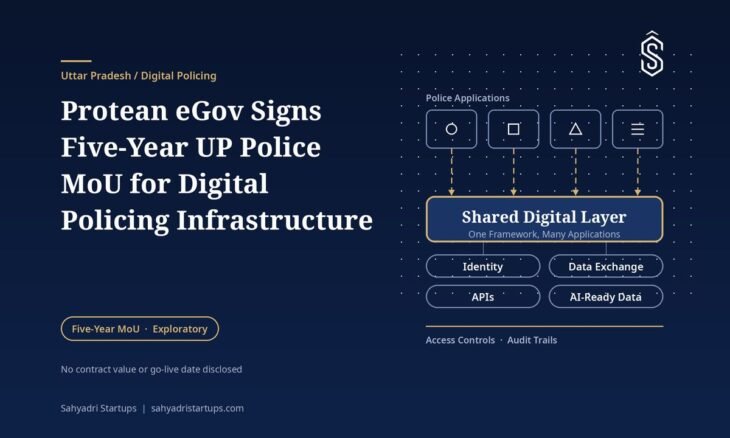
The agreement proposes a common technology framework through which different police applications could exchange information and access shared digital services.
The initiative will focus on reusable infrastructure, rather than building separate technology solutions for individual requirements.
The proposed collaboration comes as Uttar Pradesh already has a statewide digital policing network through the Crime and Criminal Tracking Network and Systems (CCTNS).
Protean’s proposed role centres on exploring additional capabilities in identity management, data integration and analytics readiness.
Protean eGov Technologies has not disclosed the financial value of the agreement, implementation milestones or a timeline for deployment.
Protean proposes common technology framework for UP Police
The collaboration will be explored under Protean’s “DPI in a Box” approach, which uses open interfaces and vendor-neutral standards to develop interoperable digital services.
Under the proposed digital policing infrastructure, identity verification, authentication and data management could be made available as shared services across multiple police applications.
The architecture is expected to use modular components connected through standardised application programming interfaces (APIs).
This would allow new applications to be integrated into the system without requiring major changes to existing operational platforms. The approach also aims to address fragmentation arising from departmental systems operating independently.
A key part of the proposed work will involve examining how different databases can be connected securely.
Protean and UP Police will explore mechanisms to identify duplicate records and establish role-based access controls and audit trails for departmental data.
AI readiness among proposed areas of collaboration
Beyond system integration, the MoU identifies data infrastructure for artificial intelligence applications as another area of exploration.
The proposed digital policing infrastructure could support use cases such as fraud detection, predictive analytics, automation and decision-support systems.
Joint workshops between the two organisations will help identify priority applications and assess opportunities to redesign existing workflows.
How the proposed initiative differs from existing UP Police systems
Uttar Pradesh has already digitised several police services through its existing technology network.
The state’s citizen-services portal provides access to the CCTNS platform for services including verification, permissions, complaints and postmortem reports. Separate online platforms also facilitate traffic challan-related services and fire-service applications.
According to the Union Ministry of Home Affairs, CCTNS had been deployed across all 1,849 Uttar Pradesh police stations listed in its data as of 1 February 2026. The ministry confirmed this in a statement issued on 11 March 2026.
CCTNS supports the digitisation of police processes, including the registration of first information reports (FIRs) and chargesheets, with state-level data replicated at a national data centre.
Protean’s proposed digital policing infrastructure would therefore be an additional area of technology exploration, not a replacement for the existing CCTNS network. The company’s filing does not specify whether a formal integration with CCTNS is planned.
Data governance and security in focus
The proposed collaboration will also examine data protection and consent-management frameworks, alongside security protocols for handling departmental information.
Protean eGov Technologies has indicated that the work will take into account applicable legal requirements, including the Digital Personal Data Protection Act, 2023.
The legislation is being implemented in phases. A November 2025 commencement notification deferred several key provisions relating to data processing, consent, individual rights and organisational obligations for 18 months from publication, placing their scheduled commencement in May 2027.
The Act also provides exemptions under Section 17(1) for processing personal data in connection with the prevention, detection, investigation or prosecution of offences. However, the exemptions do not remove the accountability and reasonable security-safeguard requirements specified under Sections 8(1) and 8(5).
The MoU does not detail how specific police datasets will be handled under the proposed framework or establish the compliance arrangements for individual applications.
Protean brings identity and e-governance experience
Protean eGov Technologies, formerly NSDL e-Governance Infrastructure Limited, has an established presence in India’s digital public infrastructure ecosystem, with services spanning taxation, pensions and identity verification.
Its existing portfolio includes PAN services, the Tax Information Network, central recordkeeping for the National Pension System and Atal Pension Yojana, Aadhaar authentication, electronic Know Your Customer (e-KYC) and eSign.
These capabilities provide the technological background to the proposed collaboration, although the agreement does not confirm the deployment of any specific existing Protean product within UP Police.
Rakesh Ramesh Dosi, Chief Business & Product Officer at Protean, said the collaboration aims to combine shared technology foundations with policing requirements while maintaining governance and accountability.
The immediate focus will be on identifying use cases, exploring the technical architecture and assessing the data infrastructure required for implementation.