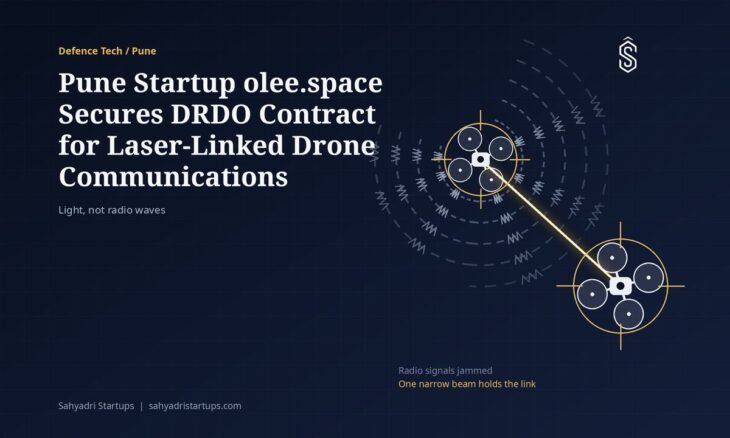
Pune-based photonics startup olee.space has secured a contract from the Defence Research and Development Organisation (DRDO) for a laser-based communication system for drones (laser-linked drone communications), bringing its optical communication technology into a defence development programme.
The development comes after the company spent a year working on laser links for moving platforms, according to co-founder and CEO James Solomon, who announced the contract in a LinkedIn post.
The laser-linked drone communications technology is designed to transmit data through a focused beam of light across open air, eliminating the need for a physical fibre-optic connection between communicating platforms.
The contract builds on olee.space’s work on maintaining optical connections with moving objects, an engineering challenge that requires continuous and precise alignment of the laser beam.
Solomon said the company had tested its fine-pointing system over distance under real atmospheric conditions before securing the contract.
Why DRDO Is Exploring Laser-Linked Drone Communications
Communication reliability is a key consideration in military drone operations, particularly in environments where radio-frequency signals could be disrupted through electronic warfare or jamming.
Laser communication offers a different transmission route by carrying information through optical signals rather than conventional radio frequencies.
It could provide an alternative for applications where radio-frequency interference is a concern, while avoiding the physical restrictions associated with fibre-optic tethered systems.
For drones, however, the technology presents a significant technical challenge. Unlike fixed optical communication installations, an airborne system must maintain an uninterrupted line of sight and keep its laser beam aligned despite movement and changing operating conditions. The fine-pointing capability developed by olee.space is intended to address this requirement.
The technology is also sensitive to the surrounding environment. The company’s published disclosures identify fog, heavy rainfall, dust and atmospheric turbulence among the factors that can affect optical transmission.
Performance also depends on distance, visibility, terrain, alignment and system configuration.
These limitations are common to free-space optical communication. NASA has similarly highlighted the impact of clouds and atmospheric turbulence on laser communication links in its documentation on optical communication infrastructure.
Pune Startup’s Work Beyond Drone Communications
The DRDO contract adds a defence application to olee.space’s broader photonics technology portfolio.
The company works across free-space optical communication, wireless power transmission and directed energy, developing photonic chips, optical control systems and beam-delivery technologies.
Its website reports 11 patent applications covering photonics, optical control and beam delivery.
Rockstud Capital lists olee.space in its investment portfolio, identifying James Solomon as CEO and co-founder and Suman Hiremath as COO and co-founder. IIMA Ventures has also publicly identified the company as part of its portfolio.
The company’s legal disclosures identify olee.space as a brand of Citoto Digital Personality Private Limited, which has its registered office in Baner, Pune.