
San Francisco, CA: Levenza has entered the global enterprise market with its personal AI agent platform, targeting the administrative workload that continues to consume employees’ time despite growing corporate investments in artificial intelligence.
The San Francisco-based company has also acquired voice AI research lab Fluid Inference as it expands beyond text-based workplace assistance.
Announced on November 23, 2026, the global launch builds on a customer base of more than 300 organisations, including Oliver Wyman, Kearney, Goodwin, Baird, Hg Capital and Spencer Stuart.
Levenza says it has reached profitability through customer revenue without raising external capital, while securing multiple million-dollar enterprise contracts.
The company’s proposition is to move AI beyond answering employee queries and towards executing routine workplace responsibilities.
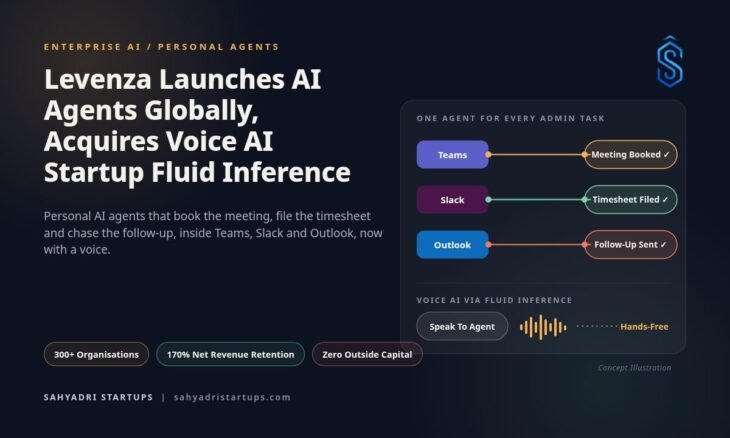
Its agents operate through Microsoft Teams, Slack and Outlook, handling tasks such as meeting coordination, room bookings, timesheet submissions and follow-ups.
They also identify commitments made across meetings, emails and workplace conversations, turning them into tasks that can be tracked and completed in the background.
“People have seen what personal AI agents can do outside work, and they’re expecting the same experience in the office,” said Haefa Mansour, Co-Founder and CEO of Levenza.
“But most people at work are still spending hours every week coordinating schedules, chasing replies and tracking tasks. We built Levenza to take responsibility for that work.”
Levenza’s Enterprise Business Shows Strong Customer Retention
Levenza’s reported customer retention figures offer an indication of how existing enterprise clients are using the platform beyond initial adoption.
The company has a net revenue retention rate of 170% and gross revenue retention of 99%, suggesting expansion in spending among existing customers alongside high revenue retention.
It also claims that more than 95% of professionals using its platform rate it highly, with some users reporting savings of up to three hours a day.
At Goodwin, the platform has been adopted as part of the firm’s existing workplace environment. Dustin Finer, Managing Director of Administration at Goodwin, highlighted its ability to coordinate meetings across calendars and time zones without requiring employees to move to another software platform.
“I’ve used several AI scheduling tools and Levenza stands out, as it’s the first AI scheduling tool that fits how I already work,” said Finer.
“It handles quick one-on-ones and more complex meetings with ease, coordinating across calendars and time zones seamlessly. Plus, Levenza lives in our existing environment, so there was no new platform to adopt.”
The integration with existing workplace applications is central to Levenza’s approach. Rather than asking employees to adopt another standalone AI tool, the company is positioning its agents within the communication and productivity software they already use.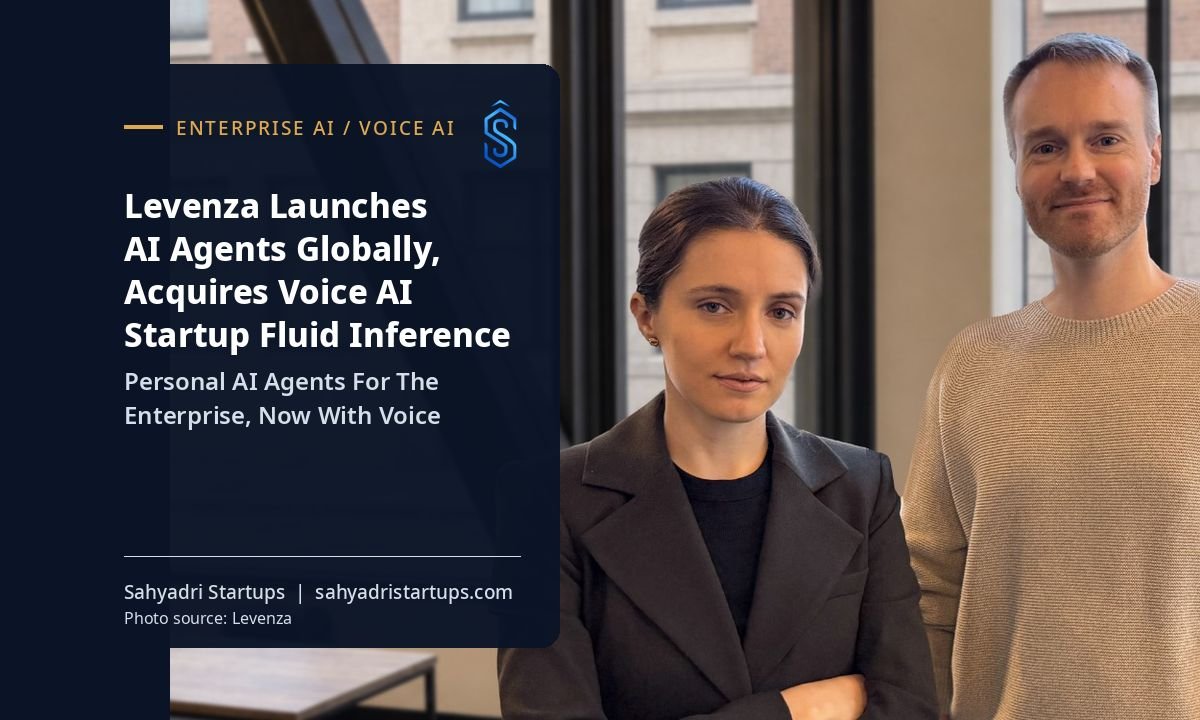
Fluid Inference Acquisition Brings Voice to Levenza’s AI Agents
The acquisition of Fluid Inference, completed in September 2026, is intended to add voice interaction to Levenza’s workplace automation platform.
Fluid Inference specialises in ambient intelligence and develops open-source AI models designed to hear, see, reason and speak. Its projects include FluidAudio, a widely recognised trending project on GitHub.
The company’s speech and system one models have accumulated more than 4.7 million downloads and are used in over 60 applications, including FluidVoice, VoiceInk and Spokenly.
Fluid Inference has also worked with NVIDIA on its Nemotron speech models and collaborated with Intel to bring speech and language models to AI PCs. Its founder, Brandon Weng, has joined Levenza as Head of Engineering.
The acquisition has already translated into product integration. Employees can interact with their agents through voice while commuting, request briefings, respond to urgent emails and rearrange meetings without opening a laptop. The platform also supports direct dictation into other applications.
For Levenza, voice is part of a broader effort to reduce the need for employees to navigate multiple enterprise applications and manually enter instructions.
Why Enterprise AI Agents Are More Complex Than Consumer Assistants
Bringing personal AI agents into corporate environments involves challenges that go beyond the capabilities demonstrated by consumer-facing assistants.
Enterprise workflows often involve multiple calendars, competing priorities, organisational hierarchies, executive assistants and regional differences in how work gets done.
Levenza is addressing these requirements through forward-deployed engineers who work with customers to configure its agents around their internal processes.
For instance, an employee requesting a client meeting through Teams or Slack can have the agent examine available calendars, coordinate with executive assistants, resolve scheduling conflicts and arrange the meeting.
The platform is designed for both employees without dedicated administrative support and executive assistants who manage complex coordination responsibilities.
The company plans to extend these capabilities into travel bookings and expense management in 2027, potentially increasing the range of administrative tasks that can be delegated to its agents.
Bootstrapped Growth and a Push Beyond Scheduling
Founded approximately two and a half years ago, Levenza emerged from Mansour’s experience at Bain, where she observed how much time consultants and executive assistants spent on routine coordination.
Mansour, a PhD graduate from the University of California, Berkeley, co-founded the company with Austin Tackaberry, a former engineer at Databricks and Uber.
The startup has relied on customer revenue rather than venture capital to finance its expansion. Its growth through enterprise referrals and word of mouth has helped it establish a customer base before its broader global launch.
Levenza’s expansion also comes at a time when businesses are reassessing the returns from their AI investments. An October Gartner survey of more than 2,000 CIOs found that only 13% reported significant value from AI initiatives within their organisations.
Meanwhile, Microsoft’s 2025 Work Trend Index reported that employees receive an average of 117 emails daily and face interruptions every two minutes, highlighting the volume of communication and coordination involved in modern workplace operations.
Levenza is targeting this gap by focusing on administrative work, where the company believes AI agents can deliver measurable productivity improvements.
Its longer-term strategy extends beyond scheduling and task management towards a network of agents that can integrate with enterprise systems and take responsibility for broader objectives.