Hyderabad: Cosmoserve Space, an Indian space technology startup focused on Active Debris Removal (ADR) and in-orbit servicing, has inaugurated its Base 1 facility at VSD Tech Park, Gachibowli, Hyderabad.
Spread across approximately 14,800 square feet, the state-of-the-art facility will serve as a centre for designing, building, testing and operating space robots, marking a significant step in the company’s efforts to develop technologies for safer and more sustainable orbital operations.
The inauguration marks an important milestone in Cosmoserve Space’s efforts to advance India’s private space capabilities, particularly in the emerging field of active space debris removal.
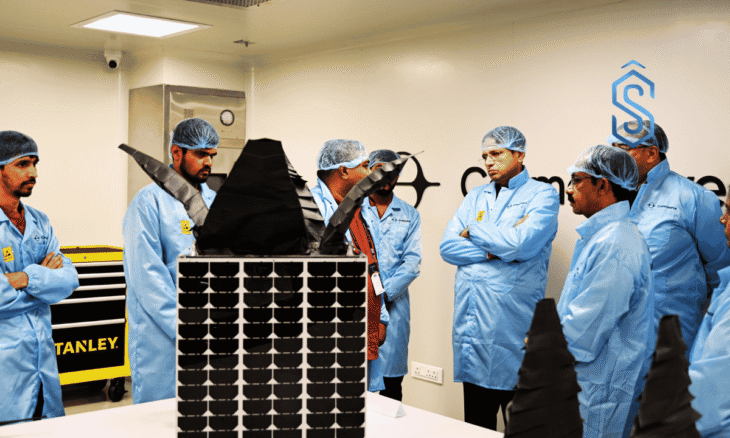
The facility brings together specialised infrastructure for space robotics, orbital rendezvous and capture, microgravity simulation and satellite integration, supporting the development and testing of technologies required for complex in-orbit missions.
The inauguration ceremony was attended by D. Sridhar Babu, Minister for IT and Industries, Government of Telangana, as Guest of Honour, and Dr Chiranjeevi Phanindra, Founder and CEO of Cosmoserve Space.
Dr. Jitendra Singh, Union Minister of State (Independent Charge) for Science & Technology and Earth Sciences, joined the programme virtually as Chief Guest.
Cosmoserve Space’s Base 1 Facility: Infrastructure for Space Robotics and Debris Removal
Located at VSD Tech Park in Gachibowli, Hyderabad, Cosmoserve Space’s Base 1 facility is spread across approximately 14,800 square feet.
It is designed to support multiple stages of space technology development, from the initial design and manufacturing of space robots to testing under simulated space conditions and mission operations through mission control.
The facility houses specialised infrastructure, including orbital rendezvous and capture laboratories, space robotics innovation labs, microgravity simulation platforms and satellite integration clean rooms.
These capabilities will support Cosmoserve Space’s work in Active Debris Removal (ADR) and in-orbit servicing, two areas focused on addressing the growing challenges associated with orbital debris and non-operational satellites.
Through its Base 1 facility, Cosmoserve Space aims to strengthen its technological capabilities for developing spacecraft and robotic systems that can capture and remove orbital debris, contributing to safer and cleaner Earth orbits.
Cosmoserve Space Advances Active Debris Removal Through Mission EMBRACE
A key part of Cosmoserve Space’s technology development is its work on Active Debris Removal (ADR), which involves removing orbital debris and non-operational satellites from space.
The company’s Mission EMBRACE, which conducted an in-space test of soft robotic petals in July 2026, represents an early milestone in its technology development journey.
The test was completed within a year of the company’s formation, demonstrating the progress of its space robotics programme.
The technology is part of Cosmoserve Space’s broader efforts to develop systems capable of capturing objects in orbit and supporting future debris removal and in-orbit servicing missions.
The company is developing proprietary technologies under its ‘Reviver’ and ‘Mothercraft’ spacecraft architecture. The spacecraft duo is designed to combine innovation and operational efficiency to deliver mission-ready solutions for satellite operators and government bodies.
With its technology-first and environmentally conscious approach, Cosmoserve Space is positioning itself in the global space sustainability ecosystem, focusing on solutions that can help protect increasingly crowded Earth orbits.
Cosmoserve Space’s ADR Technology and Commercial Space Services
Cosmoserve Space develops Active Debris Removal technology and provides commercial ADR services to remove orbital debris and non-operational satellites.
Its solutions are designed to advance space sustainability, protect crowded Earth orbits and improve orbital safety for satellite operators, human spaceflight missions and scientific activities.
Under its vision of ‘Capture Anything, Anywhere and Anytime for clean Orbits and Safer Space’, Cosmoserve Space is working towards making debris removal and in-orbit servicing more accessible to satellite operators and other space-sector stakeholders.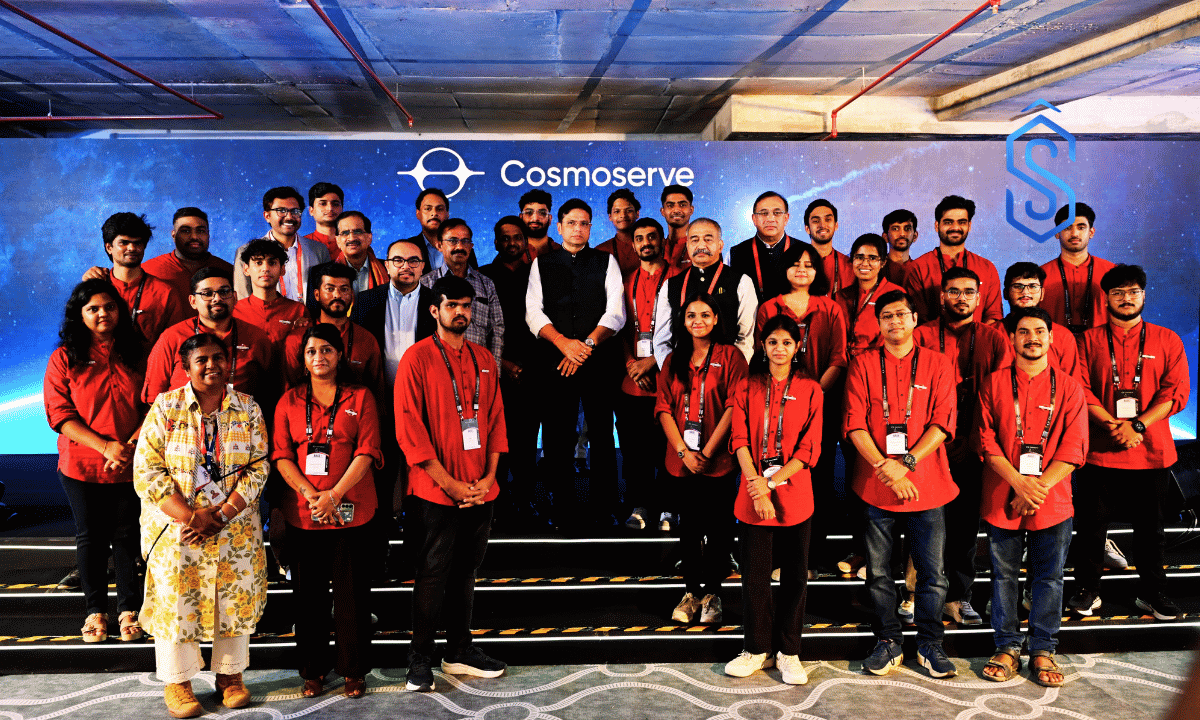
Cosmoserve Space Builds Partnerships Across the Private Space Ecosystem
Cosmoserve Space is also developing an ecosystem of partnerships to support its space missions and technology development.
Its collaborations with Pixxel for satellite systems, Dhruva Aerospace Netherlands for propulsion systems and Skyroot Aerospace for launch services demonstrate its approach towards building integrated space missions through partnerships with other private space companies.
These collaborations bring together different capabilities, including indigenous payloads, battery technologies, satellite systems, propulsion and private launch services.
The partnerships are expected to support the development of end-to-end space missions, combining different components of the private space ecosystem.
Speaking at the inauguration, Dr. Jitendra Singh highlighted these collaborations as an example of the growing culture of integration within India’s private space industry.
He also congratulated Dr. Chiranjeevi Phanindra and the Cosmoserve Space team for their work in active debris removal and in-orbit servicing. He appreciated the team’s experience in ISRO and the Gaganyaan programme being translated into a collaborative model in the private sector.
Announcing a vision of achieving debris-free space by 2030, the Minister said India’s emerging capabilities in active space debris removal reflect the country’s growing global leadership in space technology and its commitment to ensuring a safe space environment for all humanity.
He said Cosmoserve Space‘s initiative embodies the spirit of Vishwa Bandhu Bharat, extending India’s commitment to space sustainability beyond national boundaries to the benefit of humanity.
The Minister congratulated the company for contributing to a cleaner and safer space environment and said such initiatives would strengthen India’s global leadership in space technology and enhance its geopolitical stature.
India’s Space Economy and Startup Ecosystem Expand
Dr. Jitendra Singh also highlighted the growth of India’s space economy and the expansion of its private space startup ecosystem.
According to the Minister, India’s space economy has grown to nearly USD 9 billion and is projected to reach USD 40–45 billion in the coming decade. The country’s space startup ecosystem has also expanded from a single-digit number of enterprises to nearly 450.
He credited the space-sector reforms initiated around five to six years ago, followed by the establishment of NewSpace India Limited and IN-SPACe, for reshaping the country’s space ecosystem.
The Minister said India never lacked scientific talent or technological capabilities; what was needed was an enabling ecosystem to unlock the immense potential of its youth.
He called upon domestic and international investors to participate more actively in the space sector and urged greater philanthropy in science and research to accelerate innovation, strengthen collaborations and support emerging technologies.