

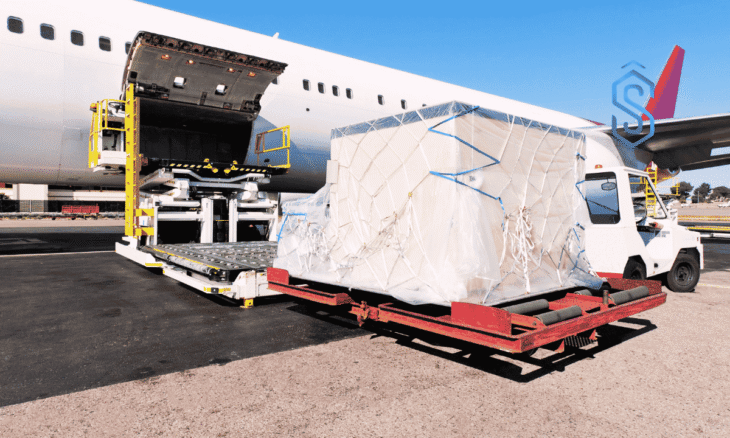
New Delhi: India Air Cargo Market is entering a capacity-led growth phase, with cargo volumes projected to increase from approximately 3.9 million tonnes in FY2026 to 6.9 million tonnes by FY2030, according to Makreo Research’s report, India Air Cargo and Express Logistics Market and Forecast to 2031.
The growth of the India Air Cargo Market is being supported by pharmaceutical and electronics exports, e-commerce shipments, new airport cargo hubs and transshipment reforms.
However, Makreo Research estimates that airport cargo-handling infrastructure operated at just 42.12% capacity utilisation in FY2023–24, highlighting significant unused capacity across the country’s aviation logistics network.
Sustaining this growth will therefore depend on improving infrastructure utilisation, cargo throughput and regional connectivity alongside fresh investments in airport and logistics infrastructure.
India Air Cargo Market Size and Volume Momentum
India is the sixth-largest air cargo market globally. However, air freight accounts for approximately 0.06% of the country’s total freight transport activity, measured in tonne-kilometres.
Despite its limited modal share, the India Air Cargo Market plays a critical role in transporting high-value and time-sensitive goods, including pharmaceuticals, electronics, perishables and express shipments.
According to Makreo Research, India’s air cargo and courier services market registered a revenue CAGR of approximately 1.30% during FY2023–FY2026E.
This revenue-based measure differs from the projected growth in physical cargo volumes, reflecting distinct dimensions of the market’s development.
Northern Region Leads India’s Air Cargo and Courier Services Market
According to Makreo Research, Northern India accounts for approximately 32.32% of the country’s air cargo and courier services market revenue, supported by international freight connectivity, manufacturing clusters and e-commerce demand.
Delhi Airport reinforces this position, handling around 0.63 million tonnes of cargo in H1 FY2027, registering a 12.2% year-on-year increase.
Cargo movement in the India Air Cargo Market remains concentrated at major gateways. According to the International Air Transport Association (IATA), Delhi, Mumbai, Bengaluru and Chennai collectively handled around 80% of India’s air cargo in 2024.
Southern hubs are also expanding their cargo operations. Hyderabad Airport handled approximately 102,000 tonnes in H1 FY2027, an increase of 5.8% year on year, supported by pharmaceutical and other time-sensitive shipments.
This concentration creates opportunities for regional airport development. However, additional infrastructure alone will not guarantee higher throughput.
For airport operators and logistics investors, improving cargo capacity utilisation, regional connectivity and handling efficiency remains essential to capturing demand beyond established metropolitan gateways.
Pharmaceutical Exports Anchor International Air Freight Demand
Pharmaceutical exports are emerging as a major driver of the India Air Cargo Market, with exports exceeding USD 30.5 billion in FY2026.
Pharmaceuticals account for nearly 70% of outbound air cargo shipments, with the United States and Europe serving as the main destination markets.
Hyderabad has become one of the region’s leading gateways for pharmaceutical products and vaccines.
In May 2026, Hyderabad commissioned a second cargo terminal featuring a fully temperature-controlled pharmaceutical zone. The facility has an initial capacity of 50,000 tonnes, with the potential to expand to 100,000 tonnes annually.
The development is expected to support the handling requirements of pharmaceutical and vaccine shipments, which require specialised temperature-controlled logistics infrastructure.
E-Commerce Extends Express Logistics Beyond Metropolitan Cities
India’s domestic air cargo volumes approached 1.5 million tonnes in FY2026, while Tier-II and Tier-III cities accounted for over 45% of online shopping demand. This is increasing the need for regional cargo connectivity and integrated air-road logistics networks.
International express logistics in the India Air Cargo Market remains export-oriented, with exports accounting for approximately 75–80% of shipments.
By FY2026, daily export consignments reached around 45,000–48,000, compared with approximately 12,000 import consignments.
Makreo Research estimates that technology-driven air freight and multimodal networks serving smaller cities could grow by over 20% annually.
The performance of logistics operators also reflects the broader momentum in express logistics.
Delhivery handled 325 million express parcels in Q2 FY2027, registering a 32% year-on-year increase. Meanwhile, Blue Dart reported 15% revenue growth and an 85% increase in profit after tax in Q1 FY2027.
New Airport Hubs and Logistics Investments Expand Air Cargo Capacity
The expansion of airport infrastructure and logistics facilities is expected to support the next phase of growth in the India Air Cargo Market.
India requires over USD 170 billion in aviation investment through 2030, including USD 24 billion for airport expansion and USD 150 billion for aircraft orders.
Additionally, approximately ₹25,000 crore is expected to be invested in airport cargo infrastructure over the next five to seven years.
Key airport and company developments shaping India’s air cargo infrastructure include:
Noida International Airport: The airport began operations in June 2026, with an initial annual cargo-handling capacity of 200,000 tonnes. This capacity can be expanded to 1.5 million tonnes.
Navi Mumbai International Airport: The airport handled 11,853 tonnes of cargo during January–September 2026, including 6,477 tonnes of international freight.
FedEx: The company is developing a 300,000 sq ft automated hub at Navi Mumbai, backed by over ₹2,500 crore in long-term investment. This is alongside a USD 150 million facility in Delhi designed to increase processing capacity from 600 to 5,000 packages per hour.
Blue Dart Express: The company opened a 250,000 sq ft multimodal logistics hub in Delhi in January 2025. The facility is capable of handling approximately 550,000 shipments daily.
UPS SCS India: In June 2025, the company nearly doubled its Delhi–Cologne air cargo capacity by deploying a Boeing 747-8 freighter, strengthening air cargo connectivity between India and Europe.
These developments highlight the growing role of airport expansion, automated cargo facilities and multimodal logistics networks in supporting the India Air Cargo Market.
India Air Cargo and Express Logistics Market Outlook to 2031
The next phase of growth in the India Air Cargo Market will depend on converting infrastructure expansion into higher cargo throughput.
Airports are expected to prioritise capacity utilisation and regional connectivity, while express integrators and freight forwarders focus on transshipment efficiency, automation and multimodal networks.
Pharmaceutical and electronics exporters will continue to drive demand for specialised cargo facilities and reliable international connectivity.
According to Makreo Research, its report, India Air Cargo and Express Logistics Market and Forecast to 2031, provides an in-depth assessment of market size, cargo volumes, regional opportunities, infrastructure developments and the competitive landscape.
Organisations evaluating market entry, network expansion or investment opportunities can also leverage Makreo’s primary research and customised consulting services.
These include shipper surveys, route-level demand assessments, competitive benchmarking and airport cargo infrastructure feasibility studies.
Companies Covered in the India Air Cargo and Express Logistics Market
The study covers a total of 12 companies operating in India’s air cargo and express logistics market.
Some of the key companies covered include:
- Blue Dart Express Limited
- DHL Express (India) Private Limited
- FedEx (India) Private Limited
- UPS SCS (India) Private Limited