
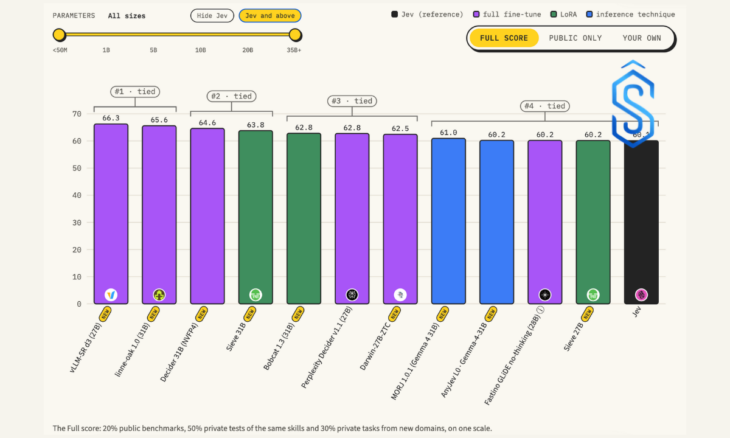
Hyderabad: Sthānika, the applied AI research lab of the PurpleTalk group, has announced that its Sieve 31B model has ranked second globally on the Jev Decision Index, an open benchmark hosted on Hugging Face for AI models designed to make rapid decisions.
Sthānika’s decision model ranked ahead of Jev and Perplexity Decider v1.1.
Sthānika’s Sieve 31B recorded a Full score of 63.8, combining the public test suite with private tests conducted by the benchmark’s maintainers.
On the public tests, the model ranked second with a Full score of 62.5.
Sthānika’s Sieve 31B Targets AI Decision-Making
Sthānika’s Sieve 31B is a cost-efficient decision model designed to operate as one component within a larger AI system.
The model is built to make decisions more reliably than general-purpose large language models for defined decision-making tasks.
Many AI agents currently send every task to an LLM, including planning and routine decisions that can be handled by a dedicated decision model at a lower cost.
As AI agents take on more tasks previously performed by people, the associated cost can increase.
General-purpose LLMs are tuned to converse with people, making them well suited for language-related tasks but expensive for choosing between defined options thousands of times a day.
In comparison, Sthānika’s decision model is designed to provide an extremely inexpensive option for such tasks.
Sieve Family Models Rank Among Top Models
The wider Sieve family from Sthānika includes Sieve 2B Plus, Sieve 4B and Sieve 9B Plus, with each model placed among the top performers in its respective size class on the same leaderboard.
Sthānika said developers can run smaller Sieve models independently on their own on-premise GPUs for everyday tasks that require privacy and involve large volumes of work.
Developers can also move to larger and more powerful models when tasks require more advanced capabilities.
Sthānika Focuses on Decision Intelligence
Most AI applications are associated with models that write, summarise and converse.
Sthānika’s Sieve family focuses on a less visible but important part of AI-powered software: making small decisions thousands of times a day.
Sieve is built specifically for decision-making. It reads the question and available choices as presented and returns a defined answer along with a confidence score that software can inspect and act on.
According to Sthānika, this makes the model suitable for applications where consistency, speed and the ability to audit individual decisions are as important as accuracy.
“Sieve 31B shows that a focused model fine-tuned in India can perform among the best in the world at this work. The private tests matter most to us.
They come from domains outside the public suite, and Sieve generalised better than most of the field. It learned the task, not the test.” said Sridhar Muppidi, co-founder of PurpleTalk.
Sthānika Builds on Compact Decision Models
Sieve builds on Sthānika’s earlier work on compact, confidence-aware decision models.
These models already run inside PurpleTalk products, including Ello and Mina, where they handle routine judgements faster and more economically than general-purpose generative models.
The lab also expects to create a new category of agentic systems with higher reliability, more granular control and low latency for applications such as voice, customer experience and robotics.
“We believe decision models will open up a new category of agentic systems: more reliable, more controllable and fast enough for voice, customer experience and robotics.
We are publishing everything needed to reproduce our results, and we invite the research community to test it, challenge it and build on it,” said Bharat Lingam, CEO & co-founder, PurpleTalk.
Sthānika is an Indian applied AI research and engineering lab that builds and evaluates open models for real-world use.
Its work centres on efficient inference, calibrated decision intelligence and India-relevant AI.
Also Read: Genrobotics Secures ISRO’s U R Rao Satellite Centre Project for Satellite Boom Arm System