
New Delhi: Bharat Innovates 2026 was jointly inaugurated by Prime Minister of India Narendra Modi and President of the French Republic Emmanuel Macron at the Palais des Expositions in Nice, France, marking the launch of a major initiative aimed at strengthening innovation-led partnerships between India and Europe.
Implemented by the Ministry of Education under the Government of India, the event serves as a premier platform for connecting India’s deep-tech innovators with global investors, academia, industry leaders, and policymakers.
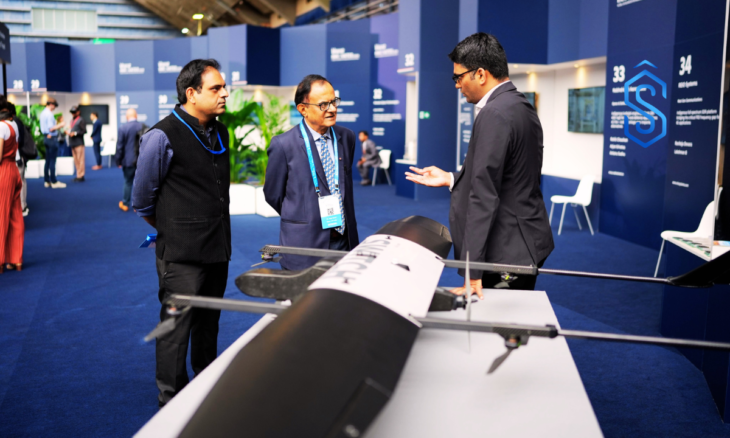
The inaugural edition of Bharat Innovates 2026 brings together more than 120 Indian innovators, over 15 higher education institutions, and upwards of 500 global stakeholders, including CEOs, venture capital firms, industry leaders, and research organizations.
The event showcases India’s expanding deep-tech ecosystem across 13 strategic sectors such as advanced computing, semiconductors, space technology, biotechnology, energy, healthcare, and manufacturing.
Designed to accelerate innovation-led collaboration, Bharat Innovates 2026 provides an international platform for fostering partnerships that can drive technology commercialization, research cooperation, and startup growth between India and global ecosystems.
The first day of the event featured keynote addresses, strategic dialogues, and industry discussions focused on strengthening international innovation corridors and expanding deep-tech collaboration.
Delivering the opening keynote, Infosys Founder N. R. Narayana Murthy emphasized the importance of academic institutions in nurturing globally competitive technology enterprises.
Reflecting on the journey of Infosys from an idea built with USD 250 into a globally respected technology company, he said enduring enterprises are created through complementary talent, shared values, disciplined innovation, transparent governance, and trust.
He further highlighted that higher education and research institutions play a critical role in developing value-driven founders and technology leaders capable of transforming knowledge into innovation, innovation into enterprise, and enterprise into long-term societal impact.
One of the major highlights of Bharat Innovates 2026 was the signing of more than 30 partnerships, including innovation-focused Memorandums of Understanding (MoUs) and joint declarations intended to strengthen collaboration between Indian and global innovation ecosystems.
Among these were 12 agreements between Indian higher education institutions and incubators with French and global incubators to promote entrepreneurship, research collaboration, innovation, and startup support.
In addition, 16 agreements were signed with leading global corporations to facilitate technology development, commercialization, and market access opportunities for Indian innovators.
Further strengthening educational cooperation, 13 French universities entered partnership agreements with 11 Indian Institutes of Technology (IITs) and the Indian Institute of Science (IISc).
These collaborations focus on student exchanges, joint research initiatives, innovation support, academic cooperation, and talent development.
Another significant initiative announced during the event was the India-France ATL Bridge, established by Atal Innovation Mission, NITI Aayog, and La Foundation Dassault Systèmes.
The initiative will extend India’s Atal Tinkering Lab framework to France by establishing the country’s first School Innovation Lab while enabling collaboration among young innovators from both nations.
A panel discussion titled “AI for Global Good: Building a Corridor for Trusted, Inclusive and Scalable AI” brought together experts from industry, investment, and research institutions to examine collaborative approaches for responsible artificial intelligence development and sovereign technology capabilities.
The discussions were followed by sessions on “India and Europe: Deep Tech Without Borders” and “Global Deep-Tech Capital Corridors,” where participants explored cross-border innovation ecosystems, venture financing, commercialization strategies, and pathways for expanding global market access for emerging technologies.
During the Bharat Innovates 2026 plenary session on “AI for Global Good,” policy makers and industry leaders from India and France advocated for building a trusted, inclusive, and scalable AI corridor.
The discussions highlighted India’s strengths in developing affordable and localized AI solutions, emphasized the growing significance of sovereign AI capabilities, and underlined the importance of open-source collaboration instead of technological monopolies.
Speakers also stressed the need for joint research and development initiatives, investment partnerships, and broader international cooperation to establish a resilient and globally competitive artificial intelligence ecosystem.
With high-level participation from governments, industry, academia, investors, and innovators, Day One of Bharat Innovates 2026 laid the foundation for deeper international engagement and expanded collaboration across the global innovation landscape.