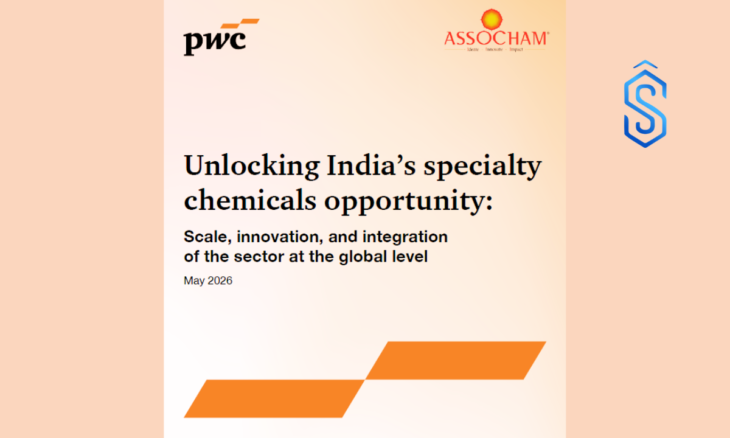
Pune: India’s specialty chemicals sector is poised for significant expansion as the global market is projected to grow from approximately $800 billion in 2025 to nearly $1.05 trillion by 2030, according to a joint report released by PwC India and ASSOCHAM titled “Unlocking India’s Specialty Chemicals Opportunity: Scale, Innovation, and Integration at the Global Level.”
The report highlights that the specialty chemicals industry is entering a new phase of accelerated growth, creating a strategic opportunity for India to strengthen its position as a global manufacturing and innovation hub.
As the country advances toward its Viksit Bharat 2047 vision, the report outlines several priorities that could help India capture a larger share of the global specialty chemicals market.
According to the report, India’s specialty chemicals industry stands to benefit from ongoing global supply chain diversification, growing demand for sustainable products, and increasing investments in advanced manufacturing capabilities.
The report notes that the global landscape is being reshaped by supply chain rebalancing, capital reallocation from commodity chemicals to specialty segments, ESG-led regulatory frameworks, and geopolitical shifts that are altering sourcing strategies worldwide.
To capitalize on these trends, the report recommends accelerating innovation across the specialty chemicals ecosystem through platform-based strategies, green chemistry initiatives, and AI-led digital transformation.
It emphasizes that innovation will be critical for enabling Indian companies to move beyond cost competitiveness and establish leadership in high-value chemical segments.
The report also stresses the importance of strengthening supply chains, chemical clusters, logistics infrastructure, and manufacturing capabilities.
While India has established integrated chemical clusters such as Dahej, Paradeep, and Visakhapatnam-Kakinada, the report suggests that greater implementation efficiency and deeper integration are necessary to match leading global chemical hubs.
Key Takeaways:
- Global Specialty Chemicals Market to Reach $1.05 Trillion
- India Currently Accounts for About $40 Billion of the Global Market
- Indian Specialty Chemical Companies Have Been Growing at 15–20% Annually
- India’s R&D Spending Remains Below Global Benchmarks
- India Produces Around 15 Lakh Engineering Graduates Every Year
- Semiconductor Investments in India Have Reached ₹1.59 Lakh Crore+
- Battery Chemicals Sector Backed by ₹40,000 Crore Investments
- More Than 200 Common Effluent Treatment Plants Support the Sector
- Advanced Chemistry Cell (ACC) PLI Scheme Worth ₹18,100 Crore
Also Read: ICL Group Expands India Presence with New Specialty Fertilizer Plant in Maharashtra
A major focus area identified for the specialty chemicals sector is sustainability. The report calls for increased investment in green chemistry, bio-based research and development, circular product portfolios, and ESG-aligned manufacturing practices.
It notes that sustainability is increasingly becoming a commercial differentiator, with global customers evaluating suppliers on factors such as emissions, waste management, water stewardship, and process safety.
The study further highlights the need for India to move up the value chain by focusing on high-growth and high-value specialty chemicals segments.
These include electronic chemicals, battery materials, pharmaceutical intermediates, agrochemical specialties, green and bio-based chemicals, and other advanced materials that offer stronger margins and long-term growth potential.
Another key recommendation is the development of stronger industry-academia collaboration and intellectual property ecosystems.
The report notes that India’s chemical talent pool remains underutilized and that enhanced cooperation between research institutions and industry can help accelerate commercialization, innovation, and the creation of proprietary technologies.
The report also underscores the need for greater consolidation and capital investment within the specialty chemicals sector.
Facts:
- ₹76,000 crore allocated under the India Semiconductor Mission (ISM) to boost semiconductor manufacturing and chemical localization.
- ₹15,000 crore Pharma PLI scheme supporting high-value pharmaceutical manufacturing.
- ₹6,940 crore Bulk Drug PLI scheme supporting APIs and key starting materials.
- India’s cost advantage is driven by significantly lower labour and land costs compared with Europe and North America.
According to PwC India and ASSOCHAM, scaling up through mergers and acquisitions, strategic investments, and stronger domestic champions will be essential for building globally competitive and export-oriented enterprises capable of serving international markets.
With India currently accounting for approximately $40 billion of the global specialty chemicals market, the report states that the coming decade will be crucial in determining whether the country can transition from an emerging contender to a global leader.
Achieving this ambition will require coordinated efforts across innovation, sustainability, infrastructure, research and development, exports, and ecosystem development.
The report concludes that India possesses the necessary talent, market demand, entrepreneurial capabilities, and manufacturing strengths to emerge as a leading global specialty chemicals hub.
However, realizing this opportunity will depend on sustained investments, policy support, deeper R&D intensity, and stronger collaboration among government, industry, academia, and investors.