
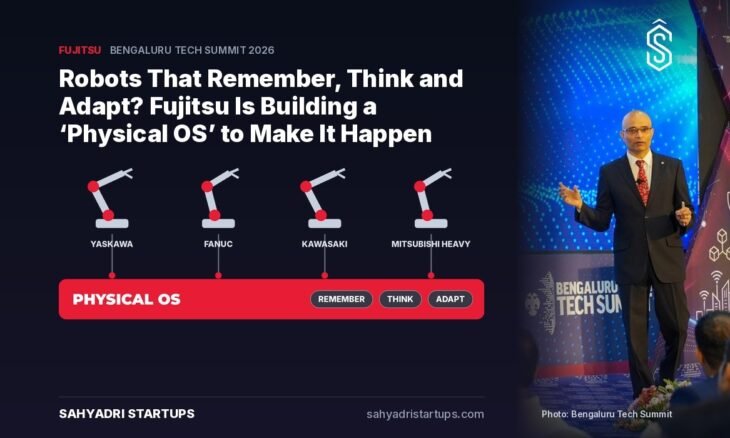
Bengaluru: Fujitsu’s Physical OS is being developed to help industrial robots communicate, coordinate and operate seamlessly across factory environments, with the company’s Bengaluru research team playing a key role in building the underlying AI software, Chief Technology Officer Vivek Mahajan said at the Bengaluru Tech Summit 2026.
The Japanese technology major, Fujitsu Limited, is not looking to manufacture robots. Instead, it is developing the software infrastructure that enables robots made by different manufacturers to work together, adapt to changing environments and perform industrial tasks more efficiently.
Mahajan identified Japanese robotics manufacturers Yaskawa, Fanuc, Kawasaki Heavy Industries and Mitsubishi Heavy Industries as examples of companies whose machines Fujitsu’s software is designed to support.
Mahajan, who serves as Fujitsu’s Chief Technology Officer (CTO) and head of its platform business, said the company is developing what it calls a Physical OS, an operating system-like software layer designed to enable robots to interact and function in industrial environments.
The Physical OS initiative focuses on three key technological areas: robot memory, spatial intelligence and world models.
These capabilities are intended to help robots understand their surroundings, retain relevant information and continue operating in changing factory environments without requiring retraining from scratch.
Mahajan said the objective is to make robots sufficiently capable and efficient to perform tasks in real-world industrial settings. A trained robot is no good if a human being can do the same task faster, he said.
Fujitsu Discussed Physical OS Go-to-Market Strategy With NVIDIA
Fujitsu’s commercial approach to its Physical OS and robotics software initiative was shaped through discussions with US-based chipmaker NVIDIA.
Mahajan said the two companies discussed how the technology would be taken to market, with former NVIDIA CEO Jensen Huang also involved in the discussions.
“This is something that we actually talked directly with NVIDIA. Jensen was there with us when we kind of agreed that this is how we are going to go to market on this.”
Beyond NVIDIA, Fujitsu is also working with Qualcomm and robotics manufacturers as part of its broader robotics technology initiative.
The company’s approach is centred on enabling robots from different manufacturers to operate through a common software infrastructure rather than developing proprietary machines of its own.
Fujitsu Is Deploying Physical OS Technology in Its Own Factories
Fujitsu is already deploying its robotics technology in its own manufacturing facilities, particularly in transportation and logistics operations.
Mahajan said the company is using robots for these applications and integrating them with its broader software infrastructure.
A part of the robot demonstration showcased at Fujitsu’s Bengaluru Tech Summit booth was developed locally in Bengaluru.
According to Mahajan, the demonstration component connects with the technology stack that Fujitsu deploys across its global operations.
Fujitsu Research of India Has Around 400 Researchers
Fujitsu Research of India, the company’s research and development arm in Bengaluru, has approximately 400 researchers, many of whom hold PhDs.
Mahajan said the research centre was established around five years ago because of the value of research capabilities available in India, rather than simply to benefit from lower operating costs.
He emphasised that the Bengaluru team contributes to Fujitsu’s wider AI software development initiatives, including technologies that support enterprise AI, robotics and other advanced computing applications.
Fujitsu’s AI Platform Focuses on Three Key Areas
Apart from Physical OS and robotics, Fujitsu’s AI platform strategy is built around three major areas, Mahajan said.
1. Multi-AI-agent framework
The first area involves developing a multi-AI-agent framework designed to improve the accuracy and speed of enterprise AI agents.
The framework is aimed at making AI agents more effective in handling enterprise applications and business workflows.
2. Takane enterprise AI model
The second area is Takane, Fujitsu’s enterprise AI model, designed for organisations that cannot move their data to cloud environments.
Mahajan cited a defence manufacturer involved in submarine production as an example of the type of customer that requires such capabilities.
3. High-accuracy computer vision
The third area is high-accuracy computer vision.
Mahajan said a US-based aircraft manufacturer is looking to deploy this technology, highlighting its potential applications in industrial and manufacturing environments.
These three areas form the foundation of Fujitsu’s broader AI platform strategy, alongside its work on Physical OS and industrial robotics.
Fujitsu Builds AI Security Guardrails With Teams in India, Israel and Japan
AI security is another important area of Fujitsu’s technology development.
Mahajan said the company is building AI guardrails and scanners through teams based in Israel, India and Japan.
He noted that although cutting-edge AI models are becoming increasingly resistant to attacks, they remain vulnerable to data extraction.
Fujitsu’s work in this area focuses on developing security mechanisms to protect AI systems and address vulnerabilities associated with enterprise AI deployments.
On networking, Mahajan said Fujitsu builds hardware in Japan while the software stack is developed in India.