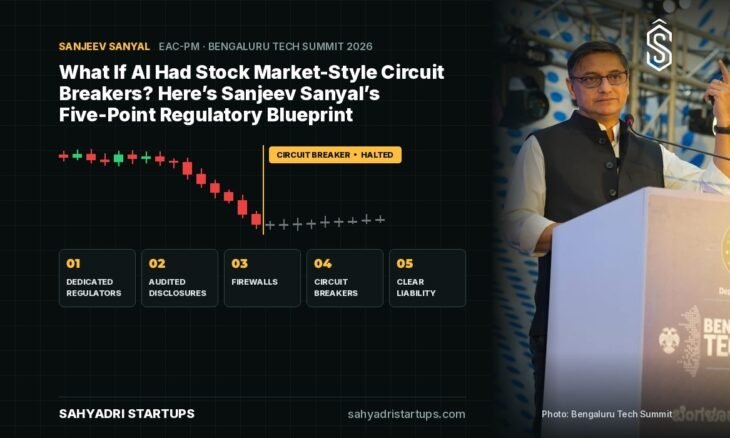
Bengaluru: Sanjeev Sanyal, Member of the Economic Advisory Council to the Prime Minister, called for artificial intelligence to be governed the way financial markets are: through dedicated regulators, audited disclosures, firewalls between conflicting activities, circuit breakers and clearly assigned liability, rather than through attempts to predict how the technology will behave.
Addressing a session titled “India AI story: building from India and scaling for the world” on November 17 at the Bengaluru Tech Summit 2026, Sanjeev Sanyal described AI as a “complex adaptive system”: non-linear, internally interlinked and self-evolving, with feedback loops and what he called butterfly effects.
Regulation built on prediction will fail, he argued, because even experts cannot foresee how such systems evolve.
Sanjeev Sanyal said no country has yet produced a satisfactory regulatory model.
He characterised the United States as deliberately hands-off, with the federal government discouraging state-level AI laws.
Its tort system punishes failure after the fact, he said, but for AI it is unclear who should be held responsible: the user, the algorithm developer, or the provider of flawed training data.
The United Kingdom’s sector-by-sector approach, he said, works only if AI stays compartmentalised, and fails if a general system cuts across sectors.
The European Union’s centralised, risk-based model assumes officials can grade risk correctly, he argued, even though in such a system a low-risk component can become a single point of failure.
China’s state-led model has the strongest explainability requirements, he said, but the state risks being overwhelmed with information and losing understanding as systems scale.
In place of prediction, Sanjeev Sanyal proposed five principles.
Partitions over integration
AI should be segregated into specialised systems rather than built as one integrated general-purpose technology, which he said “may not be a good idea at all”.
Separation should apply regardless of perceived risk, he argued, accepting lower efficiency in exchange for resilience against system-wide breakdown.
Human override
Systems should have manual overrides and switch-off choke points with multi-layer authentication, so that “human is always in the loop”.
Traceability and audit
Developers should be required to support debugging and tracing, with regular audits and continuous oversight.
Accountability fixed in advance
Responsibility should be assigned before harm occurs, not argued over afterwards, he said, so that someone has “skin in the game”. He pointed to product liability as a model, while acknowledging that deciding who is responsible for AI remains difficult.
Regulator design
Governments must choose between a single unified regulator, as in the European Union, and decentralised sector regulators, as in the United Kingdom.
Financial markets, Sanjeev Sanyal said, show that governing an unpredictable system is possible.
No regulator can predict the Sensex, yet markets run under dedicated regulators, mandatory audited disclosures, firewalls and Chinese walls between conflicting businesses, circuit breakers that act as kill switches, and clear board-level liability.
“There is no reason for us to basically reinvent the wheel,” he said.
On India, Sanjeev Sanyal said the approach is evolving in “bits and pieces”, with sector regulators such as SEBI and RBI overseeing their domains and frameworks such as sandboxes and the DEPA data-sharing architecture in use.
“We don’t claim to have created a solution to all of this,” he said.