

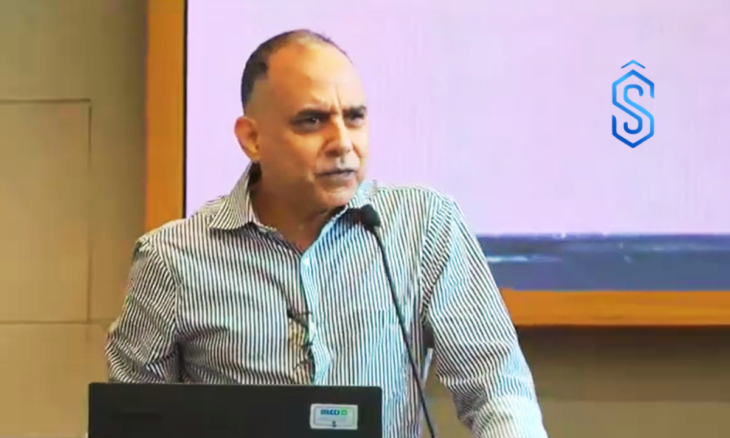
Pune: The need for a Mumbai-Pune deep-tech fund, stronger semiconductor infrastructure and a focused state semiconductor policy was highlighted by Jitendra Chaddah, Senior Executive and Strategic Advisor and former xMD/VP/COO of Semicon Enterprises, at the MCCIA Semiconductor Ecosystem Conference 2026.
Speaking at the event, Chaddah said Maharashtra currently contributes around 14% of India’s GDP, compared with approximately 15% a few years ago, even as the state’s absolute economic output continues to increase.
“If we don’t play with the similar rigor that some of the other states are, I think this 14% will become 12% of the economy,” he said. He noted that emerging industries such as semiconductors are attracting investments in other states, increasing the need for Maharashtra to strengthen its position.
Mumbai-Pune Deep-Tech Fund for Semiconductor Ecosystem
Chaddah called for a Mumbai-Pune deep-tech fund involving investors and stakeholders from the region, along with stronger semiconductor-related infrastructure such as clean rooms.
Maharashtra needs a semiconductor policy that goes beyond simply attracting investments into the sector.
The policy, he said, should focus on how semiconductor and deep-tech development can contribute to Maharashtra’s broader economic objective of reaching a trillion-dollar economy.
The proposed Mumbai-Pune deep-tech fund would form part of a broader ecosystem approach, alongside semiconductor infrastructure and policy measures designed to strengthen the state’s participation in the sector.
Prashant Girbane, Director General, MCCIA; Sanjeev Keskar, Convenor, SEC 2026; Ajay Shrivastava, Jurisdictional Director, STPI Maharashtra & Goa; Ajit Chigteri Group Lead, SEDG were present for the MCCIA Semiconductor Ecosysytem Conference 2026.
Also Read: BigEndian Semiconductors Gets ₹130 Crore RDI Support for Indigenous AI Vision SoC
India’s Semiconductor Market Growth Accelerates
Chaddah also discussed the rapid expansion of the global semiconductor industry and its implications for the India semiconductor industry.
In 2024, the global semiconductor market was projected at around $600 billion-$650 billion, with expectations that it would reach $1 trillion by 2030. Today at the end of 2026 it would be a $1.5 trillion dollar economy.”
Chaddah attributed much of the accelerated global growth to data centres, artificial intelligence, compute requirements and high-bandwidth memory.
“Some people say AI, but you know how much of compute is required on the data-centre side and how much of high-bandwidth memory is required. So the demand is so high that the capacity is so low that the prices have gone up — a little bit of inflation effect, a little bit of geopolitical effect, all of that together. So all the predictions that we have been doing over the last two-three years have gone wrong,” Chaddah stated.
Global Semiconductor Ecosystem: India’s Share Needs to Expand
Chaddah noted that India’s share of the global semiconductor ecosystem was around 5% to 6% in 2024. Earlier projections had suggested that India could reach a $100 billion-$120 billion market and account for 10% of the global semiconductor industry by 2030 if the overall market reached $1 trillion.
However, with the global semiconductor market now projected to reach $1.5 trillion by 2026, Chaddah said India could remain at around 5% of the industry by 2030 if the current growth trajectory continues.
He said the reason is that India is not yet participating fully in the high-end hyperscale growth that is driving the expansion of the global semiconductor ecosystem.
“If we do whatever we are doing today, all the investments, all the investment incentives and so on, we would not be participating in the growth that is taking the industry from 1 trillion to 1.5 trillion. So we will still be at the growth levels that are not growing as fast as the hyperscale growth that we are seeing today.”
Semiconductor Infrastructure and Advanced Packaging
Chaddah highlighted several technology trends shaping the India semiconductor industry and the broader global semiconductor ecosystem.
He pointed to growing physics limitations in transistor scaling as well as challenges associated with data transfer inside data centres using traditional electron-based technologies.
“There’s a limitation on the data centre: if you use the current technology of electrons transferring the data, it is becoming slow. So we are able to send the data faster into the cloud, but we are not able to compute or transfer the data within the cloud, within the servers, faster — and there’s a choke happening.”
Against this backdrop, Chaddah pointed to the need for light-based or photonic approaches inside data centres. He also highlighted the growing importance of advanced packaging technologies, including 3D and 2.5D packaging.
These technology shifts are becoming important as the semiconductor industry addresses increasing requirements for computing, data movement and high-bandwidth applications.
Hyperscalers Increasingly Design Their Own Chips
On the business side, Chaddah observed that hyperscalers and large technology companies are increasingly designing their own chips rather than waiting for the wider semiconductor industry to advance.
Chaddah also noted that business houses globally, including in India, are entering the high-capex semiconductor sector for the first time, attracted by the prospect of two decades of strong growth.
At the same time, he said the semiconductor ecosystem is increasingly being used as a strategic and economic tool by countries.
Semiconductor Industry Needs Wider Talent Pool
Addressing talent requirements for the India semiconductor industry, Chaddah said the sector would require professionals from a much broader range of disciplines than electronics, electrical and computer science.
“Actually if you look at the amount of chemical engineers, amount of metallurgical engineers, amount of other streams of engineering that we will require — higher — apart from electronics and electrical… you will be surprised that 30 to 40% of that industry will demand people from those streams, from supply-chain backgrounds, from financial backgrounds and so on and so forth. So if we have to prepare our talent, it cannot be only in the electronics and electrical space,” Chaddah noted.
According to Chaddah, preparing the workforce for the semiconductor industry will therefore require participation from chemical engineering, metallurgy, supply chain, finance and other fields.
Electronics End-Product Market Offers Larger Opportunity
Chaddah also urged a broader perspective on the electronics and semiconductor value chain beyond fabs and packaging.
He highlighted five broad areas of the electronics ecosystem and said that the highest value addition and gross margins often come from design and intellectual property ownership, as well as end products with strong brands.
Chaddah noted that the broader electronics end-product industry, covering areas such as systems integration and final assembly, is typically around three times the size of the semiconductor industry and already exceeds $5 trillion.