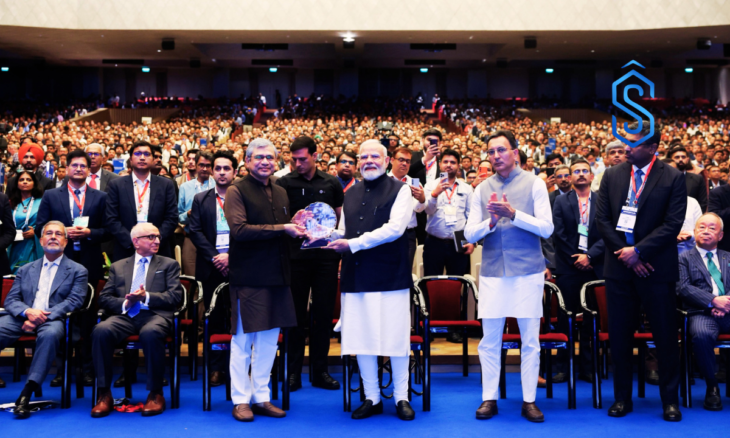
New Delhi: Prime Minister Narendra Modi today inaugurated SEMICON India 2026 in New Delhi, highlighting India’s rapidly expanding semiconductor ecosystem and the opportunities it is creating for innovation, investment and growth.
Drawing a powerful parallel between the launch of SEMICON India and Vishwakarma Diwas, the Prime Minister highlighted the nation’s centuries-old heritage of construction and creation.
India’s Economy and Global Trust Are Growing
Prime Minister Modi listed several major milestones, including discussions on inclusive finance at the Global Fintech Fest, the operationalisation of a 3,000-kilometre Dedicated Freight Corridor and a robust 7.8 percent quarterly GDP growth.
At SEMICON India 2026, the Prime Minister also highlighted the recent sovereign rating upgrade by a Japanese Credit Rating Agency as a testament to India’s growing economic credibility.
“Meaning, on one hand, India’s economy is growing, and on the other hand, the world’s trust in India is also increasing,” observed PM Modi.
SEMICON India 2026: From Semiconductor Policy to Commercial Production
Tracing the evolutionary journey of Semicon India since its inception in 2022, Prime Minister Modi mapped the progression from initial policy discussions to project planning, pilot lines and, finally, the commencement of commercial production.
At SEMICON India 2026, he celebrated the realisation of these efforts, noting that chips manufactured in India are now reaching global customers. He also highlighted the launch of commercial production in two new plants in Mohali and Surat.
“Now our chips, coming out of India’s plants, have started reaching customers in the country and the world,” noted PM Modi.
$13.5 Billion Second Phase of Semiconductor Mission
Outlining the sector’s continuing momentum, Prime Minister Modi explained the concept of ‘tape out’ and how the government is continuously pushing towards the next technological version without a pause.
During SEMICON India 2026, he announced the massive $13.5 billion second phase of the Semiconductor Mission and highlighted new regulatory reforms aimed at facilitating collaborations between international companies, startups and design firms.
“The Government of India is taking every step needed for the success of your projects,” affirmed PM Modi.
The Prime Minister also detailed the vision for building a robust domestic semiconductor supply chain. He stressed the importance of nurturing fabless companies, creating intellectual property and integrating silicon photonics for AI-enabling infrastructure.
He urged industry leaders in equipment, chemicals, gases and materials to capitalise on the opportunities presented by the 12 approved projects and an expanding demand pipeline.
Also Read: Semiconductors – India Report: Tessolve, ILJIN Lead India’s $1.4B Semiconductor Funding
India’s Engineering Talent Pool
Prime Minister Modi mentioned receiving custom-designed chips from students and reiterated the government’s ambitious target of training one lakh engineering students. According to the Prime Minister, 70,000 students have already been trained.
“Such a large talent pool is, in a way, nothing less than a gold mine for all of you,” he remarked.
Calling upon young researchers working both in India and abroad, Prime Minister Modi urged them to actively participate in developing advanced technologies in the country.
“Young talents who are researching in India should come forward; The youth who are researching abroad should also join the development of advanced technologies in India,” he said.
The Prime Minister also called upon industry leaders to spearhead research and development in the country, saying that this would benefit both businesses and India’s youth.
SEMICON India 2026: AI Demand and the Changing Semiconductor Landscape
Addressing the evolving complexities of the semiconductor market, Prime Minister Modi discussed how the explosive demand for Artificial Intelligence is changing the industry’s focus from transistor size alone towards holistic system integration.
He highlighted factors such as memory placement and heat management as important elements of the changing semiconductor landscape.
He positioned India as a reliable and continuously prepared destination for meeting emerging global manufacturing requirements.
The Prime Minister also discussed the critical issue of energy security for high-performance computing. He outlined the substantial power requirements associated with AI data centres and the need for uninterrupted electricity for semiconductor manufacturing plants.
He detailed India’s expansion in the power sector, including the country’s solar capacity crossing 160 GW, the opening of nuclear energy to private players and the development of small modular reactors.
SEMICON India 2026: Energy Security to Support Semiconductor Growth
Connecting the expansion of power infrastructure with industrial readiness, Prime Minister Modi said energy security is a fundamental strength for the semiconductor ecosystem. He reassured stakeholders that the administration remains committed to optimising conditions for industrial growth.
“The world is looking for new and trusted manufacturing destinations; India is steadily preparing itself to meet this need,” said PM Modi.
SEMICON India 2026: India’s Semiconductor Ecosystem and Global Supply Chains
The Prime Minister emphasised that India’s semiconductor ambitions extend across the entire value chain, including chip design, manufacturing, equipment, materials, testing and emerging technologies.
He highlighted the need for the ecosystem to develop collectively, with domestic companies, startups and international players contributing to the country’s semiconductor capabilities.
He also stressed the importance of research and development, intellectual property creation and the participation of India’s young talent in advanced technology development.
SEMICON India 2026: India’s Semiconductor Opportunity
Prime Minister Modi concluded his address by placing India’s technological progress within the country’s democratic legacy, referring to the 75-year history of the Indian Constitution.
Prime Minister Modi also invited global stakeholders to explore the opportunities emerging in India.