
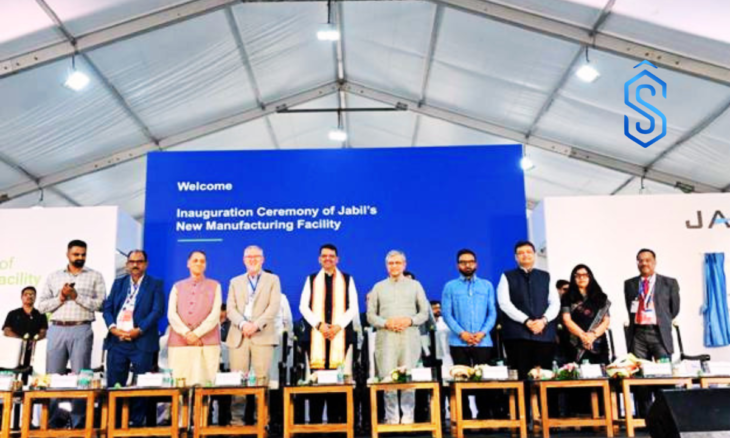
Pune: Union Minister for Electronics and Information Technology Ashwini Vaishnaw, along with Maharashtra Chief Minister Devendra Fadnavis, inaugurated the advanced manufacturing facility of Jabil at Ranjangaon, Pune, on June 17, 2026.
The new high-tech facility marks a significant addition to India’s electronics manufacturing ecosystem and is expected to support both domestic requirements and global exports while generating substantial employment opportunities.
The inauguration ceremony was attended by several dignitaries, including senior leader Dilip Walse Patil, Dnyaneshwar Katke, Andy Priestley, Executive Vice President and COO of Jabil Circuits, senior officials from the Government of Maharashtra, and members of the Jabil team.
Addressing the gathering, Ashwini Vaishnaw emphasized the growing importance of artificial intelligence infrastructure and the role of Jabil in strengthening India’s manufacturing capabilities for AI-driven technologies.
He stated that artificial intelligence has become a major driver of global growth, making it essential for countries to establish and strengthen domestic infrastructure supporting AI technologies.
The Minister noted that AI data centres have emerged as a significant growth engine worldwide and highlighted that, under Prime Minister Narendra Modi’s Make in India initiative, manufacturing the critical electronic components required for these data centres within India remains a strategic priority.
According to the Minister, Jabil will manufacture crucial data centre components through its modern and technologically advanced Pune facility.
Equipped with extensive operational capabilities, the facility is designed to serve India’s growing technology requirements while simultaneously supporting exports to international markets.
Ashwini Vaishnaw also credited Prime Minister Narendra Modi’s vision for transforming electronics manufacturing into one of the strongest pillars of the Indian economy.
He pointed out that targeted policy interventions have helped electronics manufacturing become the third-largest category among goods exported from India.
He further stated that the emerging ecosystem comprising electronic components, finished electronic products, and localized supply chains is expected to create significant socio-economic benefits across the country.
The Minister emphasized that facilities such as Jabil will play an important role in strengthening India’s position as a trusted global manufacturing destination.
Also Read: CPP Investments Acquires 8.2% Stake in CtrlS Datacenters Through ₹4,000 Crore Investment
Jabil’s Advanced Electronics Manufacturing Capabilities
The newly inaugurated Jabil facility is a state-of-the-art advanced electronics manufacturing centre focused on developing next-generation technology infrastructure.
The facility specializes in manufacturing AI systems, including AI-enabled data centre equipment, 5G technology products, high-end networking equipment, industrial power system electronics, and consumer electronics.
With a large manufacturing footprint, Jabil is positioned to address both domestic demand and international export requirements. Supported by active policy collaboration, the project is expected to create localized employment opportunities for up to 11,000 people.
The facility will also support a deep localization programme aimed at integrating domestic supply chains and micro, small and medium enterprises (MSMEs) into the global technology value chain.
Through this initiative, Jabil seeks to strengthen local manufacturing capabilities while connecting Indian suppliers with global technology markets.
India’s Growing Electronics Manufacturing Ecosystem
Reflecting on the growth of India’s electronics sector, Ashwini Vaishnaw stated that electronics manufacturing and exports from India were once considered difficult to achieve at scale.
However, under the leadership and vision of Prime Minister Narendra Modi, India has emerged as a trusted global manufacturing partner.
Highlighting the sector’s progress, the Minister shared that:
- India’s electronics manufacturing industry has reached a value of approximately ₹13 lakh crore.
- Electronics exports have steadily risen through the export rankings, moving from ninth position to seventh, fifth, fourth, and eventually third place.
- In 2025, electronics officially became the third-largest export category in India.
The Minister stated that the next objective for the country should be to elevate electronics manufacturing to become the second-largest export category.
He called upon the Central Government, State Governments, industry stakeholders, investors, and young professionals to work together towards achieving this goal through a strong focus on process quality and manufacturing excellence.
Ashwini Vaishnaw also assured continued government support for talent development, workforce training, skill enhancement, and the creation of specialized ecosystems for manufacturing high-precision mechanical components.
He encouraged industry participants to explore partnerships with innovators such as Lyten to further localize supply chains and strengthen India’s manufacturing ecosystem.
The inauguration of the Jabil advanced manufacturing facility in Pune represents another milestone in India’s expanding electronics manufacturing sector and reinforces the country’s ambition to become a global hub for advanced technology production, AI infrastructure, and export-oriented manufacturing.