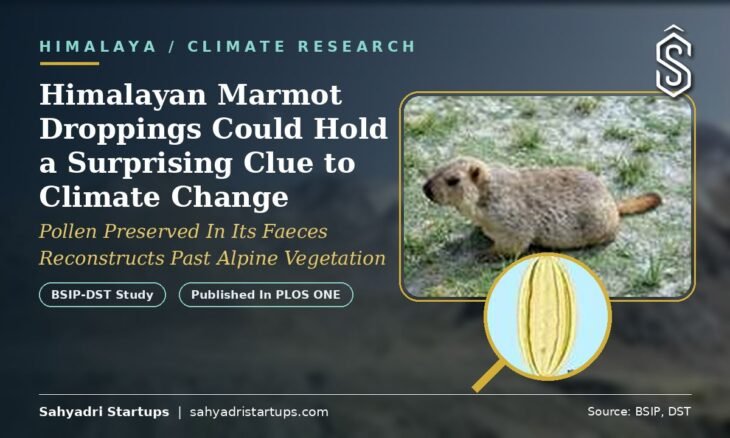
New Delhi: Scientists studying the effects of climate change in the Himalaya have identified an unusual source of environmental evidence: the droppings of the Himalayan marmot.
Pollen grains, fungal spores and elemental signatures preserved in the faeces of the high-altitude herbivore could help researchers reconstruct vegetation patterns and understand how environmental conditions in the region have changed.
The findings, published in PLOS ONE, suggest that Himalayan marmot (Marmota himalayana) faeces could serve as an alternative biological archive for studying past ecological conditions, particularly in remote mountain environments where conventional sources such as lake sediments, peat and soil are difficult to access or unavailable.
The research was conducted by scientists from the Birbal Sahni Institute of Palaeosciences (BSIP), an autonomous institute under the Department of Science and Technology (DST).
The team examined samples from two Himalayan regions to investigate whether material preserved in marmot droppings could provide reliable information about surrounding vegetation and environmental conditions.
What Himalayan marmot droppings reveal
The Himalayan marmot lives in the cold, dry alpine environments of the Himalayan region and depends on local vegetation for food. Pollen preserved in its faeces can therefore provide clues about the plants it consumes and the vegetation growing in its habitat.
Researchers identified pollen belonging to several plant groups, including Artemisia, Asteroideae, Caryophyllaceae, Poaceae, Cyperaceae and Chenopodiaceae.
The composition of these plant groups offered insights into the alpine-steppe vegetation surrounding the animals.
To examine the samples, the researchers used palynological analysis to identify pollen grains and fungal spores, alongside statistical methods to compare samples collected from the two regions.
They also employed Field Emission Scanning Electron Microscopy coupled with Energy-Dispersive X-ray Spectroscopy (FESEM–EDS) to determine the elemental composition of the material.
The team additionally assessed three pollen ratios — Artemisia/Chenopodiaceae, Artemisia/Cyperaceae and Artemisia/Ephedra — to interpret vegetation patterns and associated climatic conditions.
Himalayan marmot could become an indicator of environmental change
The analysis showed that the marmot’s plant-based diet was dominated by groups such as Artemisia, Asteroideae, Caryophyllaceae and Chenopodiaceae.
Based on these findings, the researchers identified the Himalayan marmot as a potential indicator species for understanding vegetation and climate changes in the higher Himalaya.
The study also found that changes in marmot habitats could help researchers identify shifts in altitude associated with changing environmental conditions.
Combining pollen, fungal spores and elemental analysis provides a modern reference dataset for future palaeoecological research and coprolite studies, which examine fossilised faecal material to reconstruct past environments.
Implications for snow leopard conservation
Beyond climate research, the findings could contribute to biodiversity monitoring and conservation planning in the Himalayan region.
Marmots are an important prey species for snow leopards. Understanding changes in their habitats and the vegetation on which they depend could therefore help researchers monitor broader ecological changes affecting wildlife in the Himalayan food web.
The researchers believe the approach could support the reconstruction of past ecological conditions and improve understanding of how fragile high-altitude ecosystems respond to environmental changes.
The study could also provide a useful reference for future research into biodiversity conservation and the sustainable management of Himalayan ecosystems.
Research publication: PLOS ONE
DOI: https://doi.org/10.1371/journal.pone.0358642