

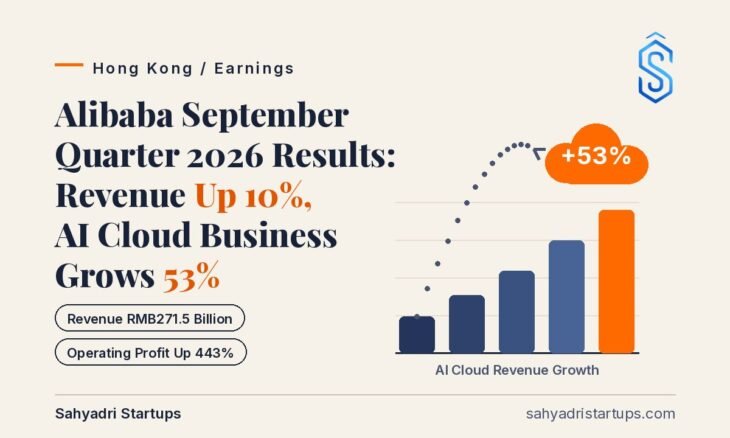
Alibaba Group reported a 10% year-on-year increase in revenue to RMB271.5 billion (US$40.5 billion) for the September quarter of 2026, as strong demand for artificial intelligence and cloud computing services helped drive growth.
The company’s operating income and adjusted earnings also recorded sharp increases, although higher infrastructure spending pushed free cash flow further into negative territory.
For Alibaba September Quarter 2026, income from operations jumped 443% year on year to RMB29.1 billion (US$4.3 billion), while adjusted EBITA increased 260% to RMB32.6 billion (US$4.9 billion).
The Alibaba September Quarter 2026 results, announced on November 19, underline the growing contribution of AI-related services to the company’s business.
AI Cloud and Compute Services revenue increased 53%, while the e-commerce division reported a significant improvement in profitability, supported by lower losses in its quick commerce operations.
“Our full-stack AI capabilities continue to improve commercialization and delivered a strong quarter. Growth in Alibaba Cloud’s recurring revenue from external customers was 67%, which drove an acceleration of overall cloud revenue growth with significantly improving profitability. AI-related product revenue delivered triple-digit growth for the thirteenth consecutive quarter,” said Eddie Wu, Chief Executive Officer of Alibaba Group.
Wu also said profitability at Alibaba E-commerce Group improved significantly, while quick commerce continued to narrow its losses substantially even as it maintained market share.
“This quarter, our business delivered strong growth in both revenue and earnings because of our strategic focus on AI + Cloud growth and profit sustainability in Alibaba E-commerce Group,” said Toby Xu, Chief Financial Officer of Alibaba Group.
“As AI monetization continues to ramp up, we will maintain disciplined investments in AI capabilities with a focus on return on invested capital while targeting to achieve positive free cash flow.”
Alibaba September Quarter 2026: AI Cloud Revenue Reaches RMB61 Billion
AI Cloud and Compute Services generated revenue of RMB61 billion (US$9.1 billion), up 53% from the corresponding quarter last year.
Revenue from external customers grew 64%, while recurring revenue from external customers, excluding compute equipment solutions, increased 67%.
AI-related product revenue reached RMB17.9 billion (US$2.7 billion), marking the thirteenth consecutive quarter of triple-digit year-on-year growth.
Alibaba said demand for its AI offerings came from a broad range of customers, including AI laboratories and businesses in the internet, automotive, embodied AI, financial services and biotechnology sectors.
The cloud division’s adjusted EBITA increased 121% to RMB8.8 billion (US$1.3 billion), with its adjusted EBITA margin reaching 14.5%.
The revenue growth, however, came alongside a substantial increase in investment. Alibaba’s capital expenditure rose 60% year on year to RMB50.5 billion (US$7.5 billion) as it expanded computing capacity to meet demand for AI infrastructure. The company also cited higher prices for a broad range of chip components.
Alibaba is investing in its own semiconductor technology alongside infrastructure expansion.
At its September Apsara Conference, its chip subsidiary T-Head unveiled the Zhenwu V900, a next-generation processor designed for AI training and inference, with commercial release scheduled for the first quarter of 2027.
The company also highlighted the Zhenwu M890 supernode instance, launched in August, which it described as China’s first supernode architecture capable of supporting inference for models with more than two trillion parameters.
Alibaba E-commerce Profit Jumps 243% as Quick Commerce Losses Narrow
Alibaba E-commerce Group revenue increased 2% year on year to RMB197.2 billion (US$29.4 billion). Adjusted EBITA, however, surged 243% to RMB38.9 billion (US$5.8 billion), primarily reflecting a significant reduction in losses from China Quick Commerce.
China Quick Commerce, which includes Taobao Instant Commerce, Freshippo and the on-demand delivery business of Tmall Supermarket, recorded revenue growth of 22% to RMB58.8 billion (US$8.8 billion).
Taobao Instant Commerce improved its unit economics during the quarter, supported by a shift towards higher-value food and non-food orders.
Customer management revenue declined 5% year on year. Alibaba said it would have increased 1% on a like-for-like basis after excluding the contra-revenue impact of a new business development programme.
The international e-commerce business faced a more difficult quarter. Revenue declined 8% to RMB25.7 billion (US$3.8 billion), mainly due to lower AliExpress revenue following the EU Customs Reform. Growth at Trendyol partly offset the decline.
Global Wholesale revenue increased 6% to RMB14.3 billion (US$2.1 billion).
Alibaba’s consumer platforms also reported higher engagement. Its 88VIP premium membership programme reached approximately 66 million members as of September 30, with membership continuing to grow at a double-digit rate year on year.
Xianyu, the company’s consumer-to-consumer marketplace for idle goods, recorded a 23% increase in daily active users and 29% growth in paid orders.
In October, Alibaba introduced QwenWork E-commerce, an AI-powered product designed to automate merchant operations, business analytics, advertising and customer service through direct integration with Taobao and Tmall data.
Alibaba AI Labs Revenue Grows 51%, but Losses Widen
Alibaba’s investments in AI applications are generating revenue growth but continue to weigh on segment profitability.
The AI Labs and Applications division reported revenue of RMB4.4 billion (US$661 million), up 51% year on year, driven by increasing demand for agentic AI products.
However, its adjusted EBITA loss widened to RMB10.5 billion (US$1.6 billion), compared with RMB3.4 billion in the same quarter last year. Alibaba attributed the increase to higher investment in AI capabilities and rising inference costs associated with the Qwen app.
The company recently introduced Qwen4-Max, a foundation model based on a new mixture-of-experts architecture, featuring 2.4 trillion backbone parameters and native visual capabilities.
In October, it also launched Qwen Go!, a cloud-based personal agent within the Qwen app that can autonomously execute multi-step tasks across platforms.
Elsewhere in its consumer technology portfolio, Amap, Alibaba’s mapping and local services platform, recorded approximately 370 million peak daily active users on October 1, the first day of China’s National Day holiday. The company said this was an all-time high.
Alibaba Net Income Rises 213%, but Free Cash Flow Outflow Widens
Alibaba‘s net income increased 213% year on year to RMB64.4 billion (US$9.6 billion) during the September quarter. The increase was primarily driven by higher net investment income and improved income from operations.
Non-GAAP net income, which excludes gains and losses from investments, share-based compensation and impairments, rose 92% to RMB19.9 billion (US$3 billion).
Diluted earnings per ADS stood at RMB25.94 (US$3.87), while non-GAAP diluted earnings per ADS increased 86% to RMB8.10 (US$1.21).
Cash flow performance was less favourable. Net cash generated from operating activities increased 55% to RMB15.7 billion (US$2.3 billion), but free cash flow recorded an outflow of RMB34.5 billion (US$5.1 billion). This compared with an outflow of RMB21.8 billion in the corresponding quarter of 2025.
Alibaba’s cash and other liquid investments stood at RMB487.9 billion (US$72.8 billion) at the end of September.

