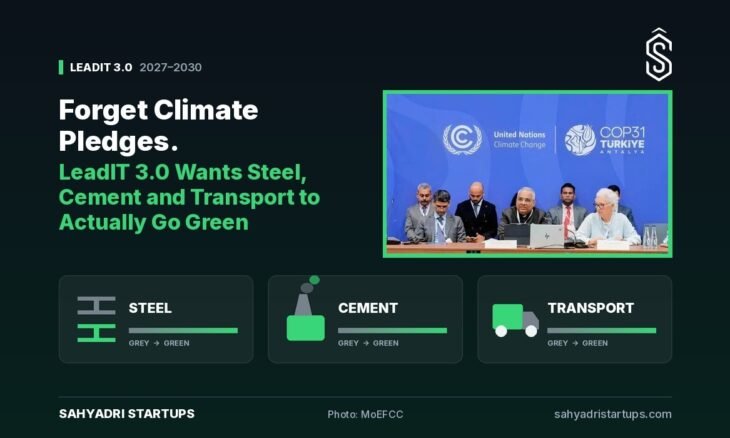
New Delhi: India and Sweden have launched LeadIT 3.0, the third phase of the Leadership Group for Industry Transition, at the United Nations Climate Change Conference (COP31) in Antalya, Türkiye, with a renewed focus on scaling industrial decarbonisation projects, mobilising capital and delivering measurable outcomes between 2027 and 2030.
Brazil has also joined the initiative as its newest country member, strengthening participation from the Global South.
Union Minister for Environment, Forest and Climate Change Bhupender Yadav announced the launch during the Industry Leaders’ Roundtable at COP31.
The roundtable was co-chaired by Yadav and Helena Dyrssen, State Secretary, Ministry of Climate and Enterprise, Sweden. Selwin Hart, Special Advisor and Assistant Secretary-General for UN Climate Action, was also present.
Addressing industry leaders and representatives, Yadav highlighted the growing importance of international cooperation amid geopolitical conflicts, volatile energy markets and competing development priorities, particularly in hard-to-abate industrial sectors.
He emphasised that India’s priorities, including poverty alleviation, energy access, job creation and infrastructure development, must progress alongside its efforts to achieve a sustainable, low-carbon future.
India highlights progress in emissions reduction and clean energy
Highlighting India’s climate achievements, Yadav said the country had reduced its emissions intensity by 37.38% between 2005 and 2022. India has also achieved 50% non-fossil fuel-based installed electricity capacity, five years ahead of its target.
Additionally, India’s cumulative additional forest carbon sink has reached approximately 2.44 billion tonnes of CO₂ equivalent.
The country’s climate achievements under the leadership of Prime Minister Narendra Modi received appreciation at the roundtable, with India’s commitment described as a guiding light for other nations in addressing climate change.
India’s efforts to decarbonise hard-to-abate sectors were also appreciated by Selwin Hart and the European Union.
LeadIT’s progress since its 2019 launch
Recalling the initiative’s progress, Yadav highlighted that LeadIT was launched by India and Sweden in 2019 to advance the transition towards low-carbon industrial development.
During its second phase, the platform facilitated 11 pre-pilot projects in the steel and cement sectors under the India-Sweden Industry Transition Partnership. Cooperation was also expanded to include low-carbon heavy-duty transport.
The projects cover several industrial decarbonisation areas, including hydrogen-based ironmaking, electrification of industrial heat, carbon capture and utilisation, clinker substitution, industrial circularity and the use of artificial intelligence to reduce cement demand.
Beyond bilateral cooperation, LeadIT has supported South Africa’s investment plan under the Climate Investment Funds and Ethiopia’s engagement on low-carbon cement.
The initiative has since expanded to include 20 countries and 33 companies, with Brazil becoming its latest country member. Its inclusion is expected to strengthen the Global South’s representation and create further opportunities for South-South cooperation.
LeadIT 3.0 to prioritise industrial projects and capital mobilisation
Covering the 2027–2030 period, LeadIT 3.0 will mark a shift from establishing partnerships towards scaling industrial projects, mobilising capital and delivering tangible results.
The third phase will focus on three key priorities:
Technology development and diffusion: Promoting the development and deployment of low-carbon technologies through industrial projects.
Capital mobilisation and de-risking: Connecting industrial transition projects with financing opportunities and addressing investment risks to facilitate implementation.
Capacity building and policy support: Strengthening institutional and technical capabilities while supporting policy frameworks, including carbon markets and workforce transition.
Steel, cement and transport will continue to be the core sectors under LeadIT 3.0. However, the platform will remain open to additional sectors and emerging technologies.
India calls for transition from feasibility studies to industrial implementation
Emphasising the need to accelerate the implementation of industrial decarbonisation initiatives, Yadav called for a shift from feasibility studies towards pilot projects, demonstrations and replication at scale.
He urged countries and companies to join LeadIT 3.0 and translate their industrial transition commitments into concrete action.
The Minister highlighted the significance of launching the third phase at COP31, whose Presidency has described the conference as the ‘COP of Implementation’.
He also stressed that the industrial transition must create opportunities for workers, communities and developing economies, ensuring that the shift towards low-carbon production supports broader development priorities.