
Pune: At the ENOVIA User Conference 2026, Ravikiran Pothukuchi, Director, Manufacturing and Logistics, Dassault Systèmes India, outlined how the company is redefining product lifecycle management (PLM) by moving beyond traditional engineering frameworks toward experience-centric innovation.
Speaking during a media interaction at the ENOVIA User Conference 2026, Pothukuchi emphasized that PLM has historically been an engineering-driven discipline focused on managing complex, multifunctional products comprising mechanical, electrical, and software components.
“Managing such a multidimensional, multifunctional product is always complex. So you need an application that can bring these pieces together, orchestrate them, and manage the various variants and configurations,” he said.
Using electric vehicles (EVs) as an example, he noted the growing complexity in product configurations, including multiple battery options, motor types, and charging architectures such as wireless, wired, fast, slow, and replaceable battery systems.
“With this evolution, products are becoming increasingly complex. To manage this complexity and to view the entire product information on one unified platform is where Enovia comes in,” he explained.
Also Read: AAKRUTI Innovation Competition 2025: Dassault Systemes Recognizes Top Student Innovators
ENOVIA User Conference 2026: From Engineering Data to Experience-Centric PLM
Pothukuchi highlighted that traditional PLM systems primarily treat product data as engineering artifacts – components, bills of materials, approvals, and certifications – largely disconnected from end-consumer relevance.
“But how does this matter to the end consumer? For example, if I am buying a car, most of this is irrelevant information for me,” he said.
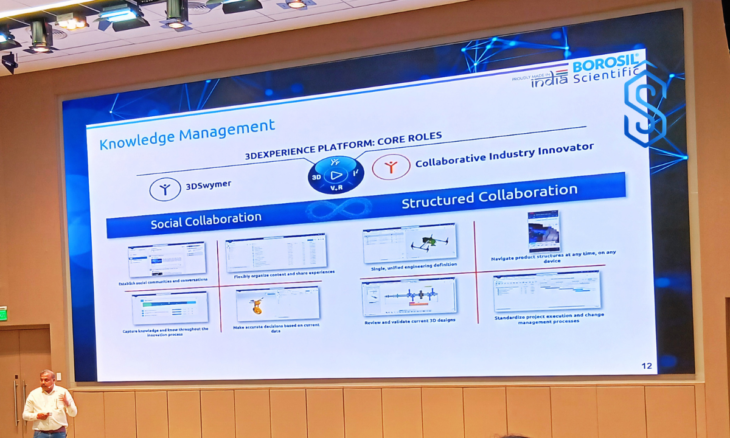
Dassault Systèmes is addressing this gap through its 3DEXPERIENCE platform, where ENOVIA functions as a core application. The platform aims to transform engineering data into immersive, personalized consumer experiences.
“What we are doing instead is transforming this information into an experience,” he noted.
He further explained that instead of presenting technical specifications, companies can now enable customers to visualize products in real-world contexts – customizing features such as interiors, colors, and environments based on user preferences.
“For example, when you visit a website, it may already know your preferences. If you like mountains, the car may be shown in a mountainous setting. If you prefer blue, the car appears in blue,” he said, adding that such capabilities leverage AI and machine learning technologies.
“This experience is not fixed—it is dynamic and tailored to your tastes, preferences, likes, and dislikes,” he added.
Also Read: Dassault Systemes Bets Big on Indian Startups, Ecosystem, and AI-Driven Innovation
ENOVIA User Conference 2026: SaaS and Cloud Driving MSME Adoption
Addressing the adoption of digital technologies among Tier 1 and Tier 2 suppliers, Pothukuchi acknowledged that while OEMs have achieved higher digital maturity, smaller suppliers are still progressing.
“One reason is that earlier, these technologies required significant IT infrastructure, staff, servers, databases, and networking,” he said.
However, the shift to SaaS and cloud-based solutions has significantly lowered entry barriers.
“Now, companies only need a computer and internet access to use the software. They don’t have to worry about hardware, networking, RAM, or IT maintenance,” he stated on the sidelines of 3DExperience and ENOVIA User Conference 2026.
He added that subscription-based pricing models – monthly, quarterly, or annual – have made these technologies more accessible and cost-effective for MSMEs.
“This flexibility is driving adoption among smaller companies,” he noted.
ENOVIA User Conference 2026: Digital Capabilities as a Competitive Advantage
Pothukuchi emphasized that digital transformation is becoming a key differentiator for suppliers competing for OEM partnerships.
“They need to demonstrate their capabilities—such as digital twins of products and plants—to attract OEMs,” he said.
“Digitalization itself becomes a selling point. If a supplier can show advanced digital capabilities, OEMs are more likely to choose them,” he added.
Dassault Systèmes is actively engaging with Tier 1 and Tier 2 companies, offering curated and affordable cloud packages tailored for MSMEs. The company also reported growing adoption among startups leveraging its solutions.
ENOVIA User Conference 2026: Expanding Beyond Core Industries
While traditionally strong in automotive, aerospace, and defense, Dassault Systèmes is expanding its footprint across emerging sectors, as highlighted at the ENOVIA User Conference 2026.
The company is working with infrastructure players such as L&T for project management solutions and with Jindal Stainless Limited for production planning and scheduling.
Pothukuchi also pointed to increasing traction in sectors like renewable energy, semiconductors, data centers, and consumer goods.
“In semiconductors, our platform is used for intellectual property management—one of the most critical aspects of chip design,” he said, noting its role in managing data, versions, traceability, and design history.
In manufacturing industries, including chemicals, paints, and pharmaceuticals, the platform supports process planning, production scheduling, and shop-floor automation.
“We serve both discrete industries and continuous manufacturing industries. Growth is particularly strong in newer sectors compared to traditional ones,” he added.
ENOVIA User Conference 2026: Startup Ecosystem and Flexible Models
Discussing startup engagement, Pothukuchi highlighted strong adoption across EV startups, aerospace, defense, and drone technologies, with emerging traction in semiconductor design.
“We offer dedicated startup programs,” he said.
Recognizing the financial constraints of early-stage companies, Dassault Systèmes provides flexible payment models.
“Since startups may not have the capital upfront, we provide flexible models where they can start using the technology with minimal cost and defer payments until they generate revenue,” he stated.
“These deferred payment models help startups get started without heavy financial burden,” he added.