
New Delhi: India has at least 1,000 Community Seed Banks (CSBs), but only 652 have so far been mapped through a nationwide exercise by DIVERSIFARM-India.
The findings offer a first consolidated picture of the country’s community-led seed conservation network while highlighting the need for stronger policy frameworks, institutional support and dedicated funding to sustain these institutions.
The findings were presented at the National Seminar for the Advancement of Community Seed Banks, held on November 17 and 18, 2026, at the National Agricultural Science Complex (NASC) in New Delhi.
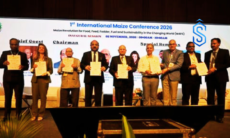
The initiative also released a GIS-based digital atlas, a policy framework identifying six types of community seed banks, a 10-point roadmap for Odisha and a capacity-building manual for establishing and managing CSBs.
The three-year DIVERSIFARM-India project is jointly led by Norway’s Fridtjof Nansen Institute (FNI) and the M S Swaminathan Research Foundation (MSSRF).
It focuses on strengthening seed systems through community institutions to improve food and nutrition security and livelihoods for small farmers.
India Needs Differentiated Policy Support for 1,000 Community Seed Banks
One of the key findings of the DIVERSIFARM-India study is that Community Seed Banks do not operate under a uniform institutional structure.
The study has identified six typologies based on their management arrangements, providing a basis for policymakers to design support mechanisms suited to different organisational models.
The classification is significant for policy planning because the requirements of community-managed institutions can differ depending on how they are organised and administered.
The project has translated this research into a policy brief outlining the six typologies, with the objective of encouraging more targeted and effective government support.
The digital atlas, meanwhile, has mapped 652 Community Seed Banks and provides profiles of these institutions through a GIS-based platform.
By bringing information about geographically dispersed initiatives together, the platform aims to improve their visibility and create a common resource for stakeholders working in seed conservation.
May-Elin Stener, Ambassador of the Royal Norwegian Embassy in New Delhi, welcomed the project’s mapping exercise and its support for community seed banks across India. She said the initiative was an important component of the partnership between India and Norway.
Dr Regine Andersen, Research Professor at the Fridtjof Nansen Institute, Norway, highlighted the outcomes of the three-year collaboration between FNI and MSSRF.
She said the digital platform brings together community seed banks from across the country and creates awareness about their strengths and collective efforts.
Odisha Roadmap Proposes Dedicated Government Secretariat
Odisha has emerged as the pilot state for the project’s detailed case studies and policy recommendations.
A separate policy brief developed under DIVERSIFARM-India outlines a 10-point roadmap for strengthening Community Seed Banks in the state.
Among its recommendations is the creation of a dedicated secretariat under the Department of Agriculture and Farmers’ Empowerment.
The proposed secretariat is intended to help establish and sustain an enabling environment for community seed banks, providing an institutional mechanism to support their development.
PPVFRA and Biodiversity Act Identified as Key Policy Instruments
The legal and regulatory framework governing seed conservation and biodiversity was another major area examined by DIVERSIFARM-India.
The study identified the Protection of Plant Varieties and Farmers’ Rights Act (PPVFRA) and the Biological Diversity Act, 2002 as two legislative frameworks with potential to strengthen Community Seed Banks.
However, discussions at the national seminar also highlighted the need for better coordination between the two laws to maximise their benefits for farmers.
Padma Shri Dr P. L. Gautam, former Chairperson of PPVFRA and the National Biodiversity Authority (NBA), said discussions had highlighted the need to establish synergy between the two legislations to further benefit farmers.
He also reiterated the principle that biodiversity is a common heritage of humankind, reflecting on the founding principles of the laws.
Dr Devendra Kumar Yadava, Director of ICAR-National Bureau of Plant Genetic Resources and Deputy Director General (Crop Science) at the Indian Council of Agricultural Research (ICAR), highlighted the scope for collaboration between community gene banks and national gene banks.
Gautam also emphasised committed funding and capacity building as immediate requirements for strengthening these institutions.
New Manual Addresses Operational Challenges of Establishing Seed Banks
While policy support and institutional recognition are important for the long-term development of Community Seed Banks, their establishment and management also require technical and organisational capabilities.
To address this requirement, DIVERSIFARM-India has developed a capacity-building manual drawing on in-depth case studies conducted in Odisha.
The manual combines technical guidance, organisational approaches and policy considerations to provide a practical reference for establishing, managing and sustaining community seed banks.
Dr Trilochan Mohapatra, Chairperson of the Protection of Plant Varieties and Farmers’ Rights Authority, released the manual at the National Agricultural Science Complex in New Delhi.
In his inaugural address, Mohapatra highlighted the PPVFRA’s support for Community Seed Banks and expressed confidence in their growth as government backing increases.
“Now that government support is growing, I am sure that the Community Seed Banks would flourish,” he said.
Community Seed Banks Extend Beyond Seed Storage
Dr Rengalakshmi R, Executive Director of MSSRF, highlighted the broader role of Community Seed Banks in agricultural systems, emphasising that their contribution extends beyond maintaining seed stocks.
She described CSBs as living institutions for in-situ conservation that build farmers’ resilience.
The project’s four major outputs – the digital atlas, typology-based policy brief, Odisha roadmap and capacity-building manual – address different aspects of strengthening this network, from documenting existing institutions to improving their management and policy support.
The digital atlas, capacity-building manual and policy brief on Community Seed Bank typologies are available at https://communityseedbanks.in/.