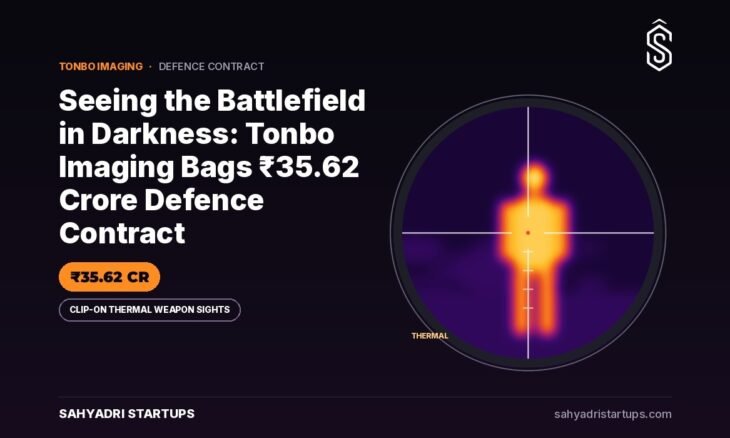
Bengaluru: Tonbo Imaging India Limited has secured a ₹35.62 crore order from the Ministry of Defence for clip-on thermal weapon sights and associated support equipment, bringing indigenous thermal imaging technology into focus as India looks to strengthen the night-fighting capabilities of its armed forces.
The order, which includes taxes, covers thermal sights for assault rifles. Under the contract, deliveries will be completed in two lots within 52 weeks from its effective date.
Unlike conventional rifle optics, clip-on thermal sights allow soldiers to detect and engage targets based on heat signatures rather than relying on visible light.
This capability is particularly important in low-visibility environments, including darkness, smoke and certain battlefield conditions where conventional optical systems can be less effective.
For infantry units, thermal weapon sights can improve target detection and situational awareness during night operations without requiring soldiers to depend exclusively on daylight or artificial illumination.
Their ability to be mounted on existing assault rifles also makes them relevant to the modernisation of individual soldier equipment.
The latest contract places Tonbo Imaging among the domestic technology manufacturers supplying specialised electro-optical equipment for India’s defence requirements.
Why Clip-On Thermal Weapon Sights Matter for India’s Armed Forces
Night-fighting capability has become an important component of modern military operations.
Armed forces increasingly require soldiers to operate across different lighting conditions, identify potential threats at longer distances and maintain operational effectiveness when visibility is restricted.
Thermal imaging addresses one of these requirements by detecting differences in temperature between objects and their surroundings.
Unlike night-vision devices that amplify available light, thermal imagers can identify heat-emitting objects even in environments where visible-light conditions are poor.
For infantry personnel, this technology has applications in surveillance, target identification and weapon-mounted operations.
Clip-on configurations are particularly useful because they can be attached to existing rifle platforms rather than requiring an entirely separate weapon system.
The equipment covered by the Tonbo Imaging contract is described as a compact, lightweight and uncooled thermal imager.
Apart from its primary application as an assault-rifle-mounted sight, the device can also be used in helmet-mounted and hand-held configurations.
This multi-configuration capability gives the equipment utility across different operational requirements, from individual soldier applications to observation and surveillance.
For India, the procurement of such systems is relevant to the broader requirement of equipping infantry personnel with modern sensors and optical technologies.
Developing these capabilities domestically also creates opportunities for Indian manufacturers to supply specialised defence electronics rather than depending entirely on imported equipment.
Tonbo Imaging’s Indigenous Imaging Technology Behind the Order
Incorporated in 2003, Tonbo Imaging transitioned into defence-focused product manufacturing in 2012.
Tonbo Imaging said the thermal sights covered by the contract were designed, developed and manufactured in India.
The company also highlighted its in-house imaging cores, optics and software as the technological foundation of its thermal weapon sight portfolio.
“Thermal weapon sights are a core Tonbo product line, built on our own imaging cores, optics and software. We are proud that the Ministry of Defence has chosen a sight designed and manufactured in India for its personnel. Delivering on schedule and supporting the equipment in the field is our immediate priority,” said Arvind Lakshmikumar, Founder, Managing Director and Chief Executive Officer, Tonbo Imaging India Limited.
The company’s emphasis on proprietary imaging technology is significant because thermal weapon sights are not simply optical accessories.
Their performance depends on the integration of thermal sensors, image processing, optics, software and the ability to withstand demanding field conditions.
Domestic development of these components can contribute to India’s broader defence manufacturing objectives, particularly in specialised electronics and electro-optical systems.
The contract carries a 24-month warranty. It also includes an option clause and a repeat-order clause, each allowing additional procurement of up to 50% of the originally ordered quantity at the customer’s discretion.
These provisions offer the Ministry of Defence flexibility to increase quantities but do not represent confirmed additional orders.
Tonbo Imaging classified the contract as a domestic order and said it was not a related-party transaction.
Tactical Systems Form a Smaller but Important Part of Tonbo Imaging’s Order Book
The contract also provides a glimpse into the composition of Tonbo Imaging‘s defence business, which spans both soldier-level tactical equipment and systems integrated into larger military platforms.
As of September 30, 2026, the company reported a confirmed order book of ₹249.8 crore in its November 5 results announcement. Platform systems accounted for ₹205.3 crore, while tactical systems contributed ₹44.5 crore.
The tactical portfolio includes thermal weapon sights and hand-held thermal imaging equipment, while the platform systems business covers missile seekers, fire-control systems and missile guidance systems.
The company separately disclosed ₹408.3 crore worth of contracts under negotiation as of September 30.