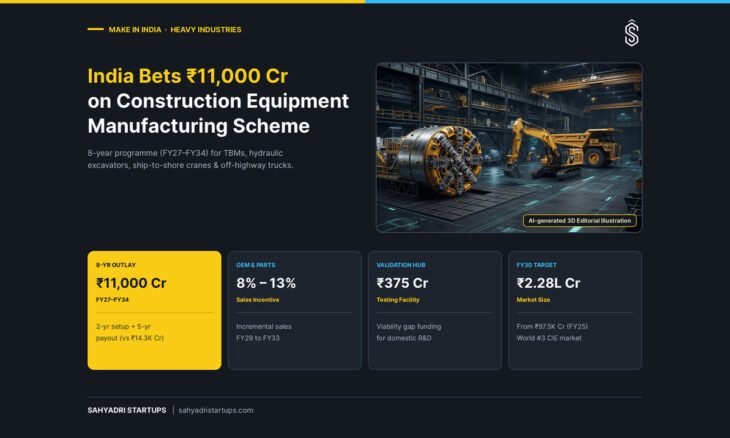
New Delhi: India will spend ₹11,000 crore over eight years to expand domestic manufacturing of construction and infrastructure equipment, with the Union Cabinet approving a new construction equipment scheme aimed at reducing import dependence and strengthening local production of advanced machinery.
The approval, granted on Wednesday under the chairmanship of Prime Minister Narendra Modi, covers the Scheme for Enhancement of Construction and Infrastructure Equipment Manufacturing Ecosystem.
The Ministry of Heavy Industries will oversee its implementation from FY 2026-27 to FY 2033-34.
The programme comes as India looks to build manufacturing capabilities in equipment used in large infrastructure projects, including tunnel boring machines, hydraulic excavators, ship-to-shore cranes and off-highway trucks.
It will also support domestic component manufacturers and establish a dedicated testing facility for the industry.
₹11,000 Crore Allocation Includes Manufacturing Incentives
The construction equipment scheme has two funding components, with the larger manufacturing support mechanism linked to incremental sales by eligible companies.
Original equipment manufacturers (OEMs) and component manufacturers will qualify for incentives based on the additional sales value of eligible products. The incentive rates will range from 8% to 13% over a five-year disbursement period.
The second component provides up to ₹375 crore in viability gap funding for establishing a dedicated testing facility for construction and infrastructure equipment.
The proposed facility is expected to address domestic testing requirements for advanced machinery, supporting manufacturers in developing and validating equipment within India.
The scheme covers both finished equipment and components, indicating that the government’s manufacturing push extends beyond machinery assembly to the supporting industrial supply chain.
Construction Equipment Scheme: Manufacturers Get Two Years to Set Up Production Facilities
The government has structured the construction equipment scheme around an eight-year implementation period.
The first two years, FY 2026-27 and FY 2027-28, will serve as a gestation period for establishing manufacturing facilities. Incentive payments will follow over five years, from FY 2028-29 to FY 2032-33.
The final year, FY 2033-34, will be used to settle incentives associated with incremental sales recorded in FY 2032-33.
This phased approach gives participating manufacturers time to establish production infrastructure before the incentive disbursement period begins.
India’s Construction Equipment Market May Reach ₹2.28 Lakh Crore by 2030
The scale of the proposed investment reflects the growth potential of India’s construction and infrastructure equipment industry.
India currently has the world’s third-largest CIE market, after China and the United States. The market was valued at approximately ₹97,500 crore in FY 2024-25 and is projected to reach ₹2,28,100 crore by FY 2029-30, according to government estimates.
Infrastructure development, particularly in roads and ports, and expansion in the housing sector are expected to drive demand for construction machinery.
However, capturing this growth will require domestic manufacturers to expand production capacity and develop capabilities in technologically advanced equipment.
The construction equipment scheme is intended to address this gap by supporting manufacturing investments and strengthening the domestic supply chain.
The government also expects the programme to generate employment and improve the international competitiveness of Indian equipment manufacturers.
Construction Equipment Scheme: Cabinet Allocation Lower Than Earlier ₹14,300 Crore Proposal
The Cabinet’s approval comes after the scheme underwent changes in its proposed financial allocation and implementation timeline.
Finance Minister Nirmala Sitharaman first announced the initiative in her Union Budget 2026-27 speech on February 1, 2026. The proposal was aimed at promoting domestic manufacturing of high-value, technologically advanced construction and infrastructure equipment.
The Budget announcement covered a broad range of machinery, from lifts used in multi-storey buildings and firefighting equipment to tunnel-boring machines required for metro projects and high-altitude roads. However, it did not specify the scheme’s financial allocation.
The final Cabinet approval sets the allocation at ₹11,000 crore, ₹3,300 crore below the earlier proposal, while extending the implementation period to eight years.
Construction Equipment Scheme: China Export Controls Include Tunnel Boring Machines
Separately, China has introduced export controls on several categories of specialised construction machinery, including equipment that India intends to support through its new manufacturing programme.
China’s Ministry of Commerce and General Administration of Customs issued Announcement No. 50 of 2026 on October 19, with the restrictions taking effect on November 18.
The controlled items include full-face tunnel boring machines, covering shield and rock tunnel boring machines, as well as specially designed components such as cutterheads, screw conveyors, segment erectors and main drive systems.
The restrictions also cover walking excavators meeting specified performance thresholds and high-altitude wet shotcrete machines, among other products.
Tunnel boring machines are explicitly included in the list of equipment targeted under India’s construction equipment scheme.