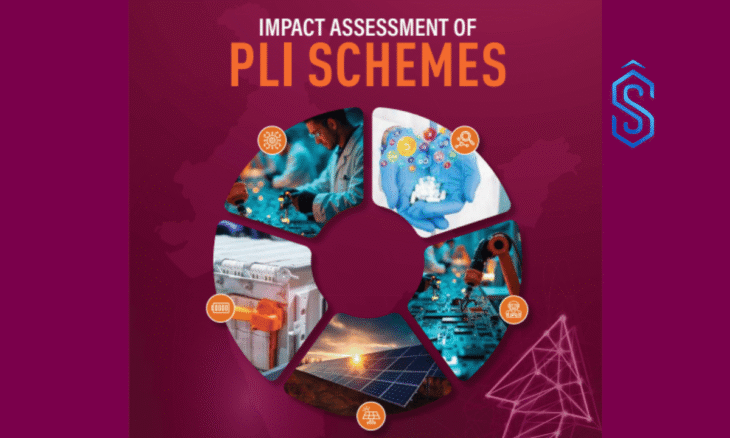
New Delhi: India’s manufacturing push under the Production Linked Incentive (PLI) programme is beginning to deliver results, with nearly 70% of targeted segments broadly on track, according to the Impact Assessment of PLI Schemes report released by NITI Aayog.
Prepared in collaboration with the Indian Institute of Management Ahmedabad (IIM Ahmedabad) as its knowledge partner, the report evaluates the performance of PLI schemes across 14 sectors, covering investment, production, exports and employment generation.
The report recognises the Production Linked Incentive (PLI) Scheme as a flagship policy intervention of the Government of India aimed at strengthening domestic manufacturing, improving India’s competitiveness in global markets and integrating Indian companies into global value chains.
By linking financial incentives to incremental production and performance, the scheme seeks to encourage companies to expand manufacturing capacity, adopt advanced technologies, attract investments and improve production efficiency.
Its performance-linked structure is also intended to reduce long-term dependence on government support through a defined sunset clause.
PLI Schemes Generate ₹2.40 Lakh Crore in Investment
According to the Impact Assessment of PLI Schemes, the 14 schemes had attracted cumulative investments of ₹2,40,138 crore as of March 2026.
They generated production and sales worth ₹22,66,412 crore, created employment for 8,49,069 individuals and resulted in incentive disbursements of ₹35,354 crore.
The combined financial outlay across the 14 sectors stands at ₹1,91,049 crore. Against this allocation, cumulative incentive disbursement had reached ₹35,354 crore, representing 18.51% of the total outlay by March 2026.
The assessment indicates that investment mobilisation has reached 76% of the full-tenure target of ₹3,15,092 crore.
Cumulative production and sales have achieved 64% of their corresponding target of ₹35,37,863 crore.
Employment generation, meanwhile, stands at 28% of the full-tenure target of 30,18,750 jobs.
The report points out that the 14 PLI schemes have completed 58% of their aggregate implementation period, with 42% still remaining.
Therefore, the differences in performance across investment, production and employment need to be considered in the context of the time required to establish manufacturing facilities, commission production lines and scale up operations.
Incentive Disbursement Reaches 100% of Annual Target in FY26
The Impact Assessment of PLI Schemes also highlights an improvement in the pace of incentive disbursement over the years.
Against a planned disbursement of ₹15,401 crore up to FY2023-24, actual disbursement stood at ₹9,721 crore, achieving 63% of the target.
In FY2024-25, the government disbursed ₹10,114 crore against a planned ₹14,277 crore, representing 71% achievement.
In FY2025-26, actual disbursement increased to ₹15,519 crore against a planned ₹15,472 crore, achieving 100% of the annual target.
The report attributes the improvement to the performance-linked structure of the schemes. As participating companies expand capacity, commission facilities and increase production beyond their base-year levels, they become eligible for higher incentive claims.
White Goods Manufacturing Achieves 90% Localisation in PCBAs
Air Conditioner and LED Manufacturing Ecosystem:
- Domestic value addition increased from 20% in FY2019-20 to 55% in FY2024-25.
- Compressor manufacturing capacity increased ten-fold, from 1 million units in 2021 to 10 million units in 2025-26.
- PCBAs, which were approximately 70% import-dependent in 2021, have reached 90% localisation.
- Cross-flow fans, which were entirely imported in 2021, are now 80% localised.
- Investment has spread across 18 states, 47 districts and 158 locations.
- The scheme includes 26 MSME participants.
The report also identifies technology-transfer partnerships involving Daikin India and Taiwan’s Rechi Precision, and Mettube Malaysia’s manufacturing operations in India.
Solar Manufacturing Capacity Increases from 8 GW to 116 GW
- Capacity before the PLI scheme: approximately 8 GW.
- Capacity as of October 2025: nearly 116 GW.
- Capacity directly attributable to PLI-supported projects: approximately 24 GW.
- Solar module imports declined from US$4.35 billion in FY2023-24 to US$2.15 billion in FY2024-25.
- Solar exports increased from US$83 million in FY2021-22 to US$1.97 billion in FY2023-24.
This is a strong illustration of the scheme’s contribution to domestic manufacturing and import substitution.
Drone Industry Turnover Expands Under PLI Scheme
The Drones and Drone Components PLI scheme has an allocation of just ₹120 crore. Despite its relatively small allocation:
- ₹92.99 crore, or 77.5% of the outlay, was disbursed.
- 18 of the 23 approved applicants received incentives.
- The industry expanded from approximately US$0.01 billion in FY2021 to US$0.38 billion in FY2026.
Pharmaceuticals: 191 Products Manufactured Domestically for First Time
The Pharmaceuticals Drugs PLI scheme has supported the domestic manufacturing of 191 pharmaceutical products for the first time in India. Other findings include:
- Pharmaceutical exports increased 32.7% between 2021 and 2025.
- Exports increased from US$19.46 billion to US$25.82 billion.
- Investment under the scheme reached ₹45,158 crore.
- Production/sales reached ₹3,64,588 crore.
- Employment reached 1,14,880 jobs.
However, MSMEs have experienced more uneven outcomes, particularly in exports, due to constraints involving scale, compliance costs and access to international markets.
Automobile PLI Attracts Investments Exceeding Target
The Automobile and Auto Components PLI scheme has attracted ₹44,326 crore in investments against a five-year projected investment target of ₹42,500 crore. The report also notes:
- Production/sales reached ₹52,414 crore against a projected incremental sales target of ₹2,31,500 crore.
- Employment reached 67,820 against a target of 1,48,147.
- Incentive disbursement increased from ₹322 crore in FY2024-25 to nearly ₹2,000 crore in FY2025-26.
The report identifies increasing domestic value addition certification and the development of advanced automotive technologies as important outcomes.
Telecom PLI Supports Domestic 4G and 5G Equipment Manufacturing
The telecom PLI scheme has supported domestic manufacturing of 4G/5G equipment by companies including Nokia, Ericsson and Cisco.
An interesting feature is the additional 1% incentive for products designed, developed and manufactured in India, intended to encourage design-led manufacturing.
However, the report also flags a limitation: the scheme does not stipulate domestic value addition, meaning beneficiaries can potentially import all components, assemble products in India and still qualify for incentives.
ACC Battery Manufacturing Remains at Early Stage
The ACC Battery PLI scheme has an outlay of ₹18,100 crore and targets:
- 50 GWh of domestic ACC battery manufacturing capacity.
- 5 GWh of niche battery capacity.
However, only 1.4 GWh of capacity had been developed at the stage covered by the assessment. Commercial production and incentive disbursement had not commenced.
The report identifies imported machinery, dependence on foreign technological expertise, shortages of skilled manpower and the absence of a developed upstream materials ecosystem as key constraints.
Recommendations: Demand-side Incentives, Not Just Manufacturing Subsidies
The IIM Ahmedabad assessment argues that future manufacturing incentive schemes should not rely exclusively on supply-side interventions.
It suggests introducing demand-side incentives for downstream companies and consumers to purchase products manufactured by PLI-supported firms.
The report describes the combination of supply-side support and demand-side incentives as a potential next evolution of the PLI framework.