

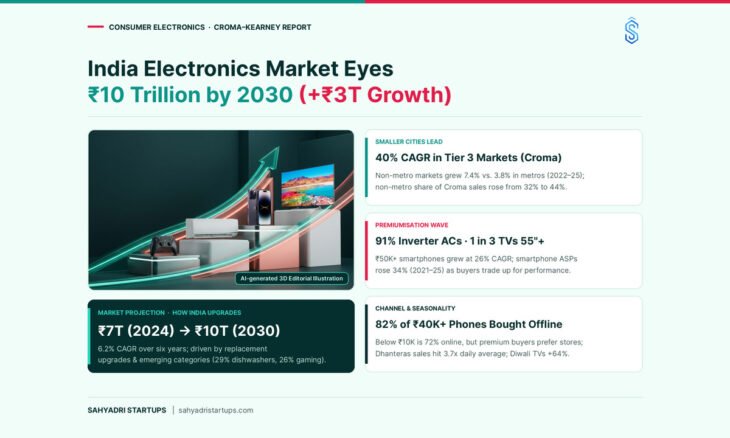
Pune: India electronics market is projected to grow by ₹3 trillion over the next six years, reaching approximately ₹10 trillion by 2030 from ₹7 trillion in 2024.
Rising demand for premium devices, faster sales growth in smaller cities and the adoption of newer product categories are expected to shape this expansion, according to a Croma-Kearney report.
The report, titled How India Upgrades, points to a shift in India’s consumer-electronics industry, where growth is increasingly being driven by consumers replacing existing devices with higher-value products rather than relying solely on first-time purchases.
Released as Croma marks 20 years in India’s retail market, the report draws on the retailer’s sales data and analysis by global management consulting firm Kearney.
It estimates a 6.2% compound annual growth rate for the India electronics market through 2030.
Smaller cities outpace metros in electronics growth
One of the most significant shifts identified in the report is the increasing contribution of non-metropolitan markets to electronics consumption.
Between 2022 and 2025, consumer-electronics markets outside metros grew at a CAGR of 7.4%, compared with 3.8% in metropolitan areas.
Croma’s own sales performance reflects this shift. Its sales in Tier 3 cities increased at a 40% CAGR during the period, ahead of Tier 1 cities at 35%, Tier 2 cities at 30% and metros at 13%.
The contribution of non-metro markets to Croma’s total sales also increased from 32% in 2022 to 44% in 2025.
The trend suggests that smaller cities are becoming increasingly important to the next phase of India’s electronics consumption, although metros continue to represent a significant share of overall demand.
India Electronics Market: Premiumisation Changes What Consumers Buy
The growth opportunity is also being shaped by a change in purchasing preferences, particularly in established categories such as smartphones, air conditioners and televisions.
At Croma, the average selling price of smartphones rose 34% between 2021 and 2025. Smartphones priced above ₹50,000 recorded a 26% CAGR between 2022 and 2025, indicating increasing demand for higher-priced devices.
The shift towards premium features is particularly visible in home appliances. Inverter ACs accounted for 91% of the category in 2025, compared with just 9% in 2015.
Television preferences have also changed considerably. One in three televisions sold in 2025 was at least 55 inches in size, against one in 25 a decade earlier.
These figures point to consumers placing greater emphasis on performance, energy efficiency, larger formats and improved product features when making replacement purchases.
Gaming, dishwashers and air fryers find more buyers
The next wave of growth is extending beyond conventional electronics categories, with products linked to convenience, entertainment and connected lifestyles gaining traction.
Croma’s volume data for 2021–2025 shows that dishwashers and dryers recorded a combined CAGR of 29%. Gaming devices followed at 26%, hearables at 23% and kitchen appliances such as air fryers at 22%.
Smaller cities are contributing to this demand as well. Between 2021 and 2025, demand across Tier 2 and Tier 3 markets increased 3.2 times for gaming devices and 2.8 times for wearables and kitchen appliances.
The share of metropolitan markets in Croma’s unit sales across these emerging categories declined from 75% in 2021 to 65% in 2025.
Festive shopping and college admissions drive seasonal demand
Consumer-electronics purchases continue to be closely linked to festivals and specific spending cycles, including the back-to-college season.
Croma’s 2025 sales data shows that its sales on Dhanteras were 3.7 times the annual daily average, while transactions were 3.4 times higher.
During Diwali, average daily mobile-phone sales were 18% above the annual daily average. Television sales recorded a sharper increase of 64%.
Akshaya Tritiya also generated a significant increase, with sales 63% above the annual daily average and transactions rising 50%.
Education-related purchases provided another demand trigger. During June–August 2025, average daily laptop sales were 50% above the annual daily average, while tablet and smartphone sales were higher by 40% and 33%, respectively.
Premium smartphones continue to favour offline retail
Despite the expansion of online shopping, physical stores remain an important sales channel for expensive smartphones.
Croma’s 2025 channel analysis found that online platforms accounted for 72% of smartphone sales in the below-₹10,000 segment.
The pattern reversed for smartphones priced at ₹40,000 and above, where offline retail accounted for 82% of sales and online channels contributed 18%.
Croma and Kearney see a shift towards experience-led consumption
Shibashish Roy, Chief Executive Officer and Managing Director, Infiniti Retail Ltd. – Croma, said: “Over the last two decades, we have witnessed India’s consumer-electronics market evolve from first-time adoption to shaped by aspiration, experience and continual upgrading. Through ‘How India Upgrades’, we sought to decode the shifts shaping consumer behaviour and the future of the category.”
Kaushika Madhavan, Chairman, Kearney India, said, “The future of India’s consumer-electronics industry will be shaped not by how many devices are sold, but by how consumers choose to upgrade their lives through technology.
The convergence of premiumisation, expanding demand across emerging markets and evolving consumer expectations is creating new opportunities for innovation, value creation and long-term growth.”