

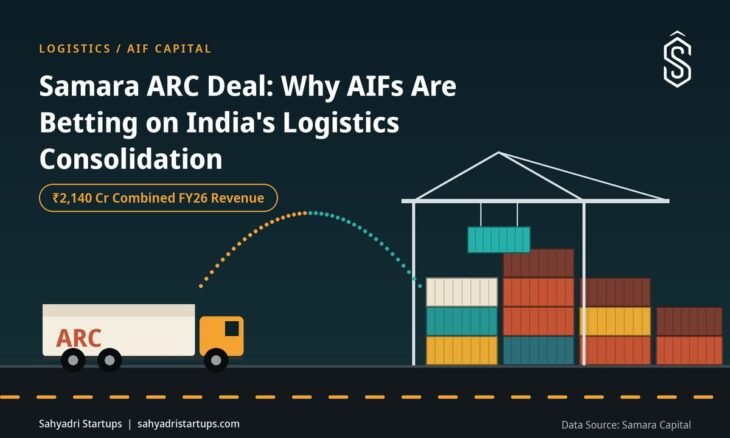
Pune: The Samara ARC deal highlights how private equity capital is increasingly being deployed to consolidate established businesses and build larger operating platforms in India’s fragmented logistics market.
By bringing Associated Road Carriers Limited (ARC), a nationwide road transportation operator, together with Calyx Container Terminals Private Limited, which operates port-linked container logistics infrastructure, Samara Capital is pursuing a strategy that extends beyond investing in an individual logistics company.
The combined businesses reported approximately ₹2,140 crore in revenue in FY2025-26, according to Samara’s September 2026 announcement.
The proposed combination could create an integrated logistics platform covering domestic transportation, container handling and export-import (EXIM) cargo movements.
The Competition Commission of India (CCI) approved the transaction on November 25, 2026, clearing a key regulatory hurdle.
AIF Investment Strategy: Building Scale Through Acquisitions
For the alternative investment fund (AIF) ecosystem, the Samara ARC deal offers an example of how institutional capital can be used to consolidate complementary businesses rather than build an operating network from scratch.
ARC brings an established transportation network, customer relationships and nationwide distribution capabilities. Calyx adds container freight station (CFS) infrastructure and supply chain management services linked to international trade.
Combining these operations gives Samara an opportunity to build a broader logistics business with access to multiple stages of cargo movement.
The transaction involves two Category II AIFs registered with SEBI: Samara Alternate Investment Fund – Scheme I LVF and Samara Alternate Investment Fund III India. Both are managed or advised by Samara Alternate Investment Management LLP.
Although the parties have not officially disclosed the transaction value or stake percentages, a September 2026 Mint report, citing an industry source, estimated Samara’s investment at close to ₹1,200 crore. This figure has not been independently confirmed by the parties.
Samara’s previous investment in Spoton Logistics also provides context for its interest in the sector. Alongside Xponentia Capital, it sold its entire stake in Spoton to Delhivery in 2021 after a three-year holding period. Samara had reported that Spoton’s net sales and EBITDA grew at approximately 24% and 30% CAGR, respectively, during that period.
The ARC-Calyx combination represents another logistics investment, but with a greater emphasis on integrating complementary infrastructure and services.
Why ARC and Calyx Are Strategically Complementary
The investment thesis rests on the different capabilities of the two businesses.
Founded in 1972, ARC has developed a nationwide road transportation network. According to Samara’s disclosures, it operates approximately 600 branches and more than 20 hubs, covering over 16,000 pin codes. It deploys around 3,500 trucks daily and serves more than 100,000 active customers.
Its asset-light model is another important feature. Less than 7% of its fleet is owned by the company, with the remainder largely sourced from third-party operators. This allows ARC to operate a large transportation network without proportionate investment in owned vehicles.
Calyx, incorporated in 2006, provides the port-linked infrastructure that complements ARC’s domestic network. Its container freight station near Chennai Port spans approximately seven acres and has a capacity of around 83,400 TEUs, including approximately 3,000 refrigerated containers. It also operates a 17-acre empty container yard.
The combination could allow the businesses to offer more connected services to customers moving cargo between ports and domestic destinations. Samara has described its objective as creating “an entity that covers both domestic and EXIM cargo movements.”
However, the commercial benefits will depend on how effectively the businesses integrate their customer relationships, technology, transportation capacity and service delivery.
Calyx’s Financial Performance Presents Another Integration Challenge
CARE Ratings’ October 2026 assessment shows that Calyx’s revenue increased in FY26, although profitability declined.Financial metric FY25 FY26 Operating income ₹123.71 crore ₹145.83 crore Profit after tax ₹8.54 crore ₹7.60 crore
Approximately 68% of Calyx’s FY26 operating income came from its CFS business and 30% from supply chain management services. Its net worth stood at ₹40.68 crore as of March 31, 2026.
CARE Ratings assigned Calyx an issuer rating of CARE BBB- and placed it on Rating Watch with Developing Implications following the proposed investment and combination with ARC.
The revenue-profitability divergence makes operating efficiency an important area to watch. Greater scale could create opportunities to improve infrastructure utilisation and cross-sell services, but these benefits will need to translate into stronger margins.
What the Deal Signals for India’s Logistics Market
Samara estimates India’s logistics market at approximately ₹28 lakh crore, growing at around 10% annually, with road transportation accounting for roughly two-thirds of transport expenditure. These are estimates cited by the investor.
The broader opportunity lies in the growing requirement for organised logistics providers capable of handling multiple stages of supply chain movement.
For corporate customers, coordinating transportation, container handling and distribution through separate service providers can increase operational complexity. A larger integrated operator could potentially offer better coordination and wider service coverage.
The Samara ARC deal also creates a potential platform for further acquisitions. Samara has identified network expansion, technology investments and selective acquisitions among its priorities.
For smaller logistics operators, the emergence of larger institutional-backed platforms could increase competitive pressure, particularly in contracts requiring nationwide reach and integrated services.
Nevertheless, the combination’s success will depend on execution rather than scale alone. Integration costs, operating margins, customer retention and the ability to generate additional business from the combined network will determine the long-term outcome.
CCI Approval Clears the Way for the Combination
Under the approved structure, Samara’s two AIFs will acquire stakes in Calyx. Calyx will then acquire a stake in ARC before merging with and into ARC, which will remain the surviving entity.
The CCI’s November 25, 2026 announcement did not disclose the transaction consideration, stake percentages or completion timeline. Its detailed order is awaited.
For Samara, the next test will be whether the combination can translate two established but different logistics operations into a more profitable and competitive platform.