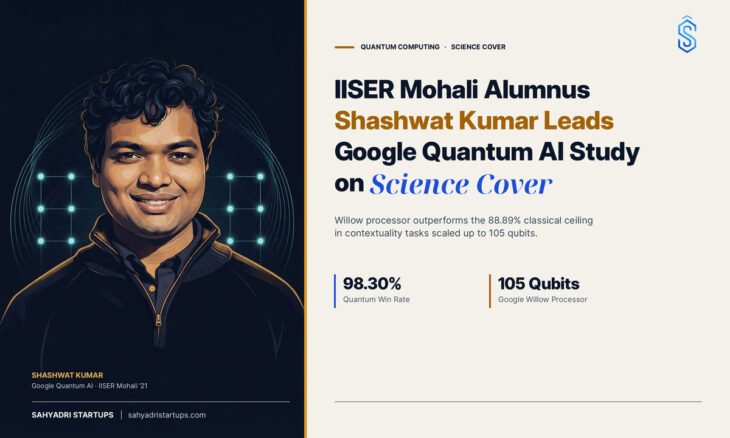
Shashwat Kumar, an IISER Mohali alumnus is among the researchers advancing Google’s quantum computing programme, with his work now featured on the cover of the prestigious scientific journal Science.
Shashwat Kumar, a BS-MS graduate of the Indian Institute of Science Education and Research (IISER) Mohali in 2021, is the first author of a Google Quantum AI paper demonstrating how quantum contextuality can help quantum processors outperform classical computing strategies.
The research, conducted using Google’s Willow quantum processor, recorded a 98.30% success rate in the mathematical ‘magic square game’, exceeding the maximum 88.89% achievable through classical strategies.
The team also demonstrated contextuality-based computational tasks involving systems of up to 105 qubits, extending experimental evidence of the phenomenon to significantly larger quantum systems.
The research paper, titled “Quantum-classical separation in bounded-resource tasks arising from measurement contextuality,” was published in Science on November 19, in Volume 394, Issue 6826, pages 870–874.
Google Willow Processor Demonstrates Quantum Advantage
The study examines quantum contextuality, a property of quantum mechanics in which measurement outcomes cannot be explained through predetermined values independent of the measurements performed alongside them.
While quantum entanglement has traditionally received considerable attention in discussions about quantum computing, researchers have increasingly explored contextuality as a potential resource behind certain quantum algorithms.
However, demonstrating the phenomenon in larger, many-qubit systems has remained an experimental challenge.
To investigate this, Google’s researchers used the magic square game, a coordination problem in which two players must produce compatible answers without communicating.
The players receive different instructions involving the rows and columns of a 3×3 grid and must satisfy specific mathematical conditions.
A classical strategy can achieve a maximum success rate of eight out of nine rounds, or 88.89%. Quantum mechanics allows the players to achieve a perfect score.
Using the Willow processor, the team tested all nine versions of the game 100,000 times each, completing 900,000 rounds.
The quantum system achieved a win rate of 98.30% (0.9830 ± 0.0001), with the remaining losses attributed to hardware noise.
The result provides an experimental demonstration of quantum performance beyond the classical limit in a task based on contextuality.
Researchers Measure Quantum Contextuality at 5.590
The team also quantified contextuality using a Bell-Kochen-Specker inequality, which distinguishes quantum measurement behaviour from theories that assume predetermined outcomes.
The measured parameter, represented by chi (χ), has a classical upper bound of 4, while quantum mechanics permits a value of up to 6. Google’s experiment recorded χ = 5.590 ± 0.008, substantially exceeding the classical limit.
The measurement was state-independent, meaning the result did not depend on the initial preparation of the qubits.
The experiment involved 540 consecutive measurements, repeated 1,000 times, with an additional ancilla qubit supporting the process.
Google Extends Experiments to 105 Qubits
Beyond the magic square game, the researchers tested two additional computational tasks to examine how contextuality-based quantum performance scales with processor size.
In the Greenberger-Horne-Zeilinger (GHZ) game, the team used up to 71 players, with one qubit representing each player.
Although increasing the number of participants introduced additional noise and reduced the success rate, the quantum system remained above the best classical strategy. The researchers also verified genuine entanglement across 45 qubits.
The second experiment involved a hidden linear function problem, for which the team implemented a shallow-circuit algorithm on grids containing up to 105 qubits.
Its success probability declined from approximately 1 to 0.6 at the largest processor size but remained above the conjectured classical bound.
These results demonstrate that contextuality-based tasks can be implemented across larger quantum systems rather than being restricted to experiments involving only a few particles.
A New Approach to Benchmarking Quantum Processors
An important implication of the research is its potential application in testing the performance and reliability of quantum processors.
Google said contextuality-based tasks can identify subtle coherent errors that conventional random-circuit benchmarks may overlook.
The experiments also use theoretical limits established by quantum mechanics, providing fixed reference points against which improvements in quantum hardware can be measured.
The paper describes the approach as one that “introduces benchmarking of quantum processors using contextuality-based algorithms.”
Google also identified potential applications in molecule simulation, chemistry and materials science.
Shashwat Kumar is a research scientist at Google Quantum AI and co-authored a Google Research blog explaining the experiments with Rodrigo Cortinas.
According to the paper’s author contribution statement, Kumar, E. Rosenberg, A. G. Dau and Cortinas made equal contributions to designing and executing the experiments, calibrating the processor and analysing the data. Michel Devoret and Pedram Roushan proposed the experiment and guided the research.
The paper’s editorial summary in Science, written by Jelena Stajic, states: “Google Quantum AI reports several experiments that exploit contextuality to outperform classical strategies in playing multiplayer games.”
The publication also includes a separate Perspective by Barbosa examining the findings.