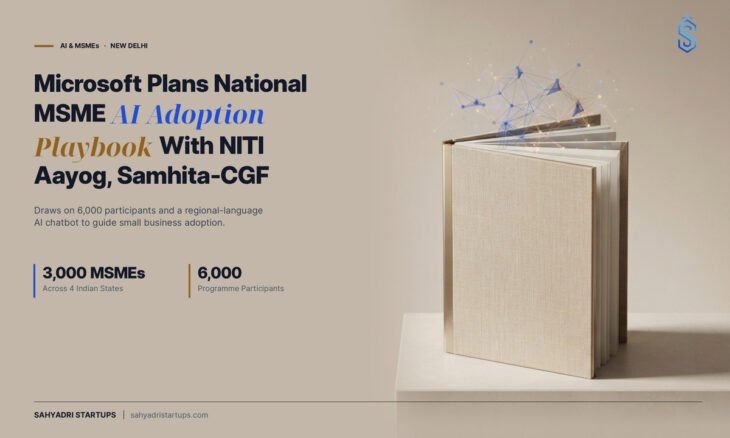
New Delhi: Microsoft India and Samhita-Collective Good Foundation (Samhita-CGF) are planning a National MSME AI Adoption Playbook to help small businesses across India integrate artificial intelligence into their operations.
The proposed framework will draw on the experiences of 6,000 individuals participating in Microsoft’s AI enablement programme and document practical use cases, implementation approaches and success stories.
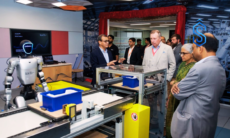
The plan was discussed at an AI Enablement for MSMEs Leadership Dialogue convened by Microsoft India and Samhita-CGF, alongside Atal Innovation Mission (AIM), NITI Aayog, in New Delhi on November 20.
The meeting brought together government representatives, industry leaders, MSME founders and ecosystem partners to examine the barriers preventing smaller businesses from adopting AI and the support needed to address them.
The proposed National MSME AI Adoption Playbook is expected to serve as a resource for industry associations, incubators and government institutions working to expand AI adoption across the country’s MSME sector.
Microsoft Targets 3,000 MSMEs Through AI Programme
The proposed National MSME AI Adoption Playbook builds on Microsoft’s ongoing AI Enablement for MSMEs initiative, which is working with 3,000 businesses across Andhra Pradesh, Delhi-NCR, Karnataka and Maharashtra.
The programme follows a 60-day learning journey that helps participating enterprises identify and integrate AI workflows across business functions, with the objective of improving productivity, operational efficiency and scalability.
The leadership dialogue also examined the economic opportunities associated with wider AI adoption, including its potential impact on business growth and employment generation.
Dr. Deepak Bagla, Mission Director, Atal Innovation Mission, NITI Aayog, said making AI accessible to smaller businesses would be important for India’s next phase of economic growth.
“India’s next leap of growth depends on how we democratize AI, so that even the smallest businesses can adopt it without the barriers of expertise, time and cost.
The biggest delta advantage in value creation from AI will come from our MSMEs and the self-employed. Their aim is not just to create financial unicorns but also to create social unicorns by impacting over a billion lives,” said Dr. Bagla.
Microsoft Introduces Regional-Language AI Chatbot
A key development announced at the meeting was the introduction of a multilingual AI chatbot by Microsoft India and Samhita-CGF, which is the programme’s delivery partner.
Designed to operate in the regional languages used by participating MSMEs, the chatbot will help businesses continue learning about and applying AI in their daily operations after completing the 60-day training programme.
The partners also plan to expand the tool’s reach to MSMEs across the country.
Sanjay Chadha, General Manager, Corporate, External and Legal Affairs (CELA), Microsoft India & South Asia, said the next stage of India’s digital transformation would depend on whether businesses could translate technology access into productivity gains.
“India’s Digital Public Infrastructure brought millions of MSMEs into the digital economy. In the age of AI, the next frontier is productivity. When small businesses adopt AI with the right skills and the trust that it is being used responsibly, their people do higher-value work, firms grow and new jobs follow.
We are working with India’s incubation network to help MSMEs move from AI awareness to adoption, and to make responsible AI the foundation of lasting economic mobility,” said Chadha.
National MSME AI Adoption Playbook to Guide Wider AI Adoption Among Small Businesses
The National MSME AI Adoption Playbook will consolidate lessons from the programme’s training activities, including how businesses are applying AI and the challenges they encounter during implementation.
The framework is intended to help organisations supporting MSMEs move beyond introductory AI awareness programmes towards practical adoption.
Its findings could also provide industry bodies, incubators and government institutions with approaches that can be adapted for businesses across different sectors and regions.
Priya Naik, CEO, Samhita-CGF, said the growing integration of generative AI into everyday productivity tools was creating an opportunity for smaller enterprises to adopt the technology.
“The timing is right. Generative AI now sits inside everyday productivity tools, India’s AI infrastructure is expanding, and larger enterprises are raising digital expectations for MSMEs. This initiative could not have come at a better time.
I am thankful to Microsoft for being the pillar that is bringing together capacity building, thought leadership, systems-level approach and meaningful collaboration with the government and enabling the success of this initiative” said Naik.