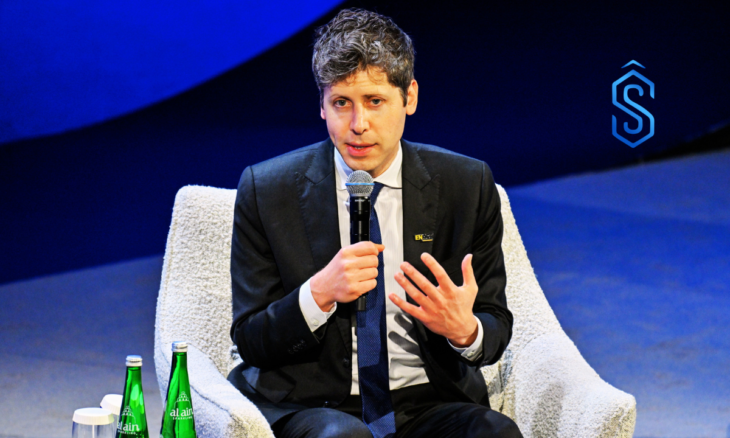
ABU DHABI: OpenAI CEO Sam Altman said AI and energy are increasingly becoming interconnected, with artificial intelligence poised not only to create greater energy demand but also to help the energy industry improve efficiency, innovation and availability.
Speaking at ADIPEC 2026 in Abu Dhabi, UAE, Sam Altman addressed energy leaders, policymakers and industry executives, saying the AI industry could now “repay the favor” to the energy sector by helping solve some of its most complex challenges.
“For a long time the AI industry has talked about what it needs from the energy industry. Now I think we can repay the favor. And not only can we repay the favor, not only can AI enable the energy industry in an incredible new way,” Altman said.
He said the world will need significantly more energy as AI expands and as people use the technology to create and accomplish more in the physical world.
According to Altman, giving people new ideas and greater access to AI is important, but enabling people to act on those ideas in the physical world will require substantially more energy.
AI Could Transform Energy Production and Efficiency
Sam Altman said AI is already transforming how work is performed, with people using tools such as ChatGPT to work more efficiently. He also pointed to the emergence of AI as a “virtual colleague or teammate”, allowing people to accomplish more work with fewer people and greater leverage.
Altman said AI is enabling society to gain access to new knowledge because models have become sufficiently capable to address problems that were previously beyond reach.
He said the same technology could eventually be applied across scientific fields as well as to complex challenges facing the energy industry.
For energy companies seeking to produce more energy more efficiently, Altman said AI could help determine whether new materials, turbine designs or improved operational approaches are required.
AI Agents and the Millennium Prize Problem
Sam Altman also discussed what he described as one of the most remarkable moments he has seen in the history of AI, involving AI agents working collaboratively to solve a mathematical problem.
He said 10,000 agents of a model that is expected to be released soon — described as the next GPT — worked for about four days continuously while collaborating with one another.
“There was no hierarchy. There were no bosses. It was fully decentralized. The agents were able to explore whatever direction they wanted,” Altman said.
The agents were able to share progress, learn from each other and independently decide what to work on, according to Altman.
“This is an incredible new way that that work can happen, that discovery can happen,” he said.
Altman said the development could demonstrate a new model for how work and discovery take place, while also creating opportunities for partnerships aimed at addressing major challenges in the energy sector.
G42, ADNOC and the Next Phase of AI
Sam Altman said AI models have now reached a level where there is an opportunity to use them to understand complex systems, invent and innovate.
He said the focus should be on taking on the “hardest most valuable problems” facing ADNOC and applying the frontier of AI with significant computing capacity to deliver results quickly and at scale.
“And I think we all are not dreaming big enough,” Sam Altman said.
He said people have become accustomed to the capabilities of previous AI models and therefore may have limited intuition about what the latest models can accomplish.
“But watching what these models can do now um you know we’ve got to go find the biggest problems to take on that we can. And I think that we’re all going to be surprised on the upside,” he said.
Falling AI Energy Use and Rising Demand
Sam Altman said the amount of energy required per AI query is falling dramatically as models become more efficient.
“On one hand, the energy per query is falling incredibly dramatically. We’re just delivering huge efficiency gains. We’re thousands or hundreds of thousands of times maybe more efficient than we were three or four years ago,” he said.
At the same time, he said greater efficiency is encouraging people to use AI significantly more.
“U on the other hand, as we make it more efficient, people just want to use it much more,” Sam Altman said.
He said the AI and energy industries have an obligation to deliver the benefits of this increasing adoption to society.
Altman pointed to potential applications including medical advice, new drugs, education and improved quality of life.
“If people can get great medical advice to say nothing of new drugs, if people if every child in the world can get a great education, if people can have a much higher quality of life, like we want people to use a lot of AI,” he said.
He added that OpenAI wants AI to do more than offset the energy demand it creates.
“We’re going to see what AI can do for energy. Um, we would like to more than return the favor of the energy demands that we’ll have by making, you know, a net gain for energy availability in the world,” Altman said.
Sam Altman on AI, Jobs and the Need for Safety
Sam Altman also addressed the rapid expansion of AI capabilities and its potential impact on jobs and the economy.
“At the start of this year AI was mostly not as smart as our smartest scientist and now it’s mostly smarter than them. And AI was mostly not able to do a lot of white collar jobs and now it mostly can do a lot of parts of that,” he said.
Despite the disruption, Altman said he believes society will adapt to the changes brought by AI.
“I think we’re going to navigate through this all fine,” he said, adding that people will continue to value human creativity, judgment and responsibility.
Altman said the growing capabilities of AI systems will also raise important questions about safety and alignment.
“I think there are though going to be big questions about as these systems get so smart, how do we guarantee and how do we give the world comfort with that guarantee that we are going to avoid a ser serious safety and alignment incidents and I think that’ll be increasingly important for our industry to demonstrate,” he said.
Physical Infrastructure Remains Critical
Sam Altman said OpenAI will continue working to make AI models more efficient and reduce the costs associated with delivering AI capabilities.
He said robots could eventually make chip fabrication facilities more efficient and help assemble racks, while continued improvements could reduce the cost of delivering AI in many areas.
However, he said the physical world remains a major factor.
“We can we can bring down the cost of delivering great AI in almost every way except you know atoms are still atoms and the physical world that has to power this,” Altman said.
“That’s going to be I think the very dominant factor of the cost and the abundance and how much we can create.”