
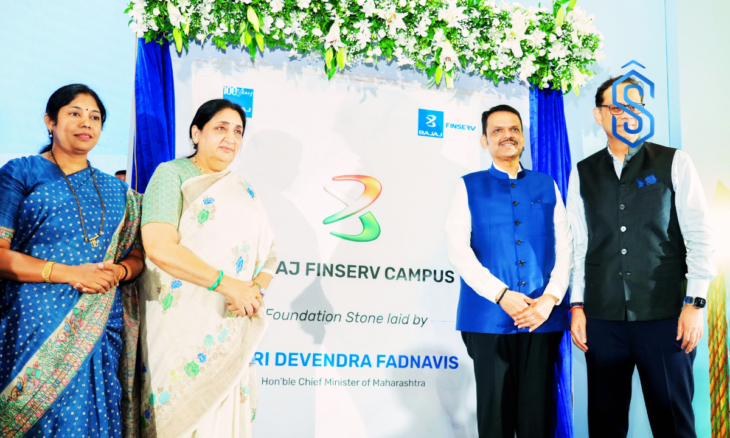
Pune: Maharashtra Chief Minister Devendra Fadnavis has called for the fintech ecosystem to be expanded beyond Mumbai and Pune, with similar ecosystems to be established in Nashik, Chhatrapati Sambhajinagar and Nagpur.
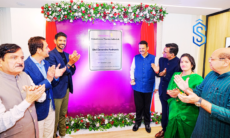
Speaking at the foundation stone laying ceremony of the Bajaj Finserv Campus in Pune, Fadnavis said the state needs to extend the growth of fintech and financial services to other major cities.
Fadnavis said Mumbai and Pune have emerged as the country’s two major fintech ecosystem capitals, but Maharashtra now needs to broaden this ecosystem across the state.
He said the Bajaj Finserv Campus and Bajaj Finserv’s role in the financial services and fintech sectors could contribute significantly to this expansion.
“In fact, there is now a need to take this ecosystem beyond these cities as well. Along with Mumbai and Pune, we need to establish this ecosystem in Nashik, Chhatrapati Sambhajinagar and Nagpur as well,” he said.
Fadnavis said he had discussed the matter with Sanjeev Bajaj and extended an invitation to him to visit Nagpur.
“Just now, while we were sitting together, we discussed this with Sanjeevji and extended an invitation to him to come to Nagpur. I am confident that we will soon see Bajaj Finserv operating in Nagpur as well,” he said.
Bajaj Finserv’s Financial Services and Fintech Presence
Fadnavis also highlighted the scale of Bajaj Finance and Bajaj Finserv Campus operations in the financial services sector, saying the companies have established a strong base over the past several years.
According to him, more than 8.5 crore people use the app, while the customer base stands at 18 crore. More than 1.25 lakh people are also part of the organisation.
“Therefore, we can look at this as a very large and influential family in this sector,” Fadnavis said.
He further praised Bajaj’s standards in the financial services sector and pointed to its net NPA of less than half a per cent despite its large customer base.
“With a net NPA of less than half a per cent, despite having such a large customer base, operating financial services in this manner is, I believe, extremely important,” he said.
India’s Digital Economy and Bajaj Finserv’s Fintech Role
Fadnavis said India’s digital economy has expanded significantly following the launch of initiatives that accelerated digital transactions. He specifically highlighted the development of UPI as a gateway for the country’s digital economy.
“We all know that when Prime Minister Modi initiated the digital economy, India subsequently created new records on a large scale in the digital economy. After creating a gateway like UPI, digital transactions began growing in the manner that we have witnessed,” he said.
According to Fadnavis, India currently accounts for 40 per cent of the world’s digital transactions.
“Today, it is truly a matter of pride for all of us that India is the country accounting for 40 per cent of the world’s digital transactions, and the country has now left everyone behind. We are the number one in digital transactions in the entire world,” he said.
He said digitisation has created several opportunities, particularly in fintech, financial services and insurance, where seamless systems have emerged.
Fadnavis cited the ease with which consumers can now obtain financial services digitally, contrasting it with the lengthy processes involved in obtaining loans in the past.
“Today, we see that in several areas, when a person is able to obtain a loan through Bajaj Finserv without any physical interaction, one is compelled to ask: Is this the same India?” he said.
“There was a time when obtaining a loan meant making rounds for six months or a year, while dealing with numerous documents and several difficulties. Today, however, such seamless interfaces have been created.”
Mumbai, Pune Emerge as Fintech Ecosystem Capitals
Fadnavis said Mumbai and Pune have emerged as the two major fintech ecosystem capitals of the country.
“Now, Mumbai and Pune have become the two cities that are the fintech ecosystem capitals of the country. Today, in the fintech sector, we are leaving everyone else behind,” he said.
“In the first quarter of 2026, Mumbai has overtaken Bengaluru, and Mumbai has now emerged as the number one city in financial technology and fintech investments,” Fadnavis said.
He further said 61 per cent of the fintech investments that came into the country during the first quarter went to Mumbai alone.
“In particular, if we look at this, of the fintech investments that came into the country during the first quarter, 61 per cent came to Mumbai alone,” he said.
Fadnavis said a significant ecosystem is being created around fintech, with Mumbai developing strong ecosystems in areas such as insurtech and wealthtech, while Pune is also emerging as an important fintech centre.
He added that there is a large search for fintech startups in Maharashtra, with nearly 69 per cent of searches for fintech startups being recorded in the state and investments worth nearly $900 million being witnessed in the sector.
Maharashtra Plans Fintech Expansion to Nashik, Chhatrapati Sambhajinagar and Nagpur
The focus on expanding fintech activity to other cities comes as Maharashtra seeks to build on the existing ecosystems in Mumbai and Pune. Fadnavis specifically named Nashik, Chhatrapati Sambhajinagar and Nagpur as cities where similar fintech ecosystems should be established.
The proposed expansion would take the fintech ecosystem beyond the state’s two established centres and create a broader footprint for financial technology, financial services and related sectors.
“In fact, there is now a need to take this ecosystem beyond these cities as well. Along with Mumbai and Pune, we need to establish this ecosystem in Nashik, Chhatrapati Sambhajinagar and Nagpur as well,” he said.
Fadnavis also said he had discussed the expansion with Sanjeev Bajaj and invited him to Nagpur.
“Just now, while we were sitting together, we discussed this with Sanjeevji and extended an invitation to him to come to Nagpur. I am confident that we will soon see Bajaj Finserv operating in Nagpur as well,” he said.
He also said Maharashtra, particularly Mumbai and Pune, has moved ahead of Bengaluru in several areas, including transactions and banking.
Fadnavis said the state has prepared a dedicated policy to further expand the fintech ecosystem.
“To take this even further in the coming period, we have prepared a very well-defined and dedicated policy through which we can certainly expand this entire ecosystem,” he said.
Bajaj Finserv Campus: Maharashtra Seeks to Retain Dominance in Digital Lending and Insurance
Fadnavis said Maharashtra wants to retain its dominance in domestic retail insurance and digital lending markets.
“In fact, our effort is: ‘We want to maintain our dominance in domestic retail insurance and digital lending markets,’ and in your core areas, we want Maharashtra to retain its dominance and prominence,” he said.
He said Bajaj Finserv should be viewed as a partner in achieving this objective.
Bajaj Finserv Campus to Host 400 Employees
Fadnavis said the Bajaj Finserv Campus being developed in Pune would become a major ecosystem, describing it as potentially the largest in the country while also emphasising its focus on intelligence and sustainability.
“While doing all of this, one thing is certain. The campus that is being created here and the kind of ecosystem that is being developed here will, I believe, be the largest in the country.
But it will not merely be the largest; it will also be the country’s most intelligent and, at the same time, most sustainable ecosystem,” he said.
The Bajaj Finserv Campus will host 400 employees, which Fadnavis described as a substantial number.
“And it will host 400 employees. Just imagine—400 employees means one entire city,” he said.
Fadnavis compared the number with the populations of major cities in several countries, saying some cities have populations of 40,000 or 50,000.
“A single campus is going to accommodate so many people, and therefore this is necessary,” he said.
Infrastructure and Mobility Support for Bajaj Finserv Campus
Fadnavis also discussed concerns regarding access, evacuation and mobility arrangements around the Bajaj Finserv Campus.
He said Sanjeev Bajaj had raised concerns about whether the necessary arrangements for entry, exit, evacuation and mobility would be created while the campus is being built.
“Sanjeev also has a concern that, while he will build this in three years, the arrangements required for entry, exit, evacuation and mobility here—whether you will create those arrangements or not—is something that needs to be addressed,” Fadnavis said.
“Therefore, I am giving them the task today itself that we are now starting a race with you. We will construct the road in front of you and the additional bridge that you require,” Fadnavis said. He said an additional bridge would be required to provide connectivity on one side.
“When we come here for the inauguration of this campus, I assure you that all the work related to entry, exit and mobility will certainly have been completed by then,” he said.
Pune Art and Culture Centre Proposed
Fadnavis also referred to a proposal by Sanjeevji to establish an art and culture centre in Pune.
“And Sanjeevji told me something very good earlier—that he wants to create a very good art and culture centre in Pune,” he said.
He directed the Mayor and officials to identify a suitable plot of land for the proposed centre.
Pune Infrastructure Push to Support Urbanisation
Fadnavis said Pune is among the fastest-growing cities and that the state government has resolved to create infrastructure capable of supporting the pace of urbanisation in Pune and the Pune Metropolitan Region (PMR).
He said work is underway on several major infrastructure projects, including Pune’s new airport, Outer Ring Road, Inner Ring Road, High Capacity Mass Transit Route (HCMTR) and a network of tunnels.
“We are, of course, starting Pune’s new airport, but along with that, we are also working on the Outer Ring Road, Inner Ring Road, HCMTR and a network of tunnels in Pune, so that Pune can have the fastest mobility,” Fadnavis said.
“Along with this, we have the Metro and our PMPML bus system. By integrating all these systems, we have decided to transform Pune into a city with the fastest mobility over the next three to four years, unlike the situation that Bengaluru is facing today, where the city is struggling with mobility,” he said.