

Mumbai: Grade A mall space demand continued to outpace new supply across India’s top seven cities during the first half of 2026, highlighting a growing structural shortage of premium retail real estate.
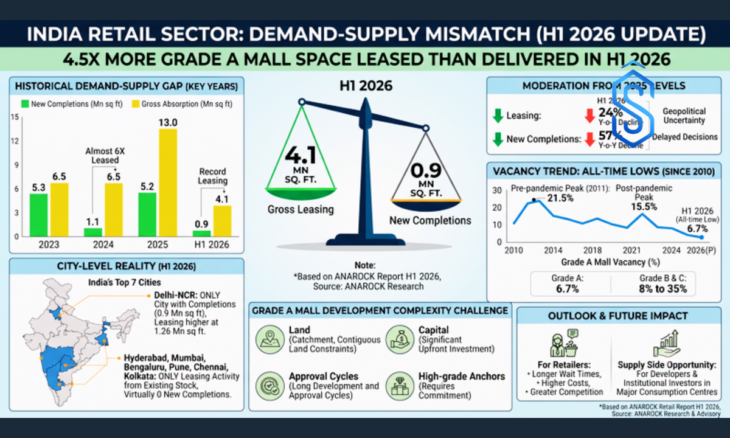
According to the latest ANAROCK Research data, gross leasing of Grade A mall space reached approximately 4.1 million sq. ft. in H1 2026, while only around 0.9 million sq. ft. of new Grade A mall completions were delivered during the same period.
The report noted that retailers leased nearly 4.5 times the amount of new space delivered, underscoring the widening gap between demand and supply in India’s premium retail market.
According to ANAROCK Research, retail leasing once again outpaced new Grade A mall completions across India’s top seven cities despite moderation in both leasing activity and new supply compared to the exceptionally strong levels recorded in 2025.
In 2025, new Grade A mall supply stood at approximately 5.2 million sq. ft., while leasing surged to a record 13 million sq. ft. During H1 2026, leasing declined by around 24% year-on-year and new completions dropped approximately 57% year-on-year.
Only Delhi-NCR recorded new Grade A mall space completions during the first half of 2026, adding approximately 0.9 million sq. ft. of supply. However, leasing in the region still exceeded deliveries, reaching nearly 1.26 million sq. ft.
Meanwhile, Hyderabad, Mumbai, Bengaluru, Pune, Chennai and Kolkata witnessed leasing activity but virtually no new Grade A mall completions, indicating that retailers continued leasing from an increasingly constrained stock of existing premium malls.
Anuj Kejriwal, CEO – Retail & CEO – Europe, Middle East & Africa, ANAROCK Group, said, “The supply problem is cumulative and escalating – data of India’s top 7 cities over the past 16 years shows a persistent mismatch between Grade A retail supply and leasing demand.
While new mall completions fluctuated sharply from year to year, leasing demand has steadily absorbed available Grade A space, pushing vacancy rates lower. We now have a chronically supply-constrained market where retailers’ the biggest challenge is not drawing shoppers but finding the right spaces to serve them in.”
He further said, “This gap has deepened in the recent few years – in 2023, the top 7 cities added approx. 5.3 Mn sq. ft. of new Grade A retail supply against gross leasing of 6.5 Mn sq. ft.
In 2024, new supply fell sharply to just 1.1 Mn sq. ft., while leasing stayed at 6.5 Mn sq. ft. – almost six times the newly added space. While new mall supply recovered partially in 2025 with 5.2 Mn sq. ft. of new completions, leasing surged to a record 13 Mn sq. ft.”
Also Read: Apollo Hospitals Partners with The ePlane Company to Launch Electric Air Ambulances in India
Grade A Mall Space: Demand-Supply Gap Widens
The H1 2026 data points to a further widening of the structural imbalance between demand and supply for Grade A mall space, as geopolitical uncertainty delayed mall deliveries and influenced some retailers to defer expansion decisions.
Although leasing activity moderated from the previous year, demand continued to substantially exceed the pace of new supply. Gross retail leasing reached approximately 4.1 million sq. ft., compared with just 0.9 million sq. ft. of new Grade A mall completions.
The report stated that retailers leased nearly 4.5 times the amount of newly delivered space during the first six months of the year.
Why Grade A Mall Development Remains Challenging
ANAROCK noted that the shortage of Grade A mall space is not merely due to developers failing to respond to market demand. Developing large-format premium retail assets involves multiple challenges.
Grade A malls require large contiguous land parcels in strategic locations, substantial upfront investment, extensive consumer and catchment analysis, commitments from high-quality anchor tenants, and significantly longer development and approval timelines than many other real estate asset classes.
Commenting on these challenges, Kejriwal said, “The availability of suitable land is itself a constraint in established urban markets, while rising land costs can make new projects difficult to structure.
Approval timelines, financing conditions and construction schedules can further delay project delivery. 2024 demonstrated how quickly supply pipelines can be disrupted – new Grade A completions fell to just 1.1 million sq. ft. that year, despite robust leasing demand.”
The report added that the 57% year-on-year decline in new completions during H1 2026 serves as a reminder that retail supply cannot be rapidly expanded in response to increasing retailer demand.
Vacancy Falls to Lowest Level Since 2010
The tightening demand-supply balance for Grade A mall space is also reflected in vacancy levels.
According to ANAROCK Research, vacancy across Grade A malls in the top seven cities declined to 6.7% in H1 2026, the lowest level recorded since 2010.
Before the pandemic, the highest vacancy rate in Grade A malls was 21.5% in 2011, while after the pandemic it peaked at 15.5% in 2021 before steadily declining.
In contrast, Grade B and Grade C malls across major cities continue to report considerably higher vacancy levels, ranging from around 8% to as much as 35%.
The report noted that India does not lack retail real estate in terms of total built-up area but faces a shortage of well-located, professionally managed, institutionally owned Grade A and A+ mall space capable of meeting the requirements of large domestic and international retailers.
Grade A Mall Space: Opportunity for Developers and Investors
According to ANAROCK, the combination of low vacancy, sustained retailer demand and continued expansion of experience-led consumption presents a significant opportunity for developers and institutional investors to build more high-quality Grade A mall space across India’s major consumption centres.
The report added that without a meaningful increase in new supply, retailers could face longer waiting periods for premium locations, higher occupancy costs and increased competition for Grade A mall space.