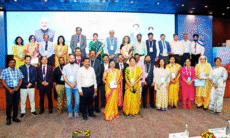

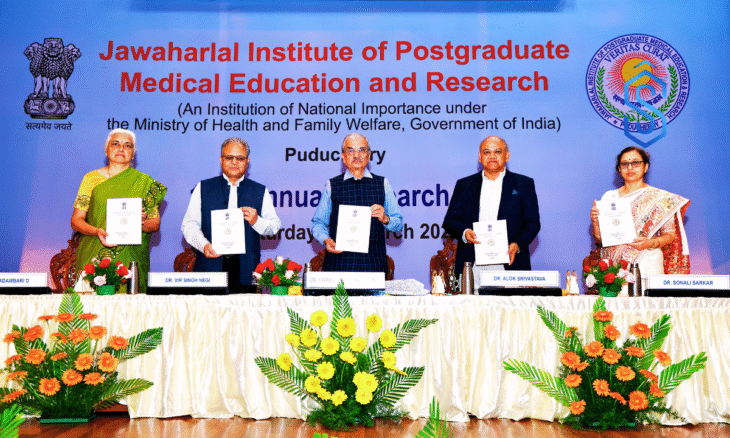
Chennai: The Jawaharlal Institute of Postgraduate Medical Education and Research (JIPMER), Puducherry, celebrated its 11th Annual Research Day on March 7, 2026, highlighting the institute’s continued commitment to strengthening biomedical, clinical, and translational research projects across healthcare disciplines.
Addressing the gathering, Vir Singh Negi, Director of JIPMER, highlighted the institute’s continued progress in strengthening research infrastructure and fostering innovation-driven research projects.
He noted the recent establishment of the Innovation, Incubation and Entrepreneurship (IIE) Cell, aimed at promoting translational science and supporting healthcare innovations that emerge from institutional research projects.
Also Read: Bacterial Gene Regulation: Indian Researchers Challenge 50-Year Sigma Cycle Theory
Dr. Negi also emphasized the expansion of undergraduate research opportunities at the institute. He noted that the Golden Jubilee Short-Term Research Award for Undergraduate Students (GJ-STRAUS) has been expanded from 22 to 40 awards, encouraging students to pursue innovative research projects and participate actively in academic inquiry and scientific exploration.
The Chief Guest, Narendra Kumar Arora, President of AIIMS Bilaspur, delivered the keynote address and highlighted the importance of evidence-based studies and robust research projects in strengthening healthcare systems and guiding effective public health policies.
He stressed that strong research ecosystems in medical institutions play a vital role in generating reliable evidence for policy formulation and clinical practice.
Chitra Sarkar, President of JIPMER, joined the inaugural ceremony virtually and extended her greetings to the participants. She emphasized the need for medical institutions to further strengthen biomedical innovation and collaborative research projects that can address emerging healthcare challenges.
The JIPMER Research Day Oration was delivered by Alok Srivastava, an internationally renowned hematologist and gene therapy researcher.
In his address, he discussed advances in translational science and innovations in the management of Hemophilia, highlighting how cutting-edge research projects are shaping new therapeutic approaches and improving patient outcomes.
The programme also included an interaction with experts from the Indian Institute of Technology Madras, focusing on interdisciplinary collaboration in medical technologies and healthcare innovation.
The session highlighted how collaborative research projects between medical institutions and engineering institutes can accelerate the development of advanced healthcare solutions.
JIPMER Research Projects: Translational Outcomes
Providing an overview of the institute’s research landscape, Kadambari D, Dean (Research) at JIPMER, outlined the vision of the Division of Research and noted that nearly 160 research projects are currently underway at the institution.
These research projects have received a total sanctioned funding of ₹112 crores from multiple funding agencies.
She also highlighted that researchers at JIPMER contributed to nearly 1,260 scientific publications in 2025, reflecting the institute’s growing academic output and the impact of its ongoing research projects in biomedical and clinical sciences.
Since 2017, the institute has filed 15 patent applications, out of which 10 have been granted, demonstrating the translational outcomes emerging from institutional research projects.
As part of the Research Day initiatives, JIPMER conducted three workshops between February and March 2026 focused on small animal research, grant writing, and advanced imaging technologies.
These capacity-building initiatives were designed to support researchers and strengthen the quality and execution of future research projects.
The event also featured around 250 oral and poster presentations across nine categories, with participation from undergraduate and postgraduate students, residents, faculty members, and research staff.
These presentations showcased diverse research projects spanning clinical medicine, biomedical sciences, and public health.
A new session titled “Innovation in Medicine” was introduced during this year’s Research Day. The session received enthusiastic participation, with several presentations highlighting the application of artificial intelligence and emerging technologies in biomedical and healthcare projects.
Through its Annual Research Day, JIPMER reaffirmed its focus on strengthening academic inquiry, fostering innovation, and expanding collaborative research that contribute to advancements in healthcare and medical science.