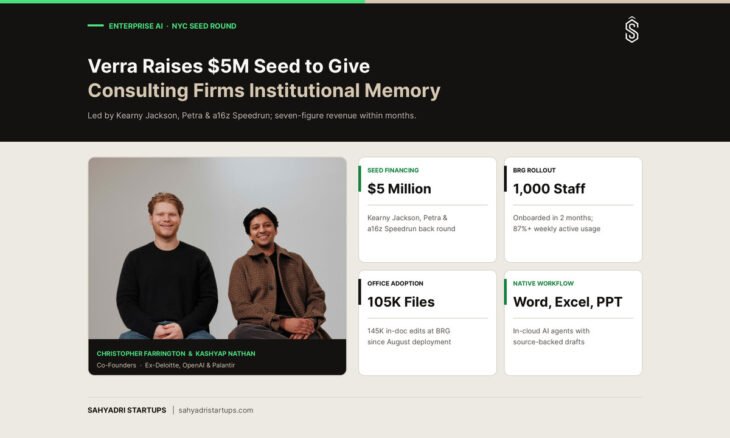
New York City, NY: AI startup Verra has raised $5 million in seed funding as it looks to expand an enterprise AI platform designed to help consulting firms reuse knowledge from previous client engagements.
The funding round was led by Kearny Jackson, with participation from Petra, a16z Speedrun and strategic angel investors.
The New York-based company said it reached seven-figure revenues within months of commercialisation.
Its platform has also secured adoption at Berkeley Research Group (BRG), where it was rolled out to 1,000 employees within two months of an initial proof of concept.
Verra plans to deploy the fresh capital towards product development, hiring and integrations with enterprise knowledge systems.
The company’s proposition centres on a recurring problem in consulting: firms accumulate years of research, financial models, proposals and client deliverables, but much of that work is difficult to locate and reuse when new assignments begin.
Rather than functioning primarily as a document search or text-generation tool, Verra uses a firm’s existing work to provide AI agents with the context needed to prepare new client deliverables.
Verra Reports Strong Adoption at Berkeley Research Group
Berkeley Research Group is among Verra’s early enterprise customers and has deployed the platform across its organisation under its own brand.
Since August, BRG consultants have used the platform to generate 105,000 files and make 145,000 edits directly within open Microsoft Office documents.
More than 87% of consultants across onboarded teams use Verra weekly, according to the company. The deployment is estimated to save thousands of analyst hours every week.
“Verra hands our teams finished, sourced first drafts on engagements that used to start from a blank page,” said Raghav Vadlamani, Global Managing Director, AI Solutions at Berkeley Research Group. “It has changed how quickly we move for clients.”
The Keystone Group, another early customer, has also implemented the platform across its organisation.
“The platform has allowed us to democratize institutional knowledge and provided a tailwind to a number of knowledge management initiatives,” said Amar Shah, Managing Partner at The Keystone Group.
These deployments are central to Verra’s pitch to consulting firms, where the ability to retrieve previous work and produce source-backed deliverables could reduce the time spent on repetitive research and analysis.
How Verra’s AI Platform Works
Verra operates within a customer’s own cloud environment and learns from its existing proposals, reports, models and other deliverables. It converts this material into reusable practice-specific knowledge that AI agents can apply to new assignments.
The platform works directly within Microsoft Word, Excel and PowerPoint. Its agents can identify relevant previous work, prepare analyses, build financial models and generate presentations, with references linking generated claims to their original sources.
The company has designed the system around three requirements of professional services firms: client information must remain within the firm’s environment, AI-generated outputs must be verifiable, and employees should not have to abandon their existing workflows to use the technology.
Verra also deploys engineering teams to configure workflows for individual practices, with the company saying these can be built within days.
Founded by Former OpenAI, Palantir and Deloitte Professionals
Founded in 2025, Verra was established by Kashyap Nathan, previously associated with OpenAI and Palantir, and Christopher Farrington, formerly of Deloitte.
The founders identified the difficulty of retrieving and reusing previous consulting work as an opportunity to build an AI platform specifically for professional services.
Commenting on the investment, Sriram Krishnan of Kearny Jackson said the speed of adoption among consulting teams was a key factor behind the firm’s interest.
“I’ve worked in consulting, and I’ve seen firsthand how much time goes into rinse-and-repeat work because a firm’s knowledge is difficult to reuse,” said Krishnan. “What stood out to us was how quickly Verra became critical to the firms using it. Consultants adopt it, use it and demand more of it. Verra is becoming the memory and operating layer for how consulting firms work.”
Verra Targets Accounting, Advisory and Investment Research
Beyond consulting, Verra plans to take its platform into adjacent professional services markets, including accounting, advisory and investment research.
The company also intends to expand its capabilities from individual practice-level deployments to firmwide intelligence systems. Another planned development is to let customers’ internal engineering teams build applications using Verra’s infrastructure instead of developing institutional knowledge systems independently.
The company sees the ability to retain and distribute expertise accumulated through client engagements as an increasingly important differentiator as AI tools make information and content generation more accessible.
As Nathan puts it: “Humans are really good at creating context. They’re really bad at sharing it.”