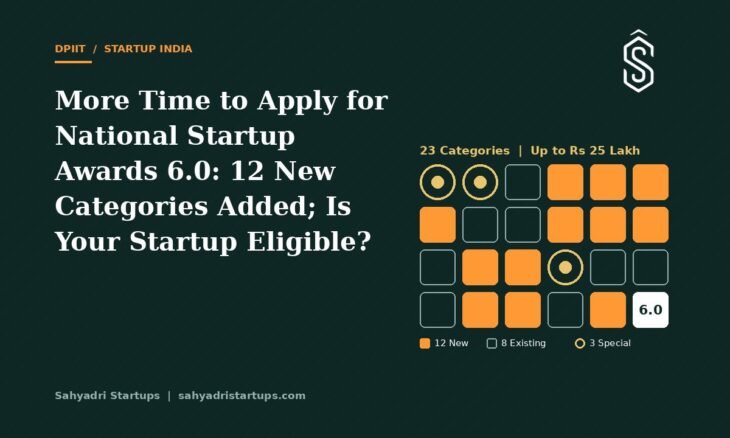
New Delhi: The Department for Promotion of Industry and Internal Trade (DPIIT) has extended the application deadline for the National Startup Awards 6.0, giving startups additional time to compete for national recognition and cash prizes of up to ₹25 lakh.
The extension comes as the sixth edition introduces 12 new sectoral categories and a separate award for student innovators.
The original application deadline was November 20, 2026. While Startup India announced the extension through its official LinkedIn account, its post did not specify a revised date.
November 30 has been mentioned in communications by other startup ecosystem bodies, although the revised date was not independently confirmed in DPIIT’s announcement.
With 20 sectoral categories and three special categories, National Startup Awards 6.0 seeks to recognise ventures across established industries as well as emerging areas such as semiconductor manufacturing, defence technology, space, ocean economy and advanced mobility.
National Startup Awards 6.0: ₹25 Lakh Prize Across Major Categories
The awards carry a cash prize of ₹25 lakh for winners in each of the 20 sectoral categories. The Women-Led Startup of the Year and North-East Startup Excellence special categories also offer ₹25 lakh each, subject to the award guidelines.
The third special category, Student Innovator / Aspiring Entrepreneur Award, follows a separate prize structure with a total allocation of ₹25 lakh across four sub-categories.
The student awards are distributed as follows:
- Budding Innovators (10–14 years): ₹3 lakh for the winner and ₹2 lakh for the runner-up.
- Rising Innovators (14–16 years): ₹3 lakh for the winner and ₹2 lakh for the runner-up.
- Young Changemaker (16–18 years): ₹4 lakh for the winner and ₹2 lakh for the runner-up.
- Emerging Entrepreneurs (18 years and above): ₹6 lakh for the winner and ₹3 lakh for the runner-up.
For participating startups, the programme also offers opportunities for mentorship, investor engagement, market access and industry partnerships.
These benefits extend the awards beyond a one-time cash incentive, particularly for ventures seeking greater visibility and connections within the business ecosystem.
12 New Categories Bring Emerging Industries Into the Awards Framework
The addition of 12 sectoral categories is a significant change in the sixth edition. The expanded coverage reflects the growing diversity of India’s startup ecosystem and brings several strategically important industries into the national awards programme.
The newly introduced categories include:
- Biomanufacturing
- Consumer Industries
- Defence and Security
- Rural Economy, Traditional Industries and Livelihoods
- Education and Skilling
- Electronics, Semiconductors and Advanced Manufacturing
- Sports, Fitness and Sports-Tech
- Future Mobility and Automotive
- Ocean and Blue Economy
- Space-Tech, Drones and Aerospace
- Telecom, Connectivity and Digital Infrastructure
- Travel, Tourism and Hospitality
The other eight categories cover Agriculture, AgriTech and Food Systems; DeepTech and Frontier Technologies; Climate-Tech, Clean Energy and Sustainability; Creative Industries, Media and Digital Content; FinTech, Financial Services and Inclusion; Food-Tech, Biotechnology and Nutrition; Healthcare, MedTech and Life Sciences; and Supply Chain and Logistics.
The expanded classification gives startups operating in specialised sectors more clearly defined categories in which to compete, rather than having to fit their businesses into broader industry groupings.
Student Innovator Award Opens Competition to Young Entrepreneurs
National Startup Awards 6.0 also introduces a separate recognition programme for school and college students, including those who have not yet established a formal startup.
Unlike the main award categories, the Student Innovator / Aspiring Entrepreneur Award does not require DPIIT recognition.
Applicants can participate individually or in teams of up to four members, provided they demonstrate a prototype, minimum viable product (MVP), working model or proof of concept.
The programme is structured around seven innovation streams under the theme ‘Shakti Ki Sapta Dhara’.
Evaluation will place the highest weight on innovation, accounting for 45 marks, followed by scalability at 25 marks, economic impact at 20 marks, and inclusivity and team diversity at 10 marks.
State and Union Territory nodal agencies can nominate up to 10 teams each. A national jury will subsequently select one winner and one runner-up in each of the four age-based sub-categories.
The category extends the awards’ reach to an earlier stage of entrepreneurship, allowing students to gain recognition for developing solutions before formally entering the startup ecosystem.
Financial Documentation and Previous-Winner Restrictions Could Affect Eligibility
For established ventures, the application requirements are an important consideration, particularly the financial documentation and restrictions on previous winners.
Applicants must have DPIIT recognition at the time of application and upload the corresponding recognition certificate. The startup must also be less than 10 years old from its date of incorporation as of the application deadline.
The financial documentation requirement covers audited statements for FY 2023-24, FY 2024-25 and FY 2025-26. Startups that are less than three years old can submit statements for the available financial years, while ventures less than one year old without audited statements are exempt.
Where FY 2025-26 audited statements are not yet available, provisional financial statements certified by a Chartered Accountant are accepted.
Other important conditions include:
- Startups that have won in any previous edition of the National Startup Awards cannot apply again.
- An applicant can participate in a maximum of three categories.
- Entities undergoing insolvency, liquidation or winding-up proceedings on the application deadline are ineligible.
- Material litigation, regulatory proceedings and investigations must be disclosed.
Applications will undergo screening, detailed assessment, due diligence and jury evaluation. The assessment parameters include innovation, scalability, market potential, demonstrated impact and sustainability.
Submitting an application or securing a place on the shortlist does not guarantee an award. The jury can also decide not to confer an award in a particular category.
National Startup Awards Applications Have Increased Over Previous Editions: DPIIT
The expansion of National Startup Awards 6.0 comes against a backdrop of growing participation in the programme.
The first edition in 2020 received 1,641 startup applications, of which 192 were shortlisted as finalists and 36 selected as winners. Applications increased to 2,177 in 2021 and 2,604 in 2022, when the programme also received 55 applications from incubators.
The 2023 edition recorded 2,335 startup applications across 19 categories. The fifth edition, held in 2025, attracted 3,163 applications across 20 categories.