Mumbai: Lord’s Mark Industries is preparing to enter India’s breast cancer screening market with a wearable, radiation-free breast cancer screening device, after securing a manufacturing licence that clears a key regulatory hurdle ahead of its planned January 2027 rollout.
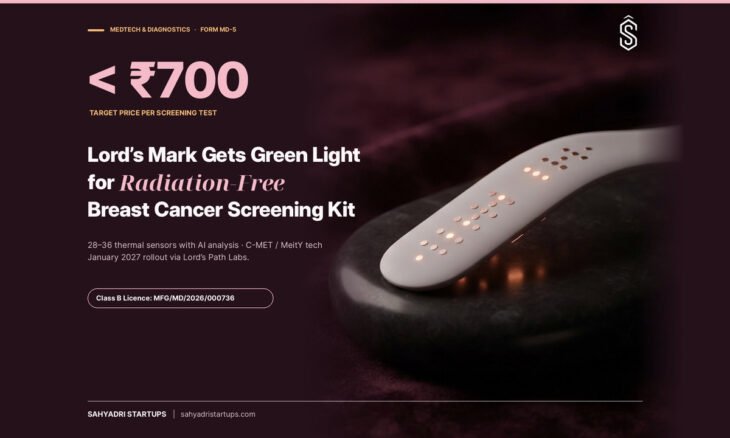
The company is targeting a price of less than ₹700 per test, positioning the product around affordability and wider access to preliminary screening.
The BSE-listed company disclosed the licence approval in an exchange filing on November 23, 2026. Issued under Form MD-5 of the Medical Devices Rules, 2017, the licence (MFG/MD/2026/000736) authorises the manufacture of its Class B medical device for sale or distribution.
The product, marketed as the Lords Med Breast Cancer Screening Kit, will initially be deployed through the company’s Lord’s Path Labs network.
Lord’s Mark is also looking to work with private hospitals, diagnostic laboratories and healthcare institutions, while exploring opportunities to integrate the service with government healthcare programmes.
How the radiation-free breast cancer screening kit works
The device uses a wearable system fitted with 28–36 thermal sensors to measure temperature patterns across the breast surface. Its AI-based technology analyses these patterns to identify variations that may indicate underlying biophysical abnormalities.
Unlike conventional imaging methods that use radiation, the company describes its approach as non-invasive and radiation-free.
Lord’s Mark intends to position the device as a first-line screening tool, with its findings guiding further diagnostic investigations where necessary. It is not being presented as a replacement for confirmatory diagnostic procedures.
The company also claims that the technology can screen women with dense breast tissue at an early stage. This capability, along with the proposed pricing, is expected to form part of its market positioning.
Management had discussed the product’s regulatory progress during an investor call on November 19, four days before the manufacturing licence was disclosed.
It indicated that a version designed for clinical use by physicians and general practitioners would follow in February 2027.
January 2027 launch and sub-₹700 pricing
Lord’s Mark is targeting a screening price below ₹700 per test. The proposed pricing is intended to make preliminary breast cancer screening more accessible, particularly through its diagnostic laboratory network.
The company plans to begin offering the service from January 2027 through Lord’s Path Labs before expanding distribution through institutional partnerships.
The commercial rollout will be an important test of whether the company can translate its technology into a scalable screening service.
Its ability to establish clinical acceptance, build partnerships and demonstrate the utility of the screening approach will be central to adoption.
From government research to commercial manufacturing
The device originated from technology developed at the Centre for Materials for Electronics Technology (C-MET), an autonomous scientific society under the Ministry of Electronics and Information Technology (MeitY).
In March 2026, Lord’s Mark announced a technology transfer agreement with C-MET covering the manufacture and commercialisation of an AI-powered wearable device for early breast cancer detection.
The agreement brought the technology into the company’s medical devices portfolio, with the manufacturing licence now providing the regulatory clearance needed to move towards commercial deployment.
The development also fits into a broader push to bring domestically developed medical technologies into the healthcare market.
India’s breast cancer burden presents a sizeable screening opportunity
The proposed launch comes amid a significant breast cancer burden in India. According to the International Agency for Research on Cancer (IARC), the country recorded an estimated 237,231 new breast cancer cases in 2024.
The disease accounted for 30.4% of all new cancer cases among Indian women.
The market opportunity is also attracting attention from medical technology companies. Citing Grand View Research, Lord’s Mark estimates that India’s breast cancer diagnostics market was valued at USD 179.7 million in 2025 and could reach USD 419.1 million by 2033, growing at a compound annual growth rate of 11.4% between 2026 and 2033.
For Lord’s Mark, the immediate opportunity lies in establishing a distribution network and generating demand for an affordable preliminary screening service.
However, the proposed price and commercial rollout will need to be assessed alongside clinical validation, regulatory requirements and adoption by healthcare providers.
Breast cancer kit adds to Lord’s Mark’s medical technology pipeline
The screening device is part of a wider expansion of Lord’s Mark’s healthcare and diagnostics business.
The company has already introduced its AI-enabled haemodialysis offering, Lord’s Renal Renalyx. In May 2026, it announced an AI-powered haemodialysis centre at Shakti Hospital in Ahmedabad.
It has outlined plans to establish 50 dialysis centres by March 2027, while management said during its November investor call that production of the Renalyx RXT 21 had commenced at its Bengaluru facility.
Other products in development include a sickle cell screening product, a gut microbiome testing offering and a CAR-T cell therapy programme.
The company is targeting a January 2027 launch for its sickle cell screening product, subject to manufacturing approval, while clinical trials for its CAR-T programme are scheduled to begin in February 2027.
In August 2026, Lord’s Mark also proposed separating its renewable energy and LED business into a new entity, Lords Shakti Power Limited, through a demerger.
Lord’s Mark reports ₹82 crore first-half profit
For the six months ended September 30, 2026, Lord’s Mark Industries reported revenue from operations of ₹718.77 crore and net profit of ₹82.01 crore.
Its first-half net profit was already higher than the ₹48.59 crore reported for the entire FY26, when revenue stood at ₹684.75 crore.
The company filed revised financial results on November 14 after identifying typographical errors in its original statements.
During the November 19 investor call, management indicated September-quarter consolidated revenue of approximately ₹411 crore and a profit after tax margin of 11.88%.
For FY2027, the company has guided for consolidated revenue of at least ₹1,550 crore and profit after tax of at least ₹178 crore.
Lord’s Mark Industries, listed on the BSE under scrip code 501261, operates across in-vitro diagnostics, medical technology, renewable energy and LED solutions. Its healthcare portfolio is marketed under the LordsMed brand.
The company underwent a change in ownership following the approval of a resolution plan by the Mumbai bench of the National Company Law Tribunal on July 28, 2025, under the Insolvency and Bankruptcy Code.
Lord’s Mark Industries Private Limited entered as the strategic investor. The monitoring committee constituted under the resolution process was discontinued with effect from November 15, 2026.
Dr. Sachidanand Upadhyay, Founder, Managing Director and CEO of Lord’s Mark Industries Limited, said: “At Lord’s Mark Industries, we believe healthcare innovation creates its greatest value when it reaches those who need it most.
Breast cancer remains a major healthcare challenge, and accessible screening can help encourage timely medical evaluation. Our radiation-free technology reflects our commitment to indigenous innovation with meaningful social impact.
Through affordable pricing and partnerships with government programmes, hospitals and diagnostic networks, we aim to extend screening access to more women across India. Our vision is to support earlier screening, timely medical intervention and better healthcare outcomes.”