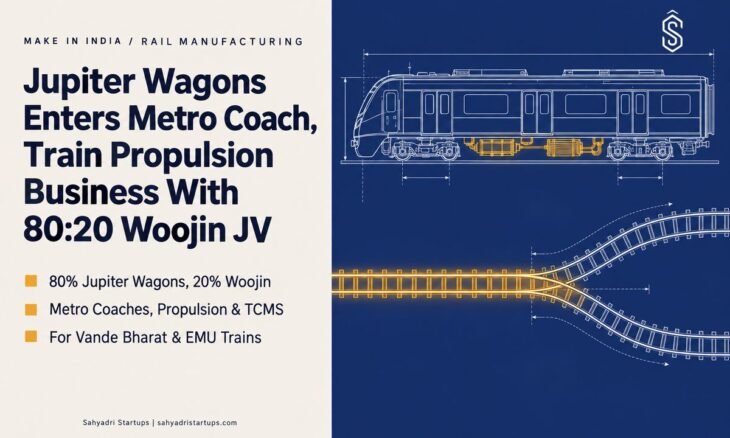
Jupiter Wagons Limited is moving into India’s passenger rail manufacturing market through a proposed joint venture with South Korea’s Woojin Industrial Systems, marking a significant expansion beyond its established freight wagon and railway components business.
Under a framework agreement executed on 23 November 2026, Jupiter Wagons will hold an 80% stake in the proposed Indian venture, while Woojin will own the remaining 20%.
The partnership will target metro rail projects and the domestic manufacturing of propulsion systems, with applications extending to electric multiple units (EMUs), Vande Bharat trains and semi-high-speed and high-speed railway projects.
The agreement gives Jupiter Wagons access to technology and engineering capabilities that could help it move further up the railway manufacturing value chain, from supplying individual components to participating in the production of complete passenger trainsets.
Jupiter Wagons and Woojin to Jointly Bid for Metro Projects
Under the agreement, the two companies will pursue Indian rolling stock opportunities through a consortium and a joint venture company. The proposed venture will jointly participate in metro tenders and manufacture metro coaches in India.
Jupiter Wagons will lead the consortium and take responsibility for financing and establishing the joint venture, including investments in land, plant, machinery and working capital. It will also oversee local execution.
Woojin, meanwhile, will contribute technical expertise, reference credentials, core components and technology transfer.
Its role will include transferring know-how for the local design, manufacture and maintenance of propulsion systems, train control and management systems (TCMS), EMUs and related railway equipment.
The technology transfer will cover propulsion systems for metro coaches, EMUs, Vande Bharat trains and other passenger railway applications. The arrangement also includes capabilities for manufacturing complete metro coaches with critical onboard systems.
The companies are yet to incorporate the proposed joint venture. Jupiter Wagons has not disclosed the investment commitment, manufacturing location or expected operational timeline.
Woojin Partnership Adds Propulsion Technology to Jupiter Wagons’ Portfolio
A major part of the agreement is the localisation of railway propulsion technology, a critical system responsible for converting electrical power into the movement of trains.
Woojin will transfer technology for propulsion systems and associated equipment, allowing Jupiter Wagons to develop manufacturing and maintenance capabilities in India.
The collaboration also covers TCMS, which manages and coordinates various train functions. These technologies have applications across metro networks, suburban rail systems and higher-speed passenger trains.
For Jupiter Wagons, the partnership represents an opportunity to build capabilities in areas that require specialised engineering and technology rather than limiting its passenger rail ambitions to coach manufacturing.
The company said the partnership would enable it to manufacture complete metro rakes with systems such as propulsion, TCMS, automatic doors and aluminium car bodies.
It also highlighted Woojin’s engineering experience across metro and commuter trains and South Korea’s KTX high-speed rail fleet.
Founded in 1974, Woojin has built a portfolio of railway electrical and control technologies. Its development milestones include auxiliary power systems for rolling stock, VVVF control technology and traction control equipment for Korea’s KTX high-speed trains.
Its project references include rolling stock orders for Seoul Metro, KORAIL and Busan Metro. In 2024, the company also undertook the refurbishment of 74 A650 heavy rail vehicles for LA Metro.
Woojin has additionally developed hydrogen fuel cell train technology, with a demonstration project scheduled for completion by the end of 2027.
Second Passenger Rail Partnership After PESA Agreement
The Woojin agreement follows another international partnership announced by Jupiter Wagons in October as the company steps up its efforts to enter the passenger rolling stock segment.
On 23 October 2026, Jupiter Wagons signed a non-binding memorandum of understanding with Poland-based Pojazdy Szynowe PESA Bydgoszcz S.A. to explore opportunities in metro, semi-high-speed and high-speed passenger rolling stock.
Jupiter Wagons has also incorporated Jupiter Rail Mobility Private Limited, a subsidiary intended to enter the rail passenger transport and engineering industry, according to its Q2 FY27 investor presentation.
The company already has several international technology partnerships covering railway components, braking systems and related equipment. These include its 50:50 joint ventures JWL-KOVIS India and JWL DAKO-CZ India, along with JWL Talegria.
Its strategic association with Slovakia’s Tatravagonka Poprad and its partnership with Italy’s Lucchini RS further strengthen its existing railway manufacturing ecosystem.
Jupiter Wagons’ ₹5,841 Crore Order Book Provides Business Context
The company reported an order book of ₹5,841 crore in its Q2 FY27 investor presentation dated 13 November 2026.
Among its recent wins was a ₹1,140 crore Ministry of Railways order for 2,583 BOXNHL and BOXNS wagons.
The company also received letters of intent from GATX India for 270 ACT2 automobile carrier wagons worth ₹214.94 crore and Chetak International for 135 ACT2 wagons valued at ₹109.10 crore.
More recently, on 20 November, Jupiter Wagons disclosed an order from JSW (South) Rail Logistics for five BFNSM1 rakes along with BVCM wagons, with an aggregate value exceeding ₹128 crore, including taxes.
For Q2 FY27, consolidated revenue from operations stood at ₹772 crore, compared with ₹671 crore in the preceding quarter. EBITDA was ₹94 crore, with a margin of 12.2%, while profit after tax came in at ₹46 crore.
For the first half of FY27, revenue increased 16% year-on-year to ₹1,443 crore, while PAT stood at ₹72 crore.
Managing Director Vivek Lohia had described the company’s entry into passenger rail as a “strategic entry into the Railway Passenger Segment.”