
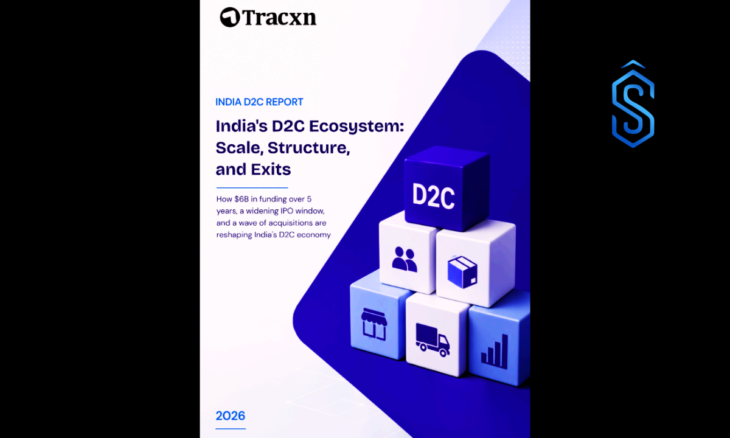
Bengaluru: India’s direct-to-consumer (D2C) sector has raised approximately $6 billion across nearly 2,000 equity funding rounds between January 2021 and August 2026, with companies increasingly moving towards public listings and acquisitions by established consumer businesses, according to the latest India D2C Report by market intelligence platform Tracxn.
Tracxn has released The Rise of India’s Consumer Brands: India D2C Report, and a Widening Exit Window, an ecosystem analysis covering funding, company leadership and exit activity across India’s D2C sector.
The India D2C Report tracks nearly $6 billion in equity funding across around 2,000 rounds during the period, alongside 15 IPOs and 105 acquisitions.
The report highlights a funding market where the pace of deal-making has remained relatively consistent even as funding values have shifted, while exits are increasingly being driven by public markets and acquisitions by established consumer conglomerates.
India D2C Funding Reaches Nearly $6 Billion
According to the India D2C Report, India’s D2C companies raised approximately $6 billion in equity funding across nearly 2,000 rounds between 2021 and 2026 YTD.
Annual funding peaked at $1.6 billion in 2022 before moderating to $824 million in 2024. Funding returned to growth in 2025, reaching $898 million, representing a 9% year-on-year increase.
Despite fluctuations in funding value, the pace of deal-making remained consistent throughout the period. Each full year recorded between 307 and 380 funding rounds.
Notably, 2024 registered the highest number of rounds during the period even as the total funding value fell to its lowest level.
The India D2C Report indicates that the number of deals has therefore remained relatively steady while the amount of capital deployed through individual rounds has changed significantly.
Seed and Early-Stage Funding Gains Share
The funding recovery in 2025 was driven largely by seed and early-stage investments, according to the India D2C Report.
Seed and early-stage capital accounted for 70% of total funding value in 2025, compared with 38% in 2021. Early-stage funding alone increased 66% from its 2023 trough.
Late-stage funding moved in the opposite direction. Its value declined 69% between 2022 and 2025, although the number of late-stage rounds returned to the 2021 level of 15.
The India D2C Report said the shift indicates that capital is reaching a broader base of companies at earlier stages compared with five years ago.
Also Read: Infineon Acquires Bangalore-Based C2i Semiconductors for AI Power Innovation
Lenskart, Licious Lead D2C Funding Leaderboard
The India D2C Report identifies five companies as the leading names on India’s D2C funding leaderboard: Lenskart, Licious, FreshToHome, BlueStone and Country Delight.
Together, these companies have raised $2.3 billion across their lifetimes. The group covers four consumer categories — eyewear, meat and seafood, jewellery, and dairy — with each company having operated for at least a decade.
Funding activity has continued among some of these established D2C businesses. FreshToHome raised $15 million in January 2026, while Country Delight secured $7 million in May 2026.
The funding concentration among the top five companies is significant. Lenskart’s $981 million in funding represents roughly 43% of the group’s combined funding.
Lenskart and Licious, the two most-funded companies, together account for about 65% of the total, leaving the remaining three companies with the other 35%.
The India D2C Report also notes that two of the five companies — Lenskart and BlueStone — have already entered public markets. Licious, meanwhile, has stated that it intends to achieve profitability before pursuing an IPO planned for 2027–28.
India D2C Report Highlights Expanding IPO Route
India recorded 15 D2C IPOs between 2021 and 2026 YTD, according to the India D2C Report.
The report’s five most notable IPO examples demonstrate that companies with very different funding histories are now reaching the public markets.
Lenskart listed in November 2025 after raising $981 million privately. Its investors included SoftBank Vision Fund, Temasek, KKR and ADIA, among dozens of other investors.
At the other end of the spectrum, Credo Brands, the owner of menswear brand Mufti, reached the public market in December 2023 without raising institutional funding. The company had been operating since 1998.
The India D2C Report highlights a clear difference in the time taken by companies with and without institutional backing to reach the public market.
Credo Brands, the only unfunded company among the five notable IPOs, took 25 years to go public. The four funded companies reached IPOs between seven and 17 years after founding.
Honasa Consumer, which raised $126 million, took seven years to reach the public market, representing the fastest path among the group. Lenskart, with $981 million raised, took 17 years, making it the slowest among the four funded companies.
Within this group, the India D2C Report found that institutional capital was associated with a shorter path to a public listing.
Conglomerates Increase D2C Acquisition Activity
The India D2C Report recorded 105 D2C acquisitions in India between 2021 and 2026 YTD.
Among the five most notable transactions highlighted in the report, all the acquirers are established consumer-facing companies rather than financial investors.
The acquirers include Hindustan Unilever and Wipro Consumer Care in FMCG, Reliance Retail and Aditya Birla Group’s TMRW in diversified retail, and pharmaceutical major USV India.
Hindustan Unilever’s $350 million acquisition of skincare brand Minimalist in January 2025 was the largest disclosed transaction among the report’s five most notable D2C acquisitions.
The India D2C Report also highlights Reliance Retail’s acquisition of Clovia in March 2022, for an undisclosed amount, and Hindustan Unilever’s $350 million acquisition of Minimalist in January 2025.
Wipro Consumer Care and USV India both completed acquisitions during the first half of 2026, adding to the broader activity by established companies acquiring D2C brands.
D2C Exit Landscape Broadens
The findings of the India D2C Report point to an evolving exit landscape for India’s consumer brands, with both IPOs and strategic acquisitions emerging as important routes.
On the public-market side, companies with substantial institutional backing and those that have grown organically have reached the same market.
Lenskart raised $981 million privately before its listing, while Credo Brands grew organically for more than two decades before its 2023 IPO.
On the acquisition side, established FMCG, retail and pharmaceutical companies are acquiring digital-first consumer brands built by D2C founders and investors.
Overall, the India D2C Report tracks a D2C ecosystem that has maintained a consistent pace of deal-making while the composition of funding and exit activity has changed.
The report covers approximately $6 billion in equity funding, nearly 2,000 funding rounds, 15 IPOs and 105 acquisitions between 2021 and 2026 YTD.