


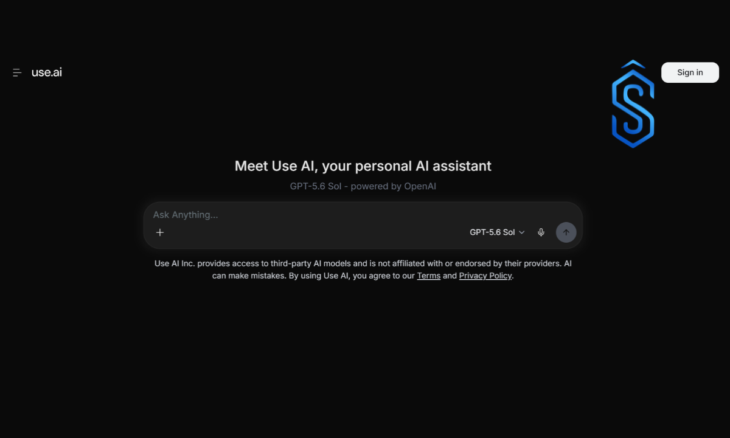
San Francisco, CA: Use.ai has reached one million monthly active users less than a year after its launch, as the all-in-one AI workspace expands access to more than 10 major AI models through a single subscription and interface.
Every new AI model creates another reason for users to switch. However, for people who have spent months or years building conversations, preferences, files and personal context within one platform, moving to another model can also mean starting over.
Use.ai was built around the idea that users should be able to switch between the AI models they use without changing their interface or losing their context.
Less than a year after launch, the all-in-one AI workspace has reached one million monthly active users, providing access to more than 10 leading AI models, including GPT, Claude, Gemini, Grok and DeepSeek, within a single conversation.
The Origin of Use.ai
Use.ai grew out of Co-Founder Ihor Herasymov’s frustration with moving between different AI platforms.
A former M&A and tech investment banker, Herasymov went on to launch seven businesses before building a technology company with more than 100 employees and $3 million in annual revenue within two years.
After ChatGPT was released, AI became central to how Herasymov researched, analyzed and made decisions. He began testing different models and found that each platform accumulated context that he did not want to lose.
“I pay around $1,000 a month for premium subscriptions because those accounts hold years of my history. My preferences, my work, my life. I don’t want to lose that context whenever a better model appears,” said Ihor Herasymov, Co-Founder of Use.ai.
“That’s where Use.ai began: one account, leading AI models, and context that stays with you.”
Use.ai Brings Multiple AI Models Into One Workspace
Use.ai aims to bring a fragmented AI landscape into a single workspace. Rather than requiring users to manage separate subscriptions, the platform allows consumers to access multiple AI models through one workspace and switch between them during a conversation.
Research, writing, planning and creation can take place within the same thread, with users able to bring in different models as their tasks evolve.
At the core of Use.ai is its free Answer Engine, which is built on open-weights models that the company configures and optimizes. More advanced frontier models are available through a paid subscription when users require deeper reasoning or more advanced capabilities.
The company is also working toward automatic orchestration that can route individual tasks to what it considers the most suitable intelligence. Alongside this, Use.ai is developing tools designed to understand more of a user’s world over time.
The objective is to reduce the need for users to follow model launches, study benchmarks or determine which AI model should be used for every individual task.
“We build for consumers, not developers”, said Herasymov. “Our users shouldn’t need to follow model releases, compare benchmarks or decide which model is best for every task. That’s our job.”
Also Read: Maximor Rebrands as Hyphenate After 86x YoY Revenue Growth, Expanding Across the Office of the CFO
Why AI Model Choice Matters
As people use AI more frequently, the context accumulated inside individual platforms can become increasingly valuable and more difficult to move.
According to Use.ai’s research, users already want the flexibility to move between AI models. In a survey of more than 5,000 users, 42% said they switch models for better quality or deeper reasoning, while 36.5% said they switch depending on the task.
One user compared the same investment question across four AI models, using areas where the models agreed and disagreed to determine what required additional research.
Use.ai is also looking at the number of people who have yet to become regular AI users. In a separate survey of more than 30,000 users, 54% said they were either using AI for the first time or had only tried it a few times.
With the company estimating that roughly four billion more people could become regular AI users over the next decade, Use.ai aims to become a platform where these users can build their AI context from the beginning.
Use.ai Looks to Move From Answers to Action
The next phase for Use.ai focuses on moving from providing answers to taking action. The company’s goal is to develop a personal assistant that understands a user’s preferences, routines, schedule and context while coordinating different AI models and connected applications.
For example, a user could ask, “Book me a haircut next week.”
With permission to access the user’s calendar, the assistant could identify their usual salon, check available appointments against their schedule, make the booking, add it to the calendar and set a reminder.
The same approach could be applied to shopping. A user looking for new running shoes could ask Use.ai to research suitable models based on their preferences and training habits, compare prices and availability across retailers and eventually complete the purchase after receiving confirmation.
Over time, this could include finding and booking appointments, researching products, comparing prices and availability, and completing purchases with user confirmation.
The underlying idea is that users should be able to describe an objective while Use.ai handles more of the research, coordination and model selection needed to complete it.
“Our goal is to minimize the effort between ‘I need something done’ and ‘it’s done,’” said Herasymov. “We want Use.ai to be where your AI relationship begins and where it stays, regardless of which model wins next.”