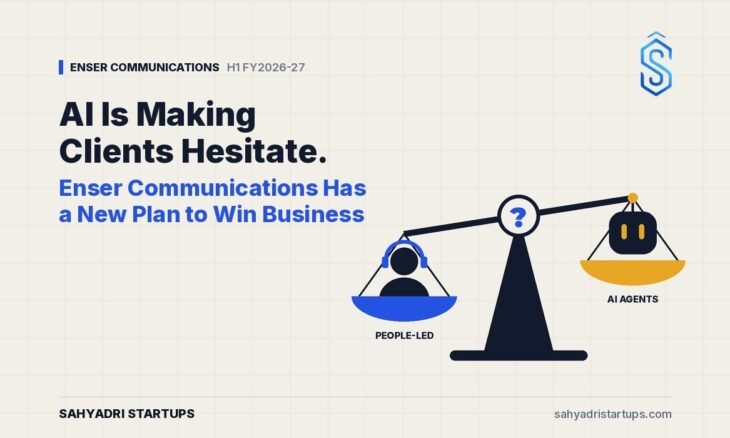
Gurugram: Enser Communications has identified uncertainty over the adoption of AI voice agents and chatbots as a factor delaying outsourcing decisions among clients, particularly in sales and customer service operations.
The business process management (BPM) company is responding by strengthening direct relationships with insurance companies, adopting a hybrid human-AI delivery model and prioritising contract profitability as it navigates a decline in first-half FY2026-27 revenue and profit.
Enser Communications said uncertainty surrounding insurance distribution and the economics of AI-led customer interactions had slowed new business allocations during the first half of FY2026-27. Insurance remains the company’s largest business vertical.
Management attributed the slower outsourcing commitments to clients reassessing whether AI-powered voice agents and chatbots could replace traditional people-led sales and service processes.
The company said it is adjusting its business strategy to address these changes, with greater emphasis on direct insurer engagements, technology-enabled delivery and the quality of contracts.
Enser Communications Reports Decline in First-Half Revenue and Profit
Enser Communications reported consolidated revenue from operations of ₹42.10 crore for the six months ended September 30, 2026, compared with ₹43.79 crore in the corresponding period last year, marking a decline of 3.9%.
Total consolidated profit for the period, including non-controlling interests, fell 19.7% to ₹3.79 crore from ₹4.71 crore a year earlier. Profit attributable to owners of the parent stood at ₹3.54 crore during the latest reporting period.
The company’s EBITDA declined to ₹9.79 crore from ₹10.30 crore in the corresponding half-year period. Its reported EBITDA margin eased marginally to 23.3% from 23.5%.
Enser Communications Looks to Strengthen Direct Insurance Relationships
Insurance distribution remains a key area of focus for Enser Communications as it looks to reduce its dependence on engagements routed through intermediaries.
The company said a meaningful share of its insurance-related customer acquisition and servicing business has historically come through insurers and intermediaries, including aggregators.
However, uncertainty surrounding insurance distribution economics has made some customers more cautious about vendor engagements and customer-acquisition spending, affecting the allocation of new business.
Enser Communications now expects direct relationships with insurance companies to create opportunities across customer acquisition, policy servicing and customer retention.
The company intends to continue working with intermediaries where commercial terms remain viable, while expanding its engagement with insurers directly.
Alongside this shift, management is placing greater emphasis on the quality and profitability of contracts rather than pursuing business volumes alone.
Its priorities include employee training, workforce management, AI-enabled quality monitoring, client retention and diversification into other customer-facing sectors.
Enser Communications Adopts Hybrid Human-AI Delivery Model
While uncertainty around AI adoption is delaying some outsourcing decisions, Enser Communications is also integrating artificial intelligence into its own service delivery operations.
The company’s preferred approach combines AI tools for routine customer interactions with trained employees handling conversations that require persuasion, judgement or trust.
Enser is integrating AI-enabled quality monitoring, voice bots and process automation into its operations as part of this hybrid delivery strategy.
Management believes the economics of automated voice systems need to be evaluated carefully, particularly for longer sales conversations, policy renewals, collections and complex customer-service interactions.
The company’s position is that automated systems may not always offer the most commercially effective solution for these interactions, where human involvement can remain important.
MuteX Noise-Cancellation Platform Ready for Commercial Deployment
Enser Communications has also reiterated the commercial readiness of its internally developed MuteX noise-cancellation platform.
The company said MuteX completed trials in October and is ready for commercial deployment, including sales to external enterprises.
MuteX is a software-based noise-cancellation solution that processes microphone audio on Windows computers before the audio reaches applications such as diallers and softphones. The company says the audio processing takes place locally on the device.