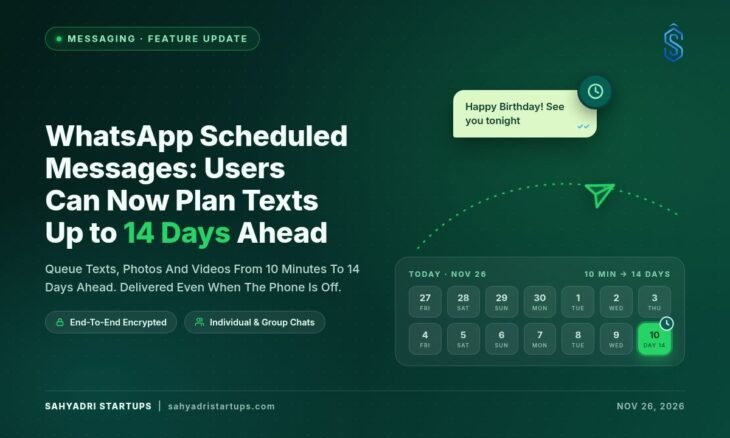
WhatsApp is rolling out a message scheduling feature that will let users decide when their messages should be delivered, bringing a long-awaited capability to the messaging platform.
The new WhatsApp scheduled messages feature allows users to queue text messages, photos and videos for delivery between 10 minutes and 14 days later.
Announced on November 25, the feature will work across individual and group chats. It is designed to let users prepare messages in advance for occasions such as birthdays, important reminders or conversations across different time zones.
Unlike manually sending a message at a chosen time, users will not need to keep their phones switched on for delivery. WhatsApp said scheduled messages will be sent even if the sender’s phone is switched off or runs out of battery.
How WhatsApp Scheduled Messages Work
Users can schedule a message by composing it in a chat and pressing and holding the send button. They can then select the intended date and time for delivery.
The recipient will see the scheduled message like any other regular message. Users will also be able to manage their pending messages, including deleting them before they are sent.
The feature supports text, photos and videos, extending scheduling beyond basic text communication. WhatsApp has also confirmed that scheduled messages will retain end-to-end encryption, meaning the company cannot read their contents.
“so no one else can read it, not even us.”
The company described scheduling as one of its most requested features, citing situations such as sending birthday wishes at midnight or wishing someone luck before an examination.
WhatsApp is introducing the feature through a global rollout over the coming weeks. Consequently, users may not see the option immediately, even if they have updated the app.
WhatsApp Enters a Market Where Rivals Already Offer Scheduling
The addition brings WhatsApp closer to features already available on competing messaging platforms.
Telegram introduced scheduled messages in September 2019, allowing users to select a future delivery time by holding the send button.
Apple subsequently added a ‘Send Later’ option to its Messages app for iMessage users, supporting message scheduling up to 14 days in advance. Apple’s implementation also allows scheduled messages to be delivered when the user’s devices are offline.
For WhatsApp, the update addresses a feature gap that has existed for several years. Its significance lies in making timed messaging available to a user base of more than 3 billion people across over 180 countries.
The rollout is expected to continue over the coming weeks, with availability expanding gradually across accounts.